Unprecedented Remarks by Chinese Minister of Science and Technology
Main Causes: Information Censorship and Semiconductor Regulations
Chinese authorities have admitted that China's technological capabilities still find it difficult to catch up with the US artificial intelligence (AI) 'ChatGPT,' drawing attention. Within China's tech industry, voices have emerged saying that the government's strict content censorship and US export controls on AI semiconductors have become obstacles.
According to a report by Hong Kong media outlet South China Morning Post (SCMP) on the 5th (local time), Wang Zhigang, China's Minister of Science and Technology, evaluated the technical level of ChatGPT at the annual National People's Congress held that day, saying it is "very difficult to catch up." In particular, he was reported to have highly praised ChatGPT's performance in generating sentences in real time.

According to the media, Chinese tech authorities are also accelerating research on language learning model (LLM) AI like ChatGPT. Minister Wang emphasized that there have been some achievements during the research process. However, he stated that it is still far from achieving the level of technology possessed by OpenAI, the owner of ChatGPT.
Some in China's tech industry express skepticism that the government's strict content censorship is holding back technological development. China already restricts its citizens' access to Western-created social networking services (SNS) and video sites, and accordingly, ChatGPT has not been officially permitted. According to Western media reports such as the UK's Guardian and US CNN, authorities reportedly completely blocked Chinese users' access to ChatGPT last month.
Moreover, private companies developing services similar to ChatGPT are also facing difficulties due to regulations. According to Taiwan's Taiwan News on the 12th of last month, 'ChatYuan,' which was developing a Chinese version of an LLM similar to ChatGPT, suddenly suspended its service. ChatYuan did not provide specific reasons for the chatbot service termination other than citing "violation of relevant regulations."
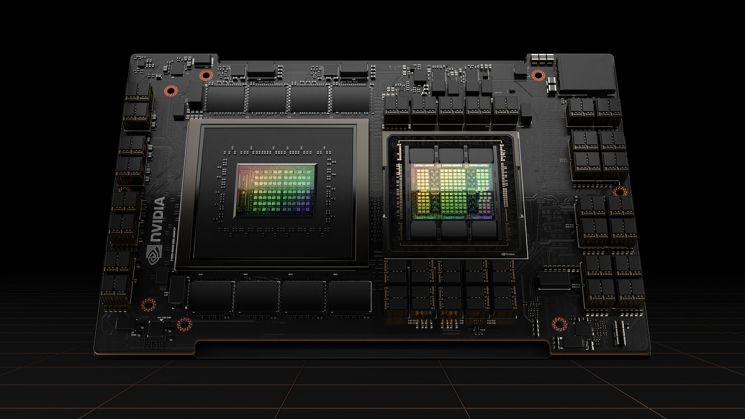 NVIDIA's next-generation 'Grace Hopper' semiconductor combines the latest GPU with an ARM-based CPU, delivering performance specialized for AI training. This semiconductor, subject to export controls by U.S. trade authorities, is difficult for Chinese technology companies to import. / Photo by NVIDIA
Another problem is that it is difficult for Chinese companies to acquire powerful AI semiconductors developed in the US. Generally, training large language models like ChatGPT requires advanced accelerators and central processing units (CPUs) specialized for AI programming.
In particular, the most commonly used accelerator in the current AI industry is the A100 server graphics processing unit (GPU) from US company Nvidia, and CPUs are server chips from US Intel, AMD, or UK-based ARM. OpenAI itself has trained ChatGPT through Microsoft's AI supercomputer, which consists of Nvidia GPUs and ARM CPUs.
The issue is that as US-China trade frictions intensify, these advanced semiconductors have also become subject to export controls. Specifically, the A100 GPU is currently regulated so that only companies with export licenses from the US Department of Commerce can import it into China, and ARM announced in December last year that it will not sell its next-generation advanced CPU 'Neoverse V2' to China.
However, SCMP reported that interest in AI within Chinese society and the IT industry remains very strong. Wang Huiyuan, founder of platform company Meituan, said, "I will create a Chinese version of OpenAI," and decided to invest 50 million dollars (about 65 billion won). Alibaba, one of China's largest e-commerce companies, has also started research on language models.
© The Asia Business Daily(www.asiae.co.kr). All rights reserved.
![User Who Sold Erroneously Deposited Bitcoins to Repay Debt and Fund Entertainment... What Did the Supreme Court Decide in 2021? [Legal Issue Check]](https://cwcontent.asiae.co.kr/asiaresize/183/2026020910431234020_1770601391.png)
















