The Thorny Path to Appointing the Next CEO Amid Fierce Power Struggles
KT CEO's Annual Salary Exceeds 7 Billion KRW During Tenure
Exerting Influence in the 12th Largest Conglomerate
Honor as Head of Korea's Leading Telecom Company
There is intense power struggle inside and outside KT over the appointment of the next CEO. While the political circles criticized KT's shortlisted CEO candidates as a 'league of their own,' insiders within KT and the telecommunications industry argued that the position should not be treated as a 'spoils of presidential victory.' The candidate list includes four former and current KT personnel, excluding political figures.
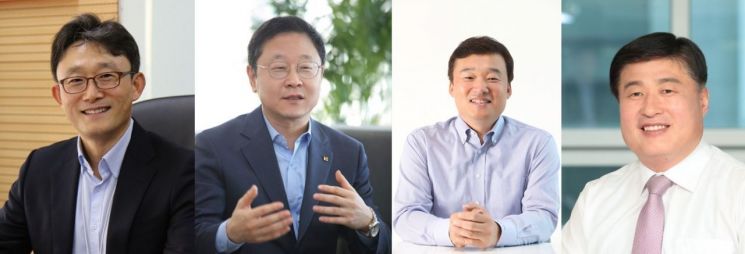 Yoon Young Park, former President of KT Enterprise Division (President, from the left), Sujeong Shin, Head of KT Enterprise Division (Vice President), Kyunglim Yoon, Head of KT Group Transformation Division (President), Heonmun Lim, former Head of KT Mass Division (President)
The reason why everyone is vying for the KT CEO position is that it is a role where one can simultaneously grasp honor, wealth, and power. The total salary that KT CEO Koo Hyun-mo is expected to receive during his tenure is estimated to exceed 7 billion KRW. Koo’s annual salaries in 2020 and 2021 were 997 million KRW and 1.522 billion KRW, respectively. His compensation until the first half of last year was 1.274 billion KRW, and the annual amount is expected to surpass 2 billion KRW. This year’s salary, including severance pay, is expected to exceed 3 billion KRW.
Severance pay is calculated by reflecting the length of service on the base salary (sum of basic pay and position allowance) for the three months prior to the date of retirement, as decided at the shareholders' meeting. Additionally, the CEO has discretionary funds such as protocol expenses and activity expenses, which are also substantial. Former Chairman Lee Seok-chae even used company funds to purchase a luxury residential complex apartment as his official residence. From 2017 to 2020, former Chairman Hwang Chang-gyu received a total salary of 7.5 billion KRW.
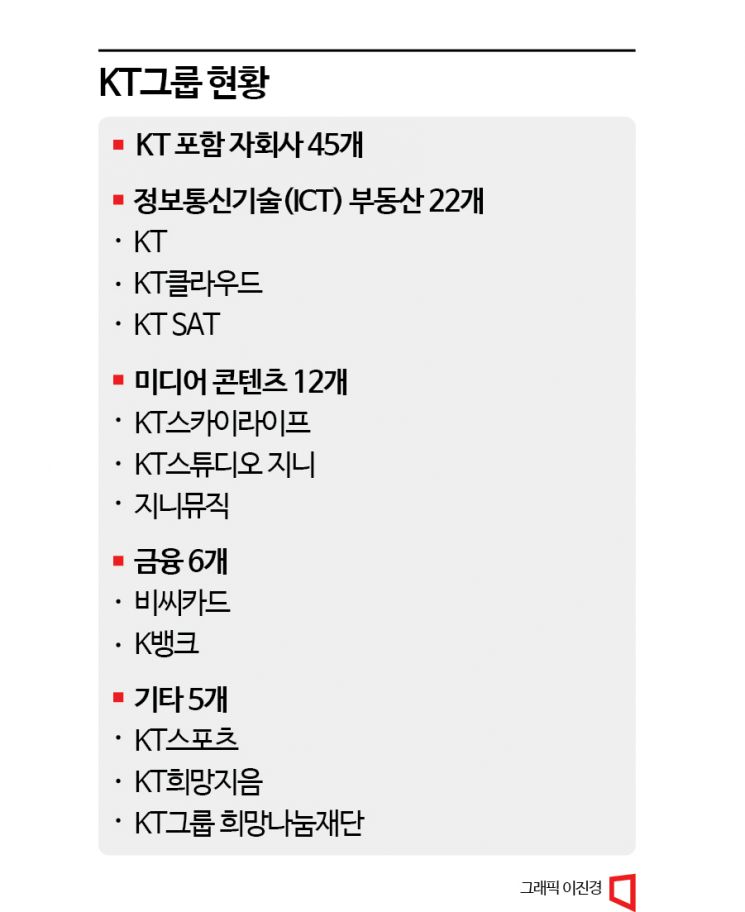
The CEO also wields influence comparable to that of an 'owner' over KT, the 12th largest company in the business world with a market capitalization of 7.9509 trillion KRW. The CEO of a company without an owner holds absolute power equivalent to that of an owner. KT’s annual revenue and operating profit last year exceeded 25.6 trillion KRW and 1.6901 trillion KRW, respectively. The company employs 58,000 people. The CEO holds personnel authority over these 58,000 employees and can dominate internally. With personnel authority, the CEO can fill the surroundings with close aides. The KT Group owns a total of 45 subsidiaries, including KT itself. Major subsidiaries include KT Skylife, KT SAT, KT Cloud, BC Card, Genie Music, KT Studio Genie, and Millie’s Library. The group also operates social contribution activities such as KT Hope Jium and KT Group Hope Sharing Foundation. There is a joke in political circles that if the KT CEO changes, they can seize the CEO positions of about 40 subsidiaries under KT.
The honor of being the head of Korea’s leading telecommunications company is an added bonus. It is no exaggeration to say that the modern telecommunications history of Korea is the history of KT. Until 1982, it was a government agency called the 'Korea Post and Telecommunications Administration,' and later became the Korea Electric Telecommunications Corporation. It was a company familiar to the public as 'Korea Telecom = Telephone Office.' Korea Telecom served as the ears and mouth of the people. In 2002, it was privatized and reborn as a global telecommunications company.
The CEO position of KT, with such a history, carries corresponding honor and responsibility. It is also a role that can play a pivotal part in the global mobile communications market and enhance Korea’s global standing. Since 2003, KT CEOs have served as members of the board of the Global System for Mobile Communications Association (GSMA) for about 20 years. The GSMA board is the highest decision-making body in the mobile telecommunications industry, composed of CEO-level executives from over 800 telecommunications companies worldwide.
An industry insider said, "For those who held key positions in presidential election campaigns, the KT and POSCO CEO positions are as coveted as the presidential office. Acting as temporary owners of these two ownerless companies means there is nothing to envy during their term." He added, "KT’s public nature, the shareholder structure without a controlling major shareholder, and its history as a public enterprise are holding it back. To avoid turmoil every time the administration changes, the governance structure must be changed."
© The Asia Business Daily(www.asiae.co.kr). All rights reserved.
![Clutching a Stolen Dior Bag, Saying "I Hate Being Poor but Real"... The Grotesque Con of a "Human Knockoff" [Slate]](https://cwcontent.asiae.co.kr/asiaresize/183/2026021902243444107_1771435474.jpg)

















