Ministry of Unification: "No Official Media Records of Punggye-ri Inspection"
Initially Denied Radiation Exposure... Expert Cited Bias
"Theory Not Applicable to North Korea... Possible Contamination of South's Water Source"
During the Moon Jae-in administration, the Ministry of Unification strongly denied concerns about radioactive material leakage from the 'Punggye-ri Nuclear Test Site,' but it has been confirmed that Kim Jong-un, the Chairman of the State Affairs Commission of North Korea, never visited the nuclear test site. Rather, there are criticisms that the Ministry of Unification used confidentiality agreements to prevent the full disclosure of radiation exposure test results or presented expert opinions in a biased manner to suit the government's preferences.
An official from the Ministry of Unification stated on the 6th, "Based on reports from North Korean state media, there has never been any mention that Chairman Kim Jong-un visited the Punggye-ri Nuclear Test Site (Northern Nuclear Test Site)." This is the first time the Ministry of Unification has confirmed that Kim Jong-un has no record of on-site guidance at the nuclear test site.
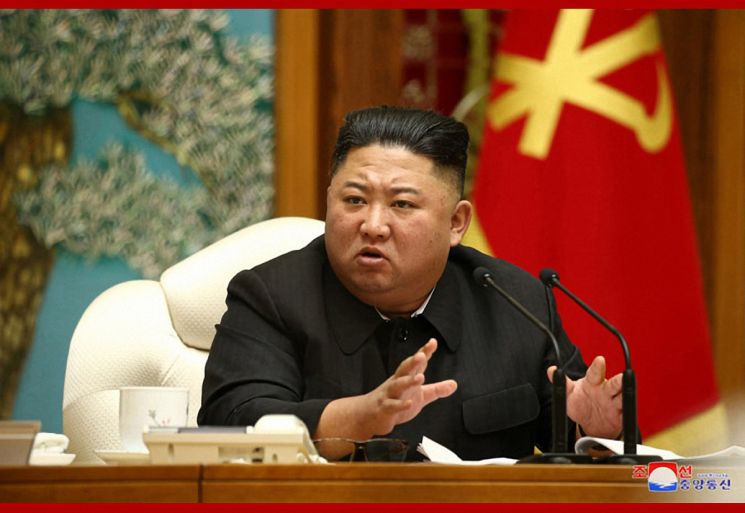
Since North Korea selectively discloses only the desired images through its state media, Kim Jong-un's whereabouts can only be inferred. However, considering that the Ministry of Unification uses state media reports as a basis for situation analysis, it can be said that the government currently also believes Kim Jong-un has never been to Punggye-ri. Even when Kim Jong-un invited international journalists in May 2018 to witness the demolition of tunnels, he visited a newly constructed railway site, not the nuclear test site.
The fact that the North Korean supreme leader, who conducted the most nuclear tests, never actually visited the nuclear test site can be interpreted as a concern about radiation exposure. Testimonies from North Korean defectors lend weight to this view. Mr. Lee (in his 60s), originally from Punggye-ri, said, "I have never heard that Kim Jong-un even came near Punggye-ri in his lifetime," adding, "On the contrary, residents were not allowed to enter Pyongyang."
North Korea has consistently maintained the claim that "there is absolutely no radioactive material leakage." It has never presented scientific evidence to support this or allowed external on-site inspections. Even during the publicity of tunnel demolition, nuclear experts were excluded, and radiation detectors brought by South Korean journalists were confiscated. There is also an anecdote where a North Korean journalist offered a South Korean journalist to drink water from a stream in front of the tunnel but refused when told to "drink first."
Even Kim Jong-un Avoids It... Moon Administration Denied 'Radiation Exposure Concerns'
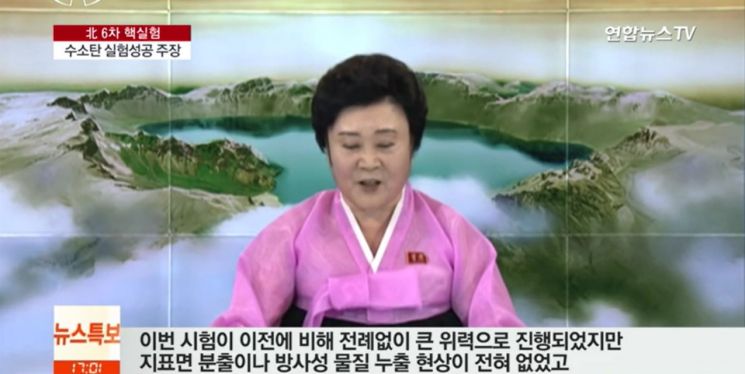 Anchor Ri Chun-hee of Korean Central TV delivering major news on the 6th nuclear test [Image source=Yonhap News]
It was rather the Moon Jae-in administration that actively denied the issue of radioactive leakage from the nuclear test site. Doubts remain about the radiation exposure tests conducted on North Korean defectors in 2017-2018. Among 40 individuals tested, 9 showed abnormal levels, and some exceeded the radiation exposure levels of workers involved in the Fukushima nuclear disaster cleanup in Japan by more than twice. However, the government gave an ambiguous response, stating, "Radiation exposure could be a cause, but confounding variables cannot be ruled out."
The Ministry of Unification had requested tests through the North Korean Defectors Support Foundation (South-North Hana Foundation) to the Korea Institute of Radiological & Medical Sciences. According to the standard service contract obtained by this outlet, the medical institute was required to sign a confidentiality agreement. Both the Ministry of Unification and the foundation claim this is a "standard procedure," but even the test results obtained recently through the office of Tae Young-ho, a member of the People Power Party, remain undisclosed for those classified as normal aside from the initial 9 individuals.
During the 2019 National Assembly audit, suspicions of concealment arose. According to the transcript, Jin Young-woo, head of the National Radiation Emergency Medical Center at the Korea Institute of Radiological & Medical Sciences, who oversaw the tests, testified to the National Assembly, "Even if the National Assembly requests the data, we cannot submit it at will, and it cannot even be used in research papers." The Nuclear Safety and Security Commission, a nuclear safety regulatory agency, stated that it had not even received concrete supporting documents.
Only Opinions Denying Concerns Presented... "Quoted to Suit Government Preferences"
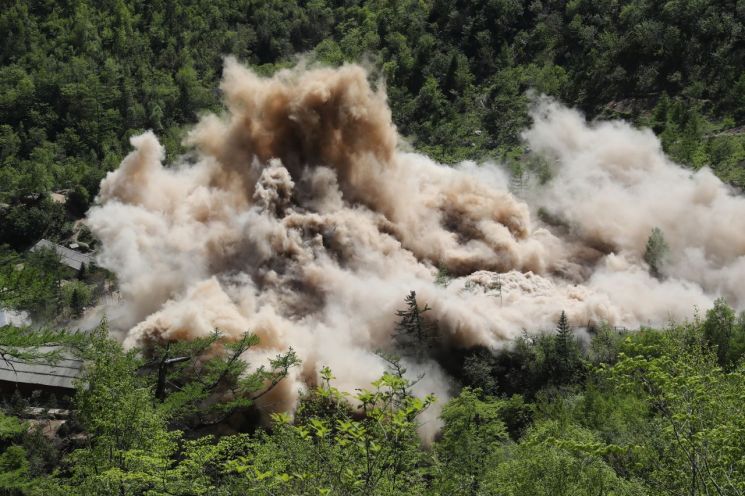 In May 2018, North Korea's Nuclear Weapons Research Institute carried out demolition work to close the Punggye-ri nuclear test site in Kilju County, North Hamgyong Province. The photo shows the command post and construction workers' barracks being demolished. Photo by XXX
A bigger problem is that the Ministry of Unification presented expert opinions in a biased manner to deny concerns about radioactive material leakage. Major foreign media began paying attention to radiation exposure concerns after the sixth nuclear test, which was the most powerful, but in October 2019, the Ministry of Unification released a document dismissing these concerns as "groundless claims by some YouTubers." The document cited an expert affiliated with a government-funded research institute, who presented the following theory.
It was explained that North Korea's nuclear tests are conducted in sealed underground locations, and the Mantapsan area where the nuclear test site is located consists of crystalline bedrock. Therefore, radioactive materials are trapped in the molten rock immediately after the nuclear explosion, making infiltration into groundwater difficult. Since the rock melted by the instantaneous extreme heat solidifies into glass, radiation leakage is impossible.
However, academia has rebutted that this theory cannot be applied to North Korea's situation. Professor Seo Kyun-ryeol of Seoul National University's Department of Nuclear Engineering, former vice president of the Korean Nuclear Society, said, "This theory can only hold if the nuclear test was conducted just once or if no water infiltrated afterward," adding, "But didn't North Korea conduct the 2nd to 6th nuclear tests by moving only between compartments within the tunnel twice?"
No Records and Questionable Selection Background... "Consulted by Phone"
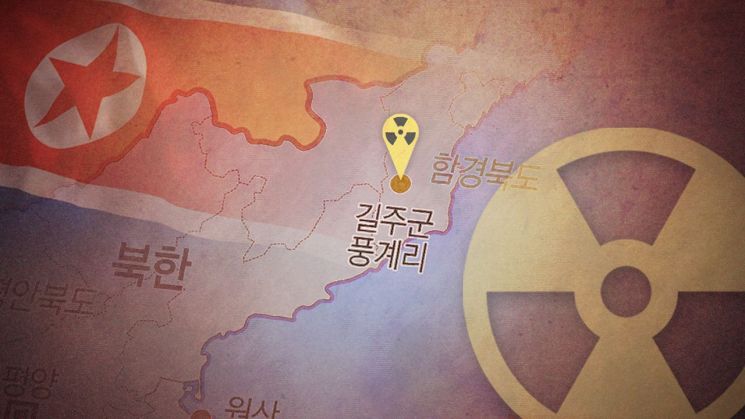 The North Nuclear Test Site (Nuclear Test Site) located in Punggye-ri, Kilju County, North Hamgyong Province [Image source=Yonhap News]
Professor Seo Kyun-ryeol pointed out, "Although vitrification makes the rock hard initially, it increases brittleness (the property of breaking without much deformation when external force is applied), so cracks and water leakage will occur with each additional nuclear test," adding, "In this case, radioactive materials could continuously spread through underground water veins. The possibility that even trace amounts have reached some water source in South Korea cannot be ruled out."
There are also criticisms that the Ministry of Unification used government-funded research institutes to present only opinions that suited its preferences. The Ministry of Unification received the expert's answers only verbally by phone without keeping records, and it was confirmed that no advisory fees were paid. Currently, the Ministry of Unification's position is that the criteria or background for selecting the expert at that time are "unknown."
Lee Young-hwan, former head of the Transitional Justice Working Group (TJWG), said, "There can be pros and cons to a scholar's research or theory, but the problem is that the government listened to only one side and presented a biased conclusion," adding, "Moreover, if the expert belongs to a national research institute, wouldn't they be under government influence?" He continued, "The fact that consultation was done only by phone, not by formally sending materials, is also inadequate as a procedure for preparing data that the government announces."
© The Asia Business Daily(www.asiae.co.kr). All rights reserved.
![User Who Sold Erroneously Deposited Bitcoins to Repay Debt and Fund Entertainment... What Did the Supreme Court Decide in 2021? [Legal Issue Check]](https://cwcontent.asiae.co.kr/asiaresize/183/2026020910431234020_1770601391.png)

















