Failed to Control Population Even with 'Pium Hwasal'
About 70 Individuals to Be Sent to India and Mexico
Some of the descendants of the hippos once raised by Colombia's 'drug lord' Pablo Escobar are scheduled to be sent overseas.
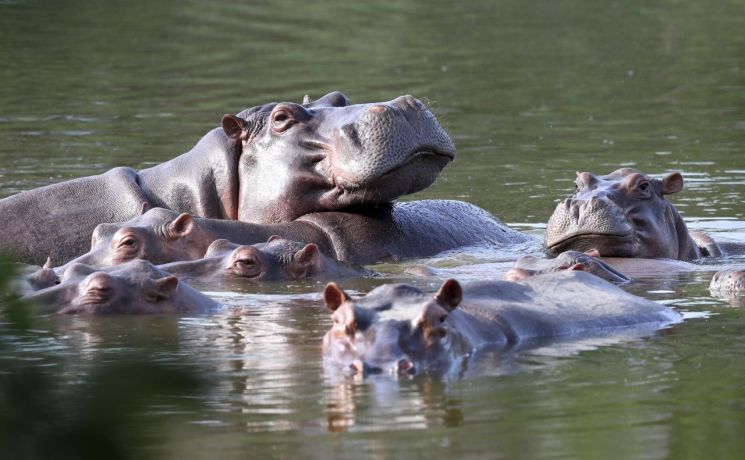
On the 4th (local time), the US CNN reported that Colombian authorities recently devised a plan to relocate 70 hippos to nature reserves in India (60 hippos) and Mexico (10 hippos), respectively.
The hippos in Colombia have been a long-standing headache. Originally, hippos did not inhabit the South American continent, but in the 1980s, Escobar introduced four hippos?one male and three females?into his private zoo at 'Hacienda Napoles,' his estate located about 250 km from Medellin in Antioquia, Colombia. This marked the first time hippos set foot on South American soil. He created this place in 1978 intending to build a Disneyland-like park for his son.
At that time, Escobar's wealth was unimaginably vast. He was the mastermind behind developing the cocaine transport route from South America to the United States, spreading cocaine in the US. In 1990, Forbes estimated Escobar's fortune at $30 billion (approximately 33 trillion KRW), ranking him as the world's 7th richest person.
However, Escobar's end was tragic. He was killed in 1993 while being pursued by military and police forces. Afterward, other animals in the private zoo, such as elephants and giraffes, were sold to zoos, but the hippos were left behind. The hippos then escaped to the nearby Magdalena River basin, where, without natural predators, they rapidly multiplied from the original four to an estimated 130?160 individuals over 40 years. These hippos earned the nickname 'Cocaine Hippos.'
Experts Warn of Hippo Risks
Several experts have repeatedly warned about the various risks posed by the 'Cocaine Hippos.'
A paper published in the academic journal Nature predicted that the hippo population could surge to 1,500 within 20 years. The paper expressed concerns that hippo feces negatively affect oxygen levels in water bodies, threatening not only fish ecosystems but also local residents. More cyanobacteria were found in the hippos' habitat waters compared to other areas, leading to water quality deterioration and fish die-offs, which could adversely impact fisheries.
Another paper published in 2021 in the journal Biological Conservation warned that hippos might damage crops or exhibit aggression toward residents. Hippos have strong territorial instincts and are naturally aggressive. In fact, in 2021, there were two incidents where residents were attacked by hippos in the river.
As residents' concerns grew, local authorities introduced sterilization and contraceptive darting methods to control the hippo population, but these were costly, dangerous, and ineffective.
Ultimately, the authorities decided to send 70 hippos to India and Mexico. An?bal Gaviria, governor of Antioquia, told local media Blue Radio, "The goal is to send them to countries capable of accommodating the hippos and controlling their reproduction." India and Mexico are not the hippos' natural habitats. Regarding this, Governor Gaviria explained, "Sending them to Africa, their natural habitat, was not permitted."
He expects the overseas relocation of the hippos to be possible within the first half of this year after approvals from institutions such as the Colombian Agricultural Research Corporation. The hippos will be transported by plane in special crates, and sedatives will be administered as needed.
© The Asia Business Daily(www.asiae.co.kr). All rights reserved.
![Clutching a Stolen Dior Bag, Saying "I Hate Being Poor but Real"... The Grotesque Con of a "Human Knockoff" [Slate]](https://cwcontent.asiae.co.kr/asiaresize/183/2026021902243444107_1771435474.jpg)
















