Majority Opinion: "Hospital Oversight Causing Excessive Non-Covered Medical Fees Burden"
Opposing Opinion: "Non-Covered Treatments Sometimes Used to Conceal Physical and Mental Defects"
The Constitutional Court has ruled that the amended Medical Service Act, which requires medical institutions to disclose non-reimbursable medical fees and details, does not violate the Constitution.
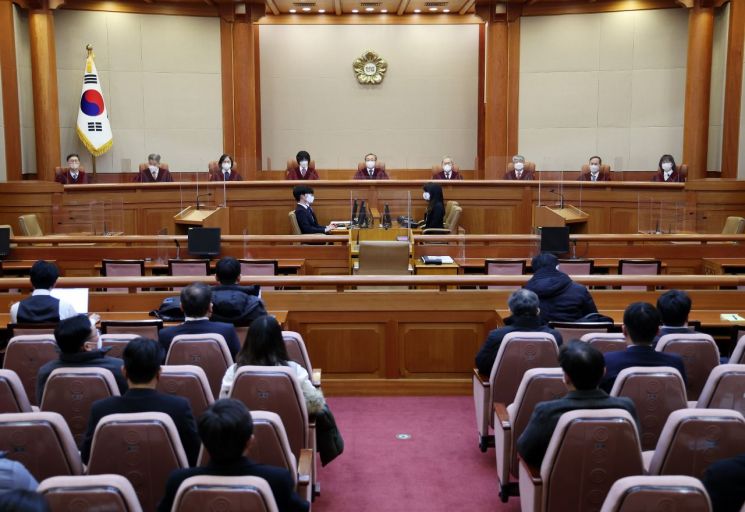
On the 5th, the Constitutional Court announced that it decided the constitutional review case filed by the president of the Korean Association of Private Medical Practitioners and others, who claimed that Article 45-2 of the Medical Service Act was unconstitutional, with a 5 (constitutional) to 4 (dissenting) vote in favor of constitutionality.
The current Medical Service Act, amended in 2021, stipulates that the head of a medical institution must report non-reimbursable medical details, certification fee items, standards, and amounts to the Minister of Health and Welfare.
The majority opinion stated, "The reporting obligation provision is legitimate in its legislative purpose as it supervises medical institutions that impose excessive non-reimbursable medical fees, thereby guaranteeing the public's right to choose medical services and expanding health insurance benefits to reduce medical expenses."
The Constitutional Court viewed the provision requiring prior explanation of non-reimbursable treatments as not violating the principle of legal reservation, stating, "The explanation obligation provision is intended to guarantee patients' right to know and their medical choice rights. Patients must know the non-reimbursable items and costs necessary for them to decide whether to receive the treatment by considering their ability to pay and cost-effectiveness."
On the other hand, Justices Lee Seon-ae, Lee Eun-ae, Lee Jong-seok, and Lee Young-jin pointed out, "The names of diseases and surgeries or procedures included in the medical details are secrets at the core of privacy," and "There is a great need for protection as some patients deliberately receive non-reimbursable treatments to hide physical or mental defects."
They added, "Although the medical details containing extensive medical information of patients are subject to reporting, there is no regulation whatsoever on the scope of the provided medical details or the minimum standards to be observed to avoid infringing on patients' personal information self-determination rights."
In December last year, the Ministry of Health and Welfare issued a public notice on the amendment of the ‘Standards for Reporting and Disclosure of Non-Reimbursable Medical Fees’ (Ministry of Health and Welfare Notice), which specifies detailed reporting targets based on the delegation of the reporting obligation provision.
A Constitutional Court official said, "With the Constitutional Court's ruling on the constitutionality of the reporting obligation provision, once the amended notice is implemented, the reporting system for non-reimbursable medical fees, which has not been enforced due to the absence of the notice, is expected to become a reality soon."
© The Asia Business Daily(www.asiae.co.kr). All rights reserved.
![Clutching a Stolen Dior Bag, Saying "I Hate Being Poor but Real"... The Grotesque Con of a "Human Knockoff" [Slate]](https://cwcontent.asiae.co.kr/asiaresize/183/2026021902243444107_1771435474.jpg)
















