Record Foreign Bond Capital Outflow in January
Widening Korea-US Interest Rate Gap Raises Exchange Rate Concerns
BOK Says "Outflow Scale Slows in February"
Tug-of-War Between US Tightening and China Reopening Intensifies
As expectations for prolonged tightening by the U.S. Federal Reserve (Fed) grow stronger, foreign investors are increasingly withdrawing funds from South Korea. With the Bank of Korea (BOK) holding its benchmark interest rate steady, the interest rate gap between South Korea and the U.S. is likely to widen further, raising concerns that capital outflows could accelerate. However, the BOK explained that the scale of outflows has slowed since February and that normal flows are expected to resume soon.
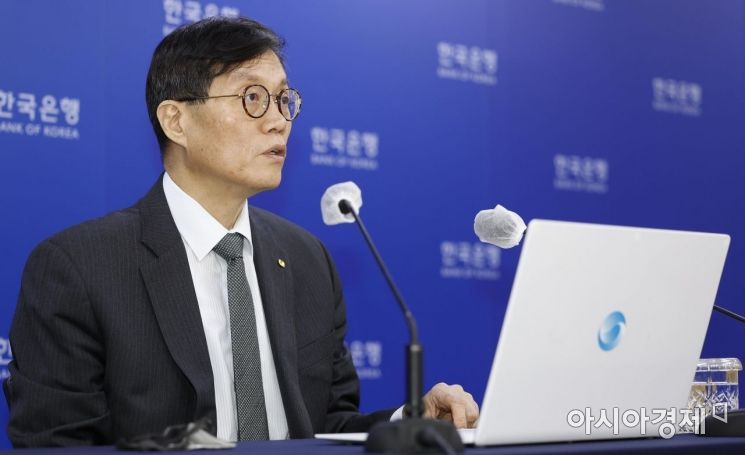 Bank of Korea Governor Lee Chang-yong is explaining the base interest rate hike at a press conference held at the Bank of Korea in Jung-gu, Seoul, on January 13.
According to the BOK and market sources on the 4th, recent foreign exchange and financial markets have shown increased volatility amid concerns over prolonged Fed tightening and expectations for China's reopening (resumption of economic activities). The won-dollar exchange rate hit a yearly high of 1,326.6 won on the 28th of last month and continued its upward trend, but dropped to 1,299.2 won during intraday trading the previous day. This is interpreted as the exchange rate easing as the U.S. New York stock market rebounded and risk appetite recovered.
However, given the persistent inflation in the U.S. and ongoing Fed tightening outlook, exchange rate instability is expected to continue for the time being. Kim Chan-hee, a researcher at Shinhan Investment Corp., forecasted, "The won-dollar exchange rate is expected to fluctuate in the low to mid-1,300 won range, linked to the dollar's movement," adding, "A tense tug-of-war is anticipated between strong dollar pressure due to Fed tightening concerns and optimism about China's economic recovery."
As the U.S. continues to raise policy interest rates, widening the interest rate gap between South Korea and the U.S., concerns over capital outflows are spreading beyond just the exchange rate. According to the BOK, net outflows of foreign bond funds amounted to $2.73 billion in December last year and $5.29 billion in January this year. The January outflow was the largest since related statistics began being compiled in April 1999. The previous record for net outflows was $5.18 billion in December 2010.
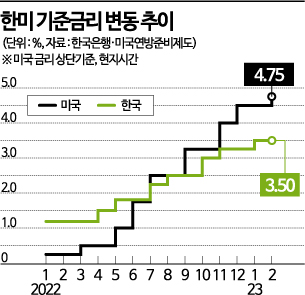
Some market participants predict that the U.S. terminal interest rate could exceed 5.25?5.5% and reach up to 6%. Neel Kashkari, president of the Federal Reserve Bank of Minneapolis, recently left open the possibility of a 'big step' (a 0.5 percentage point increase in the benchmark interest rate) at the next Federal Open Market Committee (FOMC) meeting, stating that his terminal rate forecast is leaning toward an upward revision from the 5.4% indicated in the December dot plot last year.
Nonetheless, the BOK expects that market instability, including capital outflows, will gradually ease despite these trends. Son Seung-hwa, head of the Capital Movement Analysis Team at the BOK's International Department, explained in a blog post titled "Background and Assessment of Recent Foreign Bond Investor Outflows" posted yesterday that "since February, outflows of overseas public institution bond funds have slowed, and private institution funds have turned to net inflows, significantly reducing the overall scale of bond fund outflows."
The recent sharp outflow of foreign bond funds is attributed more to the recovery of losses by major countries' public institutions and portfolio adjustments by country due to China's reopening, rather than the interest rate gap between South Korea and the U.S. Since this phase is nearing completion, it is analyzed that there will be no sudden capital outflows going forward. Son said, "The portfolio adjustments by overseas public institutions at the beginning of the year are nearing completion, and as arbitrage incentives expand again, some public and private institutions seeking profits through these transactions appear to have resumed domestic bond investments."
There is also an opinion that exchange rate volatility will weaken after March. Although upward pressure on the won-dollar exchange rate will continue for now due to high inflation in the U.S., the dollar is expected to weaken once U.S. inflation and employment slow down significantly. Additionally, as China's economic recovery leads to an improvement in South Korea's terms of trade after bottoming out, there is hope that this will positively affect not only the exchange rate but also the domestic stock market.
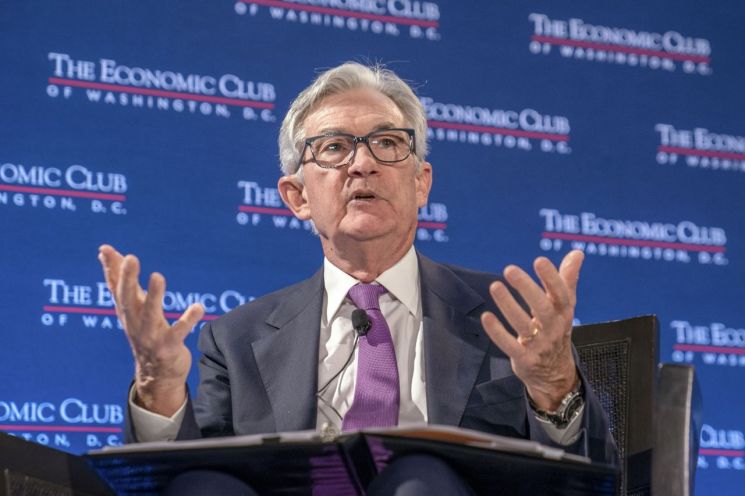 Jerome Powell, Chairman of the U.S. Federal Reserve (Fed), is speaking at a discussion hosted by the nonprofit organization 'Washington DC Economic Club' on the 7th of last month (local time). [Image source=Yonhap News]
© The Asia Business Daily(www.asiae.co.kr). All rights reserved.



















