FKI Conducts Survey on Working Hours Perception Among 2030 Generation

Millennial and Gen Z workers (born from the early 1980s to the early 2000s) strongly feel the need to reform the current working hours system.
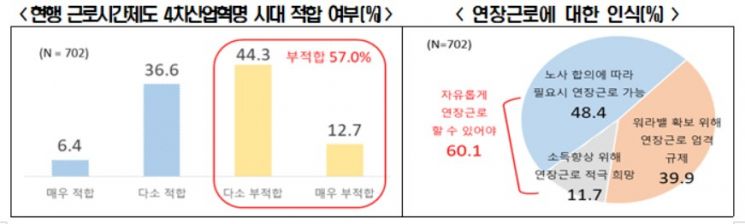
On the 5th, the Federation of Korean Industries (FKI) commissioned Research & Research, a polling agency, to conduct a 'Working Hours Perception Survey' targeting 702 workers in their 20s and 30s. The results showed that 57% believe the current working hours system is not suitable for the Fourth Industrial Revolution era. Regarding perceptions of overtime work, 60.1% thought that rather than strictly regulating overtime, workers should be able to work freely when necessary.
Nearly half (48.4%) of the respondents answered that "overtime work is possible when necessary based on labor-management agreement." The proportion of those who responded that "overtime work should be strictly regulated by law to secure work-life balance" was lower at 39.9%. In this regard, the FKI explained, "The 'weekly' working hours regulation, which has been maintained without major changes since the enactment of the Labor Standards Act in 1953, has limitations in responding to the rapidly changing industrial field and runs counter to the trend of diversified working styles."
Almost half (44.9%) also responded that working hours and job performance are not proportional. Reflecting this perception, 68.1% of respondents chose "freely selecting commuting times based on workload or individual concentration" as a working hours operation method that helps improve productivity. This is twice the level of those who responded that "applying the same commuting time to all employees (31.9%)" is helpful.
Regarding preferred working hour types, 55.3% of respondents chose "working intensively 3 to 4 days a week when necessary and taking 1 to 2 days off," which was higher than the 44.7% who answered "working 8 hours a day, 5 days a week." The FKI stated, "Unlike the past when working hours were directly linked to production volume, in the current Fourth Industrial Revolution era, quality of work has become more important than quantity due to factory automation and technological convergence. Therefore, the existing personnel management system centered on working hours needs improvement."
Meanwhile, 73.5% of workers in their 20s and 30s who utilize flexible working hours systems (hereafter flexible work systems) evaluated the use of flexible work systems as 'positive' for improving job performance and productivity. When asked whether the use of flexible work systems is effective in reducing unnecessary overtime, 70.0% of respondents answered 'yes.'
Choo Kwang-ho, head of the Economic Headquarters at FKI, stated, "The government's policy to promote flexible working hours is expected to enhance work efficiency and prevent unnecessary long working hours by giving labor and management the option to operate working hours according to industrial field demands." He added, "Since young people who will lead the national economy agree on the necessity of flexible working hours, it is necessary to establish a foundation that can improve productivity and enhance workers' quality of life through reforming the working hours system."
© The Asia Business Daily(www.asiae.co.kr). All rights reserved.


















