Intense Competition for Subsidy Securing in Large-Scale Investments
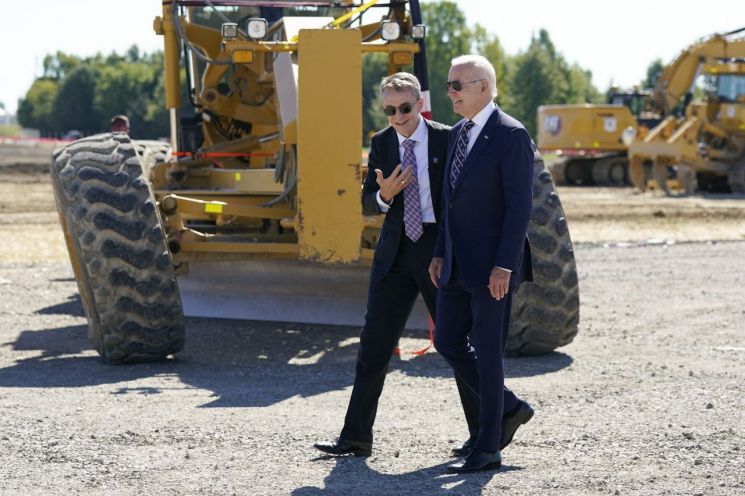 On September 9 last year, Pat Gelsinger (left), CEO of Intel, is guiding President Joe Biden, who attended the groundbreaking ceremony of a new semiconductor factory in Ohio, USA.
 [Image source=AP Yonhap News]
Global semiconductor giants Intel and TSMC are engaged in intense jockeying to secure a larger share of the $39 billion (approximately 50 trillion won) subsidies provided by the U.S. government under the CHIPS and Science Act (CSA). Since massive investments are being made to establish semiconductor manufacturing facilities in the U.S., receiving more government support helps reduce financial burdens and improve business outcomes. In this process, Intel, which advocates for prioritizing domestic companies, and TSMC, which emphasizes advanced fabs, are clashing, signaling a potential escalation of conflict.
According to U.S. media outlets such as Bloomberg and The New York Times on the 6th, Intel is lobbying for domestic companies to receive more support than foreign firms under the semiconductor support law. Intel argues that since advanced U.S. intellectual property could leak through foreign companies, American firms like Intel should be prioritized for support. In response, Taiwanese company TSMC counters that preferential treatment based on headquarters location is not an effective or efficient use of U.S. funds. Intel’s stance is largely based on American prioritization. The issue is that Intel hopes to receive subsidies for technologies it has yet to realize, as it has lagged behind Taiwan’s TSMC and Samsung Electronics in entering advanced process nodes.
In this regard, the recent CSA subsidy review criteria announced by the U.S. government create a peculiar dynamic. The Department of Commerce’s CSA subsidy evaluation standards include six major categories: economic and national security, business viability, financial soundness, technological readiness, workforce development, and social contribution. The advanced process node specified by the Department of Commerce is 5 nanometers. Intel’s own CPU production does not meet this standard. TSMC has already started 3-nanometer processes in Taiwan and plans to begin 4-nanometer production next year at its U.S. factory, which is nearing completion and preparing for operation. It has also announced plans to start 3-nanometer production in 2026. Samsung Electronics began 3-nanometer production last year, ahead of Intel.
Financial strength for large-scale investments is also an issue. Demonstrating financial soundness is essential, but Intel recently entered a cost-cutting phase, including reducing executive salaries due to poor recent performance. Intel’s decision to collaborate with private equity firms for new factory establishment is also interpreted as a measure to supplement funding shortages.
Another disadvantage for Intel is that various chips produced by TSMC are used in U.S. military equipment. Pat Gelsinger, Intel’s CEO, announced after taking office that the company would enter the foundry business. Naturally, since Intel currently lacks large-scale customers, it has no strong allies backing it. In contrast, TSMC is supported by Apple, which outsources all its self-designed chip production to TSMC. Apple CEO Tim Cook even pledged to use American-made chips at TSMC’s U.S. factory equipment inauguration event attended by President Joe Biden. AMD, a competitor in Intel’s CPU business, has also openly sided with TSMC.
The Biden administration has expressed some skepticism toward Intel’s claims. Some officials have questioned whether Intel can catch up with TSMC or Samsung’s advanced process technologies. U.S. bureaucrats reportedly place greater importance on expanding TSMC’s domestic production of advanced chips needed by the U.S. military.
Commerce Secretary Gina Raimondo drew a clear line, stating, "While some companies may feel shortchanged by the subsidies, our goal is not to provide aid to struggling companies. The purpose of this investment is to achieve national security objectives." Some interpret the "struggling companies" Raimondo referred to as Intel, and the national security goal as TSMC. If Intel receives fewer subsidies compared to TSMC, it would put CEO Gelsinger, who has been actively promoting the CSA in Washington, in a difficult position.
© The Asia Business Daily(www.asiae.co.kr). All rights reserved.
![Clutching a Stolen Dior Bag, Saying "I Hate Being Poor but Real"... The Grotesque Con of a "Human Knockoff" [Slate]](https://cwcontent.asiae.co.kr/asiaresize/183/2026021902243444107_1771435474.jpg)
















