Interview with Selbach Oster Owner and Winemaker
"The Mosel region in Germany has the most ideal climate and soil for cultivating the delicate and fresh Riesling grape variety. This is why Mosel Riesling is recognized as one of the best wines by wine experts and enthusiasts worldwide."
Johannes Selbach, owner and winemaker of Selbach Oster winery in Germany's Mosel, emphasized during a meeting with Asia Economy on the 3rd that Mosel Riesling, enhanced by the finest terroir and long-standing winemaking traditions, is undoubtedly the "essence of German wine."
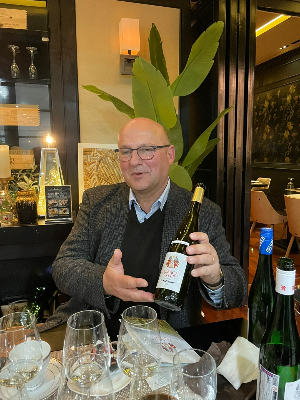
Steep Slopes and Slate Soil... The Origin of Elegant and Refreshing Flavors
Selbach Oster is a family-run winery that has been operating for over 400 years since 1600 in Zelltingen, the heart of the Mosel region in southwestern Germany. Selbach Oster’s vineyards stretch horizontally across approximately 24 hectares (ha) in the area known as the "Golden Mile," from Zelltingen to Bernkastel. To maintain high quality, they adhere to low yields from the best vineyards and strictly insist on hand harvesting.
The Mosel region, where Selbach Oster is rooted, is the center of German wine production, and its Riesling is regarded as one of the world’s premium white grape varieties. Mosel, with a climate close to Mediterranean, is characterized by steep slopes nearing 60 degrees and rocky slate soil. Selbach explained, "The soil was formed by sediment accumulation and compression over 400 million years, breaking down finely, which helps the vine roots deeply anchor into the ground and solid bedrock to absorb water and minerals well." He added, "The soil’s acidity (pH) is very low, making it suitable for producing crisp and fresh wines."
Due to these geographical features, Rieslings produced in the Mosel region are known for their elegance, salty taste, and refreshing minerality. Selbach said, "Compared to Rieslings from other German regions, Mosel Rieslings are delicate yet refreshing, light but with rich body, and have moderate alcohol levels." Rieslings from other German regions like Rheingau or Pfalz are generally considered drier and fuller-bodied than those from Mosel.
Most of Selbach Oster’s wines are also made from Riesling grapes, producing a variety of styles ranging from dry to sweet, elegant and light to complex and rich. A distinctive feature of Selbach Oster’s winemaking is slow, low-temperature fermentation using natural yeast in old German oak barrels. Fermentation takes place in low-temperature cellars to preserve delicate and diverse aromas and the freshness of the must, with natural yeast used in most wines.
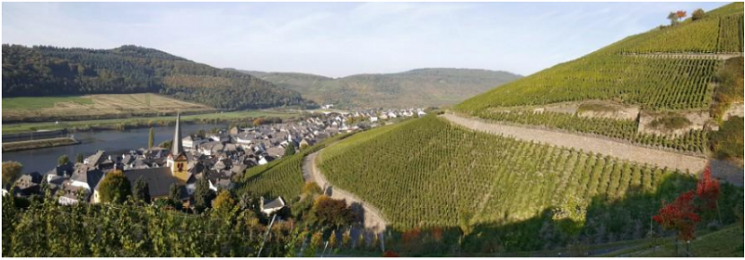 A view of the vineyards of Selbach Oster located in Zeltingen, Mosel, Germany.
 [Photo by Geumyang International]
A Korean Market Unafraid of New Wines... Great Growth Potential for German Riesling
Selbach said, "While stainless steel tanks make cleaning and temperature control easier, simplifying winemaking for producers, we use oak barrels because slight oxidation adds complexity and flavor to the wine, even though it is more cumbersome and costly." However, he added, "To preserve the delicacy and acidity of Riesling, we use large 1000-liter barrels to minimize oak influence."
Selbach sees high growth potential for German Riesling wines in the Korean market, noting the presence of many young and adventurous consumers and increasing preference for white wine. He said, "During this visit to Korea, I discovered potential by seeing young generations fearlessly trying new wines with an open mind." He expressed hope that "since Riesling can be made in many different styles, it could become a new alternative for consumers who have only been drinking Chardonnay or Sauvignon Blanc."
He also views the growing preference for white wine as an opportunity. Selbach stated, "In the past, the Asian wine market strongly favored red wines such as Bordeaux at a rate of 80-90%, but recently, consumers are seeking a variety of wines including white and sparkling wines." He added, "This trend was observed not only in Korea but also in Singapore, which I visited earlier."
Currently, eight types of Selbach Oster wines, including the n?gociant brand ‘J&H Selbach,’ are imported into Korea. Among them, ‘Selbach Oster Riesling Sonnenuhr GG’ is a flagship premium Riesling produced from the steepest south-facing vineyard in the Zelltingen area behind the Mosel River called Sonnenuhr. It is made from fully ripened grapes harvested from vines over 80 years old. The wine features ripe stone fruits and flowers, a slight oak aroma, ripe apricot and peach, subtle herbal notes, and minerality. It received scores of 96 points in 2019 and 93-94 points in 2020 from James Suckling.
Selbach concluded, "High-quality German Rieslings consistently show elegant and delicate aromas, rich fruit flavors, and refreshing acidity, and also possess top-level aging potential among white varieties. I hope Korean consumers can get one step closer to German Riesling wines through Selbach Oster."
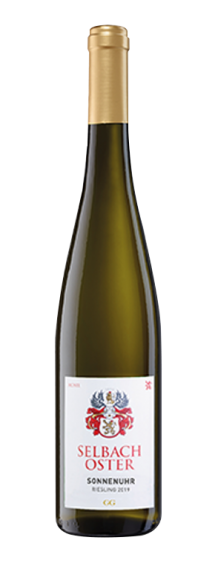 'Selbach Oster Riesling Sonnenuhr GG'.
 [Photo by Geumyang International]
© The Asia Business Daily(www.asiae.co.kr). All rights reserved.
![Clutching a Stolen Dior Bag, Saying "I Hate Being Poor but Real"... The Grotesque Con of a "Human Knockoff" [Slate]](https://cwcontent.asiae.co.kr/asiaresize/183/2026021902243444107_1771435474.jpg)












