3rd Regulatory Innovation Strategy Meeting
'Regulatory Innovation to Boost Corporate Investment Vitality' Presentation
The government has eased location regulations related to secondary batteries, enabling the construction of a secondary battery factory in Ochang and the expansion of a secondary battery research and development (R&D) center utilizing sites from the relocation of public institutions to local areas. Additionally, the allowable weight for mechanical parking garages will be expanded to accommodate electric vehicles.
On the 2nd, the government held the 3rd Regulatory Innovation Strategy Meeting chaired by Prime Minister Han Duck-soo and announced the 'Regulatory Innovation Plan to Promote Corporate Investment and Revitalize the Livelihood Economy,' which includes these measures.
The government prepared this regulatory innovation plan based on the judgment that excessive penalties, which lag behind international standards (global standards) or changes in the times, restrict private economic activities. Excessive economic penalties hinder the economic freedom and creativity of citizens and companies, causing various side effects such as stigmatization and the proliferation of ex-offenders. Therefore, the government saw the need to focus on discovering and improving economic penalty regulations that have high demand for improvement from the private sector and can be felt by the public, and thus pursued this regulatory innovation.
Resolving Difficulties in Investment Projects in Secondary Batteries, Electric Vehicles, and Energy
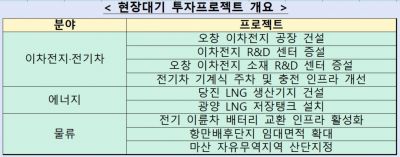
The government resolved difficulties in nine on-site pending investment projects focusing on secondary batteries, electric vehicles, energy, and logistics.
First, to enable the construction of the Ochang secondary battery factory, the government took measures to allow construction to continue without demolition and reconstruction through safety verification by the Fire Industry Technology Institute regarding the reinforcement of safety facilities by the company. This means that the factory under construction can be built based on existing facilities without demolition. The company was in a situation where, to modify the construction to meet the requirements for installing hazardous material handling facilities during the construction of the secondary battery factory, it had to demolish the factory under construction and rebuild it. This would have increased time and costs and risked failing to fulfill contracts with overseas contractors.
The expansion of the secondary battery R&D center, which was difficult because the site purchased by a private company following the relocation of public institutions to local areas was designated as natural green space, has also become possible. To expand, the city master plan must be changed to rezone the 'natural green space' to 'Type 1 residential.' Accordingly, the government coordinated with relevant agencies such as basic and metropolitan local governments to push for changes to the basic city plan of the local government and site rezoning by the second quarter of this year. The government expects that rapid R&D investment in secondary batteries will secure competitiveness in related industrial sectors and create an efficient utilization case for sites from the relocation of public institutions to local areas.
Electric vehicles will also be able to use mechanical parking garages. Mechanical parking garages currently limit vehicle weight to '1,850 kg for medium-sized and 2,200 kg for large vehicles.' Because of this, electric vehicles exceeding this limit, such as the EV6 (vehicle weight 2,160 kg), Ioniq 6 (2,055 kg), and Taycan GTS (2,295 kg), could not use mechanical parking garages. Accordingly, the government plans, as the first phase, to expand the allowable vehicle weight for mechanical parking garages by the second quarter of next year and then establish safety standards based on the operation results of mechanical parking garages equipped with electric vehicle charging.
Construction of the Dangjin liquefied natural gas (LNG) production base will also accelerate. Establishing the production base requires multiple administrative procedures such as permission for the occupation and use of public waters, but progress had been hindered due to disagreements between companies and local governments. The government coordinated the differences between the company and Dangjin city by deciding to install the contentious dredged soil disposal site within Dangjin Port and jointly promote waterfront facilities (such as waterside parks).
Also, since the acquisition of new wharf facilities was not reflected in the basic port plan, making investment difficult, the government advanced the revision of the basic port plan for installing the Gwangyang LNG storage tank from the originally scheduled 2025 to 2022, alleviating concerns about investment setbacks. A foundation for creating a new business called battery subscription service was also established. The government plans to create a method to provide zero-emission vehicle subsidies for battery-separable electric two-wheelers by the second quarter of this year.
The government evaluated that resolving these investment project difficulties generated a total investment of 2.8 trillion KRW and created about 12,000 jobs.
Focused Improvement on Corporate Freedom Restrictions and Excessive Penalties
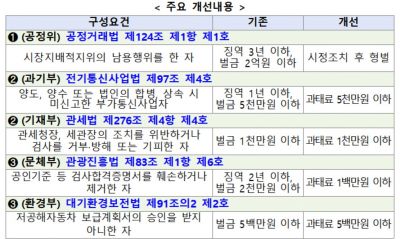
The government reviewed 232 regulations with high demand for improvement from businesspeople and self-employed individuals and decided to improve 108 of them. Of these, 87 regulations will be converted from penalties to administrative sanctions, and 21 will have their penalties adjusted.
Specifically, for those who 'abuse market-dominant positions' under the Fair Trade Act, instead of the existing punishment of 'up to 3 years imprisonment or a fine of up to 200 million KRW,' the government will impose 'corrective measures first, then penalties.' Excessive penalties for minor administrative violations under laws such as the Customs Act, the Clean Air Conservation Act, and the Tourism Promotion Act will also be converted to fines.
Additionally, penalties for violations of reporting obligations under the Food Sanitation Act will be eased, and minor fines under the Certified Public Accountant Act, Electrical Construction Business Act, Livestock Manure Act, and Apartment Management Act will be converted to fines.
The government plans to proceed with legislative procedures for this second phase of economic penalty regulations by May and finalize the third phase by July.
© The Asia Business Daily(www.asiae.co.kr). All rights reserved.
![Clutching a Stolen Dior Bag, Saying "I Hate Being Poor but Real"... The Grotesque Con of a "Human Knockoff" [Slate]](https://cwcontent.asiae.co.kr/asiaresize/183/2026021902243444107_1771435474.jpg)

















