No Reflection or Apology Demanded by Any Previous Government
Quick Resolution of Korea-Japan Relations...Criticism of Lost Sense of Balance
Calls to Observe Diplomatic Achievements
President Yoon Suk-yeol is facing growing criticism for not mentioning any issues related to the historical disputes between Korea and Japan in his March 1st Independence Movement Day commemorative speech, instead focusing solely on the future and cooperation between the two countries. Critics point out that the omission of contentious historical issues such as the comfort women and forced labor, as well as the remark that “we lost our sovereignty because we were not properly prepared for changes in world history,” reflects a lack of balance.
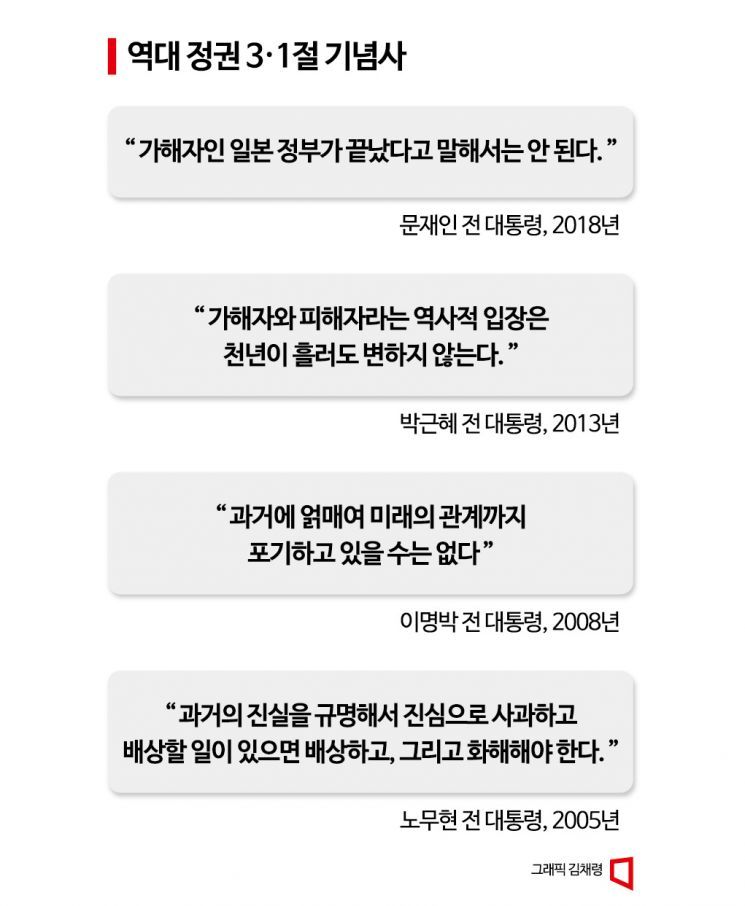
According to political circles on the 2nd, the absence of demands for Japan’s reflection and apology is considered unusual. Past presidents, regardless of political orientation, have always included references to historical issues in their March 1st speeches. For example, “We must never turn away from the truth of history” (Lee Myung-bak, 89th anniversary), “The historical positions of perpetrator and victim cannot change even after a thousand years” (Park Geun-hye, 94th anniversary), and “Japan must face the truth and justice of history with the universal conscience of humanity” (Moon Jae-in, 99th anniversary).
"Lack of past history message is regrettable due to insufficient explanation"
Choi Eun-mi, a research fellow at the Asan Institute for Policy Studies, evaluated that “the message was read as an intention to strengthen cooperation with Japan considering the impact on future Korea-Japan negotiations.” However, she added, “The absence of a message about past history seems to emphasize an internal change in perception regarding Korea-Japan relations, but the content was brief and condensed, so the lack of explanation is regrettable.”
Political commentator Lee Jong-hoon said, “I understood the remarks as an intention to move Korea-Japan relations forward in a future-oriented way, but it was not appropriate to say this on March 1st. It would have been better to speak from a perspective suitable for the March 1st speech.” He especially noted, “Considering the economic damage caused by export restrictions during the Moon Jae-in administration, it seems that in an effort to differentiate from the previous administration, a hasty and forced remark was made.”
In diplomatic circles, there is also an interpretation that the government is trying to quickly resolve contentious Korea-Japan issues, including forced labor, in anticipation of the G7 summit to be held in Japan in May. Former National Intelligence Service Director Park Jie-won appeared on the radio that day and pointed out, “There is talk in diplomatic circles that the government is hastily trying to humiliatingly improve Korea-Japan relations to receive an invitation to the G7.” Currently, the United States is pushing to establish a security consultative body among Asian allies similar to NATO (North Atlantic Treaty Organization) in Europe. For the formation of this security consultative body, it is necessary to show harmony among the leaders of Korea, the U.S., and Japan at the G7, which is why there is an excessive sensitivity toward Japan.
Furthermore, there are criticisms that the part of the speech stating “we lost our sovereignty because we were not properly prepared for changes in world history” was inappropriate. Professor Park Sang-byeong of Inha University criticized, “If one understands East Asian history and the hardships and suffering of Korea’s liberation struggle, such a remark would not come out,” adding, “It is a commemorative speech reflecting the Japanese government’s position.”
"We should wait and see Japan’s response on issues like forced labor," some say
However, given the sensitive situation where Korea and Japan are currently negotiating on issues such as forced labor, there is also an interpretation that we should wait and see Japan’s response. The intention is to avoid provoking Japan while discussions on compensation solutions for forced labor victims are ongoing. Professor Shin Yul of Myongji University said, “In diplomacy, results are ultimately important, and in the current international situation, Japan’s role is crucial in terms of security and economy,” adding, “In that sense, the speech can be seen as one that sought a compromise. It is more important to look at what diplomatic achievements come from it rather than the remarks themselves.”
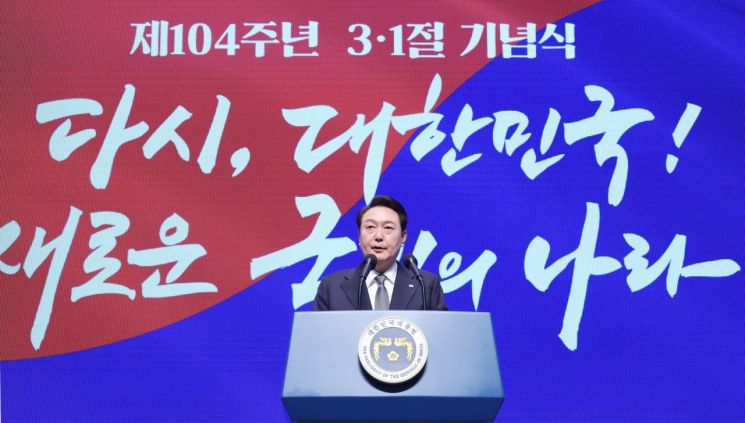
▲Below is the full text of President Yoon’s March 1st Independence Movement Day commemorative speech.
Dear fellow citizens,
Today marks the 104th March 1st Independence Movement Day, a day for the 7.5 million overseas Koreans and independence patriots. First, I pay tribute to the patriots and independence activists who sacrificed and devoted themselves for the freedom and independence of our homeland. I sincerely thank the independence patriots and their families.
The March 1st Movement 104 years ago was an independence movement to establish a nation where the people are the masters and a free democratic country, as seen in the March 1st Declaration of Independence and the Provisional Government Charter. It was a historic day that showed what kind of world we, who longed for new change, wished for. Now, 104 years later, we must look back on our past when we lost our sovereignty and suffered because we were not properly prepared for changes in world history.
We must think about how to overcome the current global complex crises, the severe security threats including North Korea’s nuclear threat, and the crises of division and polarization in our society. If we fail to read the changing currents of world history and prepare properly for the future, it is clear that the misfortunes of the past will repeat. Also, we must never forget the patriots who, in the pitch-dark times when no one could imagine independence in their lifetime, gave everything for the freedom and independence of the homeland. Without properly remembering those who devoted themselves to the country, there is no future for us.
Dear fellow citizens,
One century after the March 1st Movement, Japan has transformed from a militaristic invader of the past to a cooperative partner sharing universal values with us in security, economy, and global agendas. Especially, cooperation among Korea, the U.S., and Japan to overcome complex crises and serious security threats such as North Korea’s nuclear threat has become more important than ever. We must unite and cooperate with countries that share universal values to contribute to the expansion of freedom for global citizens and common prosperity worldwide. This is no different from the spirit that cried out for the freedom and independence of the homeland 104 years ago.
Fellow citizens,
The prosperity we have achieved today is the result of relentless efforts to protect and expand freedom and faith in universal values. We must never stop those efforts. That is the proper way to repay the patriots who sacrificed and devoted themselves for the freedom and independence of the homeland. Whether it is a glorious history or a shameful and sorrowful one, history must not be forgotten. It must be remembered. This is to protect and prepare for our future. Today is a day to remember the patriots who devoted themselves to the country, reflect on the unfortunate past of our history, and think about what we must do for future prosperity.
Dear fellow citizens,
Let us all inherit the spirit of the March 1st Declaration of Independence and create a future of freedom, peace, and prosperity. Thank you.
© The Asia Business Daily(www.asiae.co.kr). All rights reserved.