As the Economy Worsens, SME Loans Were Expected to Increase
But Loan Growth Significantly Slowed Compared to Last Year
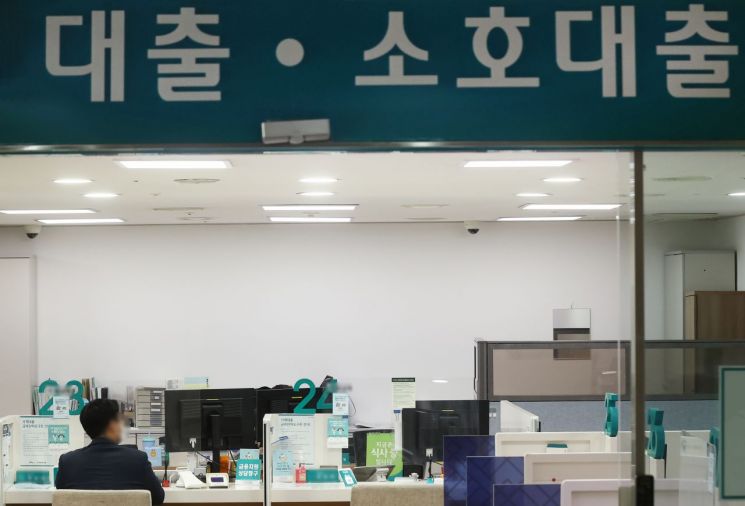
Industrial Bank of Korea has set its small and medium-sized enterprise (SME) loan target at 56 trillion won for this year, an increase of 3 trillion won compared to last year's supply. This is because it anticipated an increase in SME loans, including those to self-employed individuals, due to the worsening economy. Commercial banks have similarly targeted corporate loans. With household loans decreasing due to the sluggish real estate market, the only area for business expansion is corporate lending. However, contrary to banks' expectations, SME loans have also slowed down since the beginning of this year.
An executive in charge of credit at a commercial bank said, "Starting with Industrial Bank of Korea, which accounts for 23% of the SME credit market share, the increase in corporate loans at the end of last year was only about 60% compared to the same period the previous year, and the increase in January this year was about half of last year's. The five major banks also saw a significant reduction in the growth rate."
As of the end of February, SME loans from the five major banks (KB Kookmin, Shinhan, Hana, Woori, NH Nonghyup) totaled 599.3626 trillion won, an increase of 1.2415 trillion won compared to the previous month (598.1211 trillion won). This is about one-third of the net increase of 3.2227 trillion won in SME loans during the same period last year. When looking specifically at loans to small business owners, the increase was even smaller. From January to February this year, loans increased by only 145 billion won (from 313.065 trillion won to 313.210 trillion won). This is a significant drop compared to the 2.1097 trillion won increase during the same period last year (from 301.4069 trillion won to 303.5166 trillion won).
The clear slowdown in loan growth is due to interest rates. A senior official at a commercial bank explained, "During the past low-interest-rate period, many businesses borrowed money in advance to prepare for worsening management or investments, but now that interest rates have suddenly risen, more businesses are repaying loans rather than borrowing new funds because it is more advantageous financially." A bank branch manager also said, "As delinquency rates rise and risks increase, banks are focusing their operations on high-quality companies and are conservatively reviewing new loans for companies in poor economic conditions."
In fact, most SME loans are in the 5% and 6% interest rate ranges. According to the Bank of Korea's statistical system, as of January, 45.1% of SME loans from deposit banks were borrowed at interest rates between 5% and 6%, and 24.9% were at rates between 6% and 7%, based on new loan amounts.
However, even if corporate credit centered on SMEs slows down, the financial sector predicts that commercial banks' earnings this year could be similar to or even higher than last year. A senior official from the financial authorities forecasted, "If the base interest rate does not fall this year, there is a possibility that banks' interest income will increase compared to last year."
© The Asia Business Daily(www.asiae.co.kr). All rights reserved.

















