Statistics Korea, January 2023 Industrial Activity Trends
Retail Sales Down 2.1%, Declining for 3 Consecutive Months
In January this year, total industrial production increased by 0.5% compared to the previous month, showing an upward trend for the first time in four months. Retail sales decreased by 2.1%, continuing a decline for three consecutive months. Statistics Korea evaluated that "the flow remains sluggish."
On the 2nd, Statistics Korea announced the 'January 2023 Industrial Activity Trends' report containing these details.
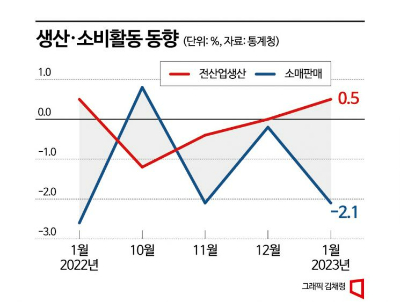
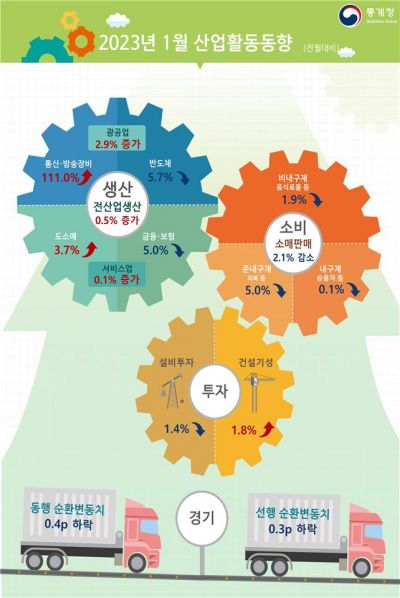
Total industrial production rose by 0.5% month-on-month as production increased in mining and manufacturing, construction, and services, despite a decline in public administration. This marks a turnaround to growth after four months. However, compared to the same month last year, production decreased by 0.8% due to declines in mining and manufacturing and public administration.
Mining and manufacturing production increased by 2.9% month-on-month, with growth in telecommunications and broadcasting equipment (111.0%) and automobiles (9.6%), although semiconductor production fell by 5.7%.
Manufacturing inventories rose by 2.6% month-on-month and 10.0% year-on-year. The average operating rate of manufacturing increased by 2.6 percentage points from the previous month to 70.9%.
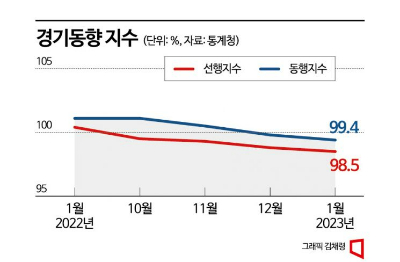
Kim Bo-kyung, Economic Trend Statistics Officer at Statistics Korea, said, "(The January industrial activity indicators) did not reach a level that reverses the recent sluggish trend," adding, "With the number of employed persons also decreasing, the coincident composite index cyclical component, which reflects the current economic situation, has declined for four consecutive months."
The coincident composite index cyclical component, which indicates the current economic flow, fell by 0.4 points month-on-month. It has been declining for four months since a 0.2-point drop in October last year. The leading composite index cyclical component, which shows economic outlook, also decreased by 0.3 points month-on-month, marking a decline for seven consecutive months since July last year (-0.3 points).
Retail sales fell by 2.1% month-on-month as sales of non-durable goods such as food and beverages (-1.9%), semi-durable goods such as clothing (-5.0%), and durable goods such as passenger cars (-0.1%) all declined. Compared to the same month last year, sales of semi-durable goods like clothing (-5.8%) and durable goods such as home appliances (-3.5%) decreased, but sales of non-durable goods like food and beverages (3.9%) increased, resulting in a 0.7% rise.
Facility investment decreased by 1.4% month-on-month as investment increased in transportation equipment such as automobiles (15.9%) but declined in machinery such as special industrial machinery (-6.9%).
In construction performance, civil engineering works decreased by 10.3%, but both residential and non-residential construction increased, leading to a 1.8% month-on-month rise in building construction (5.9%). Construction orders increased by 7.7% year-on-year as orders for civil engineering such as machinery installation (237.5%) rose, despite a 41.0% decline in building orders such as housing.
Statistics Korea refrained from making a definitive evaluation of the economic situation. Officer Kim said, "Statistics Korea tentatively set May 2020 as the economic trough, after which there was some recovery, but recently there has been slight slowing or a small decline," adding, "However, to make a clearer judgment on this, we need to observe data accumulated over 10 months, so it is difficult to say what phase we are currently in."
© The Asia Business Daily(www.asiae.co.kr). All rights reserved.
![Clutching a Stolen Dior Bag, Saying "I Hate Being Poor but Real"... The Grotesque Con of a "Human Knockoff" [Slate]](https://cwcontent.asiae.co.kr/asiaresize/183/2026021902243444107_1771435474.jpg)


















