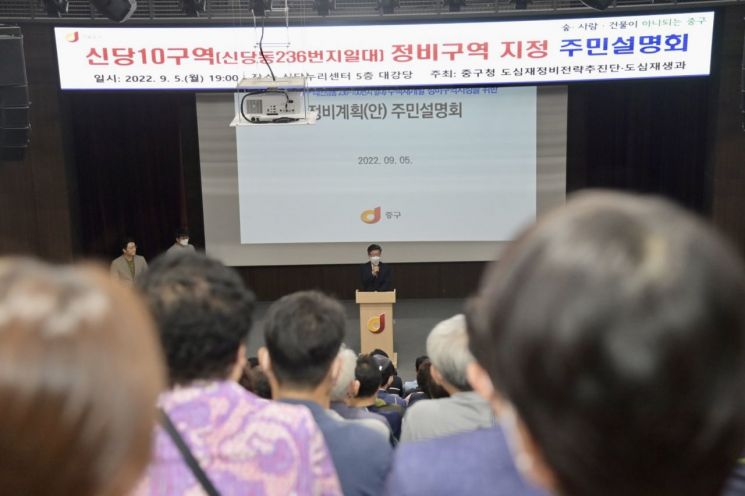
 Kim Gil-seong, Mayor of Jung-gu, attending the residents' briefing session for the designation of Sindang 10 District redevelopment zone in September last year
Targeting Shindang 10 District and Jungnim-dong 398 Area Housing Redevelopment Project Zones
Improving Response Rates through On-site Promotion of Direct Establishment System for Associations to Reduce Resident Burden
75% Consent Requirement from Landowners Nearly Achieved in Shindang 10 District, 41% in Jungnim-dong
Jung-gu, Seoul (Mayor Kim Gil-seong) will operate an 'On-site Support Center for Direct Establishment of Redevelopment Associations' starting from the 6th in the planned housing redevelopment zones of Shindang 10 District and Jungnim-dong 398 area. This is the second time following December last year.
Shindang 10 District is planned to supply 1,400 apartment units with a maximum height of 35 floors. The housing redevelopment maintenance plan, established through the rapid integrated planning, was approved by Seoul City on the 20th of last month. The Jungnim-dong 398 area is also preparing for designation as a redevelopment zone aiming to build a complex of 815 apartment units.
The direct establishment of redevelopment associations requires consent from more than 75% of landowners within the project zone, and Shindang 10 District is currently close to meeting this threshold. With the operation of the district's on-site support center this month, surpassing 75% consent is expected to be certain. Furthermore, the district plans to secure over 80% consent to facilitate smooth approval of association establishment in the future.
Jung-gu will open the on-site support center in front of Saemaeul Geumgo Shindang branch in Shindang 10 District from the 6th to the 9th of this month, and in front of Exit 5 of Chungjeongno Station for the Jungnim-dong 398 area from the 9th to the 17th. Considering the consent rate (41%) in Jungnim-dong 398 area, the operation period has been extended.
At the on-site support center, the direct establishment system of associations will be promoted to increase response rates among landowners residing within the project zones, and consent forms will be collected. Detailed one-on-one consultations will also be provided to address procedures and questions related to the redevelopment project.
Additionally, the district will send notices to landowners not residing in the project zones and will individually contact residents who have not responded regarding their consent to ascertain their intentions.
Jung-gu is putting full effort into promoting the direct establishment system and improving response rates because it not only reduces residents' burdens but also plays a significant role in accelerating the project.
With the introduction of the direct establishment system, the promotion committee, which is usually formed to establish the redevelopment association, can be bypassed. The average association establishment period, which takes six years, can be shortened to 2 to 3 years. Moreover, the budget required for association establishment will be supported by Jung-gu and Seoul City. In redevelopment projects where time is money, such system effects are undoubtedly powerful.
Jung-gu also operated on-site booths last December to intensively promote the direct establishment system in these zones. As a result, the consent rate increased by 11% in Shindang 10 District and 4% in Jungnim-dong 398 area.
Kim Gil-seong, Mayor of Jung-gu, said, "The direct establishment system is a valuable system that residents might overlook or misunderstand. We will continue to actively promote good policies and systems on the ground to ensure residents do not miss out on benefits."
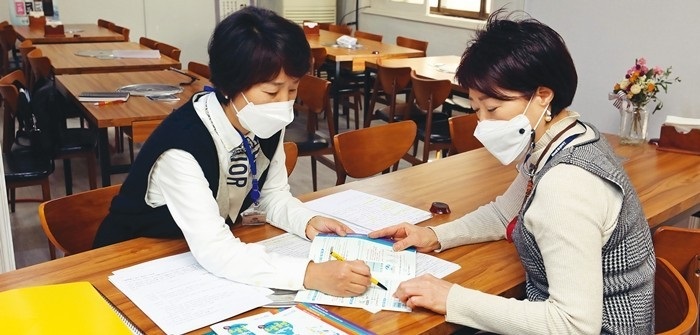
Songpa-gu Resumes Startup Education for the First Time Since COVID-19, Expands ‘Visiting Small Business Hope Planner’ Service
The Only Hope Planner Operated in Seoul... Provided Over 20,000 Consultations in 2022
Seo Gang-seok, Mayor of Songpa-gu: “We Will Do Our Best to Overcome Small Business Management Difficulties and Revive the Local Economy”
Songpa-gu (Mayor Seo Gang-seok) announced on the 2nd that it will expand the operation of the ‘Visiting Small Business Hope Planner,’ which directly visits small business owners and self-employed individuals in the area to guide various support policies and invigorate the local economy.
The district has been operating the only ‘Hope Planner’ in Seoul since August 2019, providing practical assistance at business sites. The Hope Planner visits small business owners and self-employed individuals struggling due to economic downturn and rising prices, listens to their difficulties, provides tailored policy guidance such as financial support and legal, tax, and labor consultations, and assists with application procedures when necessary.
Last year, the program conducted 14,458 on-site consultations and 6,254 center visits and phone consultations, serving a total of 20,712 people as a ladder of hope.
For example, a self-employed person A running a sashimi restaurant in Bangi-dong learned about the Nakhyang Gourmet Project and Our Neighborhood Store Artterior Project through a visit by the Hope Planner. After detailed consultation on application procedures and methods, A was selected for support and received various store improvement benefits, regaining the will to manage the business.
Another self-employed person B, operating a hair salon in Garak-dong, struggled alone with employee wage burdens due to COVID-19 and missed the application for small business loss compensation. After receiving a non-payment notice and falling into despair, the Songpa-gu Hope Planner visited, informed B that reapplication was possible, and helped with the application.
This year, startup education for small business owners, which was suspended due to COVID-19, will resume in September. Targeting 20 prospective entrepreneurs and small business owners, the program will jointly hold courses on essential basic knowledge by sector and SNS online marketing with the Seoul Credit Guarantee Foundation to support self-reliance and capacity building.
Four small business experts will be hired to continuously operate the ‘Visiting Small Business Hope Planner.’ The district will produce a ‘2023 Comprehensive Guide to Small Business Support Policies and Monthly Newsletter’ to provide an easy overview of support policies and distribute them by visiting each responsible area. Additionally, assistance will be provided on-site for elderly and other small business owners needing help, including document preparation and application submission.
Small business owners can also receive visits and phone consultations through the Small Business Comprehensive Support Center (15-1 Baramdri-gil, Songpa-gu), which operates to help stabilize management and strengthen self-sufficiency.
Seo Gang-seok, Mayor of Songpa-gu, said, “The Hope Planner project in Songpa-gu has received over 90% ‘very satisfied’ ratings in satisfaction surveys and has gained great support from small business owners. We will continue to listen directly to their difficulties on-site and strive to discover policies that provide real help.”
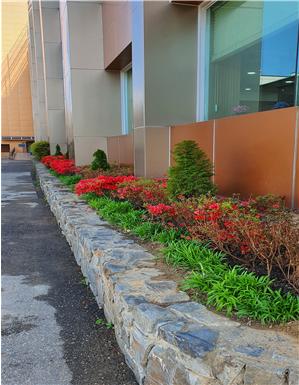
Gwangjin-gu Opens Applications for Living Area Tree Planting Support Project
Applications Accepted Until March 10, Supporting Trees Such as Plum Trees and Hydrangeas to Be Planted Around Living Areas
Targeting Detached and Multi-family Housing, Facilities for the Elderly and Children (Daycare Centers, Senior Centers), and Educational Research Facilities (Kindergartens, Elementary, Middle, and High Schools)
Gwangjin-gu (Mayor Kim Kyung-ho) supports residents by providing trees so they can plant them directly in small spaces around their living areas.
To create a pleasant living environment and improve residents’ quality of life, the district enacted the Gwangjin-gu Urban Greening Support Ordinance in October 2021 and has been promoting the ‘Living Area Tree Planting Support Project’ since last year.
The ‘Living Area Tree Planting Support Project’ is an urban greening initiative where residents plant trees in idle spaces such as rooftops and small plots in a city with a severe shortage of green spaces.
This year’s application period is until March 10. Eligible applicants include ▲detached houses and multi-family houses (excluding multi-unit housing and apartments with 20 or more households) ▲facilities for the elderly and children such as daycare centers and senior centers ▲educational research facilities such as kindergartens and elementary, middle, and high schools.
Supported trees include ▲four types of tall trees (arboreal) such as persimmon and plum trees ▲six types of small trees (shrubs) such as hydrangea, blueberry, and four-season roses. Applications for tall trees require a planting area of at least 1㎡ per tree, and for small trees, at least 0.25㎡ per 5 shrubs.
Applications can be submitted by filling out the application form and submitting it to the Parks and Greenery Division. Submission is possible via email, mail, or direct visit. Detailed information is available on the Gwangjin-gu website.
Last year, the district distributed a total of 2,055 trees to 13 educational research facilities, 25 detached houses, 14 multi-family houses, and 21 facilities for the elderly and children. Notably, the Guroi Aiwa Tree Daycare Center planted climbing roses, and the Korean-Mongolian School planted hydrangeas in small spaces, improving the surrounding landscape and receiving high satisfaction from children and local residents.
Mayor Kim Kyung-ho said, “Increasing green spaces in the city helps improve various environmental issues such as the heat island effect and fine dust. We hope many people will take interest in this tree planting support project.”
© The Asia Business Daily(www.asiae.co.kr). All rights reserved.


















