The Constitutional Court has ruled that the Nationality Act, which requires men born to Korean parents residing abroad without the intention of permanent settlement to fulfill their military service obligations before renouncing Korean nationality, is constitutional.
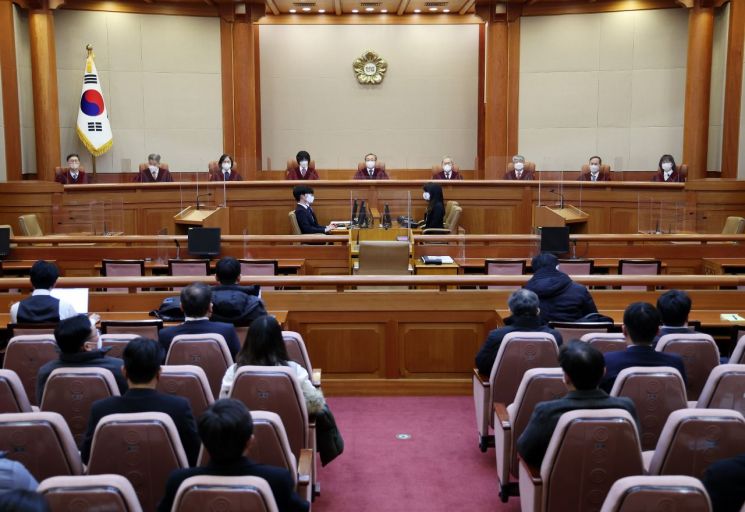 Yoo Nam-seok, Chief Justice of the Constitutional Court (center), and the justices are seated in the Grand Bench of the Constitutional Court in Jongno-gu, Seoul, on the afternoon of the 23rd of last month.
 [Image source=Yonhap News]
On the 1st, the Constitutional Court announced that it reached a unanimous decision on the constitutionality of Article 12, Paragraph 3 of the Nationality Act in the constitutional complaint case filed by Mr. A.
The provision under review stipulates that a person born to direct ascendants residing abroad without the intention of permanent settlement can only file a nationality renunciation report if they have fulfilled military service obligations by serving active duty, full-time reserve service, supplementary service, wartime labor service, or have been exempted from military service.
The Court judged, "The provision in the Nationality Act aims to prevent dual nationals from opportunistically using nationality renunciation as a means of evading military service. Considering the dictionary meaning of the words and the legislative intent, it is not so vague as to cause arbitrary enforcement by law enforcement agencies."
It also pointed out, "Without this provision, male citizens born abroad who acquire dual nationality could evade their military service obligations by renouncing their nationality under the pretext of holding dual citizenship, and there would be no way to impose those obligations."
Furthermore, the Constitutional Court unanimously ruled the constitutionality of Article 14, Paragraph 1 of the Nationality Act, which requires dual nationals to have an address abroad in order to file a nationality renunciation report.
The Court stated, "The expression 'having an address abroad' is used not only in law but also in everyday language, meaning a place that serves as the actual basis of life, and does not violate the principle of clarity," adding, "Renouncing nationality to evade obligations as a citizen without any actual living basis abroad can undermine the fundamental principles of the existence and maintenance of the national community."
© The Asia Business Daily(www.asiae.co.kr). All rights reserved.
![Clutching a Stolen Dior Bag, Saying "I Hate Being Poor but Real"... The Grotesque Con of a "Human Knockoff" [Slate]](https://cwcontent.asiae.co.kr/asiaresize/183/2026021902243444107_1771435474.jpg)











