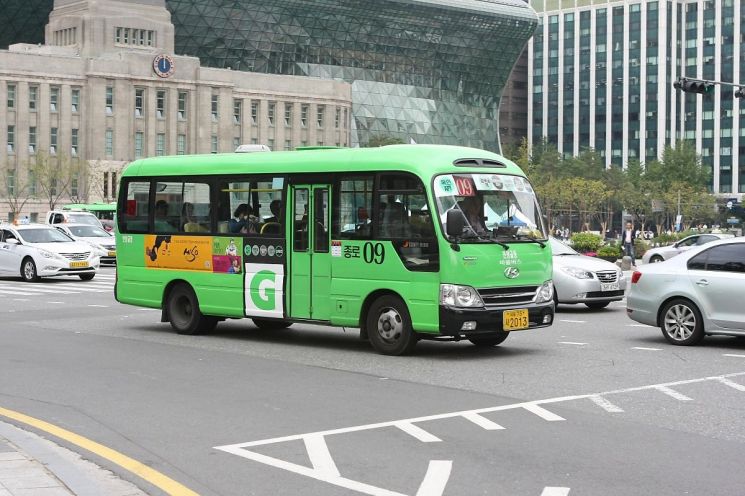
Despite significant price increases in fuel and labor costs, fares for children and adolescents have been frozen for 16 years, and adult fares for 8 years. Although a fare increase was scheduled for the end of April this year, it was postponed to the second half of the year as part of the government's price stabilization measures... Village bus drivers are complaining about extremely low wages and high turnover rates.
Seoul's village buses, known as the "people's transportation," have reportedly faced severe management difficulties due to an 8-year fare freeze.
Accordingly, urgent measures such as management support for Seoul's village buses are being called for.
According to the village bus industry, the current fares in Seoul are 300 won for children, 480 won for adolescents, and 900 won for adults, based on transportation card usage. More than 65% of village bus users transfer to city buses or subways.
In comparison, adult fares in other cities and provinces are 1,350 won in Gyeonggi-do, 1,300 won in Sejong City, and 1,130 won in Busan, making Seoul 450 won cheaper than Gyeonggi-do.
In particular, despite significant increases in fuel and labor costs, Seoul's village bus fares have been frozen for 16 years for children and adolescents and 8 years for adults. Although a fare increase was planned for the end of April this year, it was postponed to the second half of the year as part of the government's price stabilization measures.
This is because Seoul postponed the fare increases for subways, city buses, and village buses, which were scheduled for April, to the second half of the year all at once.
The postponement of the fare increase is lamented as causing village buses to lose the strength to endure and cease functioning as the citizens' means of transportation.
They argue that if village buses stop operating, the fundamental cause is the prolonged fare freeze by Seoul City.
The decrease in passengers due to COVID-19 and the rise in fuel and labor costs have further worsened the financial difficulties of village buses.
In contrast, Seoul's city buses and subways operate under a semi-public system. Even if fare increases are delayed, the city provides budget support to cover financial shortfalls, ensuring stable finances, company management, and employee treatment.
However, village buses are privately operated, so unlike the semi-public system, business owners are responsible for managing their operations. Although Seoul City provides some financial support, it is downward support that ignores reality, and the support criteria are highly subjective. As of 2023, the 2019 transportation cost is applied, and based on a monthly deficit of 457,040 won per village bus, even if the deficit is high, only up to 85% is compensated within a limit of 210,000 won.
The village bus industry insists that if the fare increase, which has been awaited for 8 years, is unilaterally postponed for administrative purposes, Seoul City should provide appropriate compensation such as expanded financial support or deficit compensation accordingly.
Park Joo-woon, Executive Director of the Seoul Village Bus Transportation Business Association, explained the difficulties: “Village buses are on the brink of bankruptcy due to accumulated deficits. Although income is low and deficits occur, buses must operate even without passengers, and it is common to refuel on credit because fuel costs cannot be covered. Facing structural financial difficulties and the threat of route closures, credit ratings have worsened, and both the Seoul Credit Guarantee Foundation and banks have begun to refuse loans.”
He added, “Some companies even delay paying drivers' monthly wages. Among the 139 village bus companies in Seoul, 113 companies, or 81.2%, are operating at a loss.”
He continued, “Village bus drivers earn 2.91 million won for 26 working days, while city bus drivers earn 4.96 million won for 22 working days. Low wages make recruitment difficult, and even after employment, drivers quickly leave seeking better treatment. Due to low wages and driver shortages, operation rates drop and intervals between buses become irregular and longer,” he lamented.
Meanwhile, village buses, which began in 1981, serve as the capillaries of public transportation. They have been the citizens' means of transportation for 42 years, traveling through blind spots where transportation is inconvenient.
If village buses stop, the damage will affect me, my family, and neighbors. There is a pressing need for countermeasures.
© The Asia Business Daily(www.asiae.co.kr). All rights reserved.

















