Top Priority Political Resolution Task Ranked as the Two Major Parties System
56.5% Say "No Need for Constitutional Amendment," Preference for Maintaining Current Electoral System
Overlapping Issues of Imperial Presidency and Political Polarization Lead to Democratic Regression
On the 27th, when the arrest motion for Lee Jae-myung, leader of the Democratic Party of Korea, was being voted on, a session was held on one side of the National Assembly to share the final results of the year-long study on the "Current Status and Solutions of Political Polarization." This seminar, attended by experts from the National Assembly, academia, and the media, was a meaningful occasion where lawmakers from both ruling and opposition parties gathered regardless of ideology to discuss the limitations of two-party politics, party reform, and policies to alleviate polarization. However, as the vote on Lee’s arrest motion dragged on, many lawmakers who had planned to attend were unable to come. Ultimately, the 'Comprehensive Debate among Lawmakers' was canceled, but the proposals made that day are expected to be referenced in the plenary committee on election law reform, which will involve all lawmakers in March, making it important to pay attention to the presentation content.
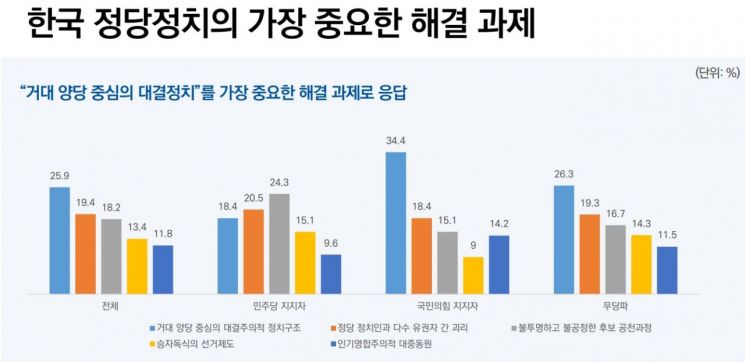
Core Issue of Korean Party Politics: "Confrontational Politics Centered on Two Major Parties"
According to the "Public Perception Survey on the Current Status of Political Polarization in Korea and Institutional Proposals," presented by Park Jun, the lead researcher from the Korea Institute of Public Administration, when asked about the most important issue to be resolved in Korean party politics, one in four respondents (25.9%) identified "confrontational politics centered on the two major parties." (Korea Research, survey of 1,001 men and women aged 18 and over, conducted from December 21, 2022, to January 15, 2023, with a sampling error of ±3.1 percentage points at a 95% confidence level)
Regarding constitutional amendment, 43.5% answered "necessary," while 56.5% responded "not necessary."
If a constitutional amendment were to take place, the highest proportion chose the American-style four-year renewable term system. 69.1% selected the "American-style four-year renewable term," followed by the French-style semi-presidential system (18.4%) and the British or German-style parliamentary system (12.5%).
Regarding changes to the electoral system, 31.1% preferred "maintaining the current system (15.7% proportional representation seats)," while 27.1% favored "abolishing proportional representation and electing all representatives from constituencies." The opinion that proportional representation seats should be reduced compared to the current system was 24.0%. This is notable as it shows a majority negative view toward recent political discussions on expanding proportional representation seats.
The proportion supporting an increase in proportional representation seats ("abolishing constituency representatives and electing all by proportional representation" 0.9%, "increasing proportional representation seats to outnumber constituency representatives" 1.3%, "equal ratio of proportional representation and constituency representatives" 5.9%, "slightly increasing proportional representation seats" 9.8%) was less than 20%.
Regarding the major electoral district reform proposed earlier this year by President Yoon Seok-youl and National Assembly Speaker Kim Jin-pyo, the general public mostly favored "maintaining the current small constituency system" at 55.4%. By party support, People Power Party supporters showed the highest rate at 64.2%, followed by the Democratic Party at 59.8%.
Researcher Park analyzed, "While the public recognizes confrontational politics centered on the two major parties as a problem, they are lukewarm about electoral system reform," and advised, "Electoral system reform can gain public sympathy when accompanied by party reform."
"Constitutional Amendment to a Decentralized Presidential System and Introduction of Runoff Voting Needed"
There was also an analysis that the current power structure, characterized by an imperial presidency and political polarization overlapping and mutually worsening, is causing democratic regression.
Professor Jeong Jae-gwan of Korea University expressed in his presentation on "Power Structure Reform to Overcome Political Polarization" that "a constitutional amendment toward a decentralized presidential system is necessary." He explained that while maintaining direct presidential elections, constitutional authority over cabinet formation and dissolution, as well as the composition of the Supreme Court and Constitutional Court, should be transferred to the National Assembly to separate and check presidential power. He emphasized that political polarization should be alleviated through the introduction of a presidential runoff voting system and reform of the National Assembly election system.
He suggested that a sequential approach securing inter-party agreement and public consent and support is necessary.
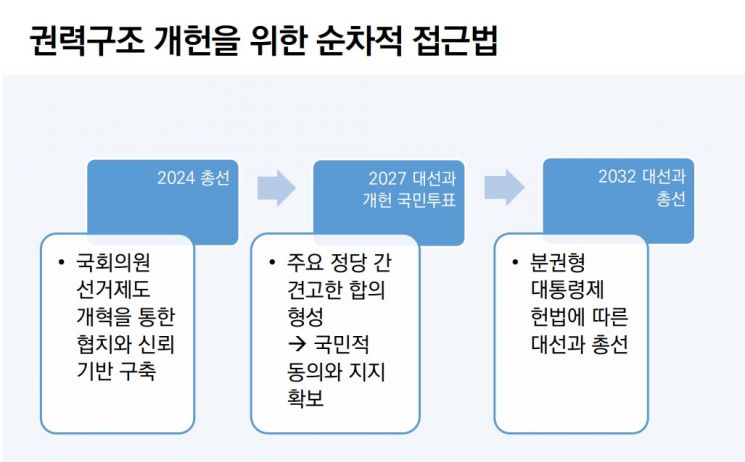 Source: Presentation materials by Professor Jeong Jaegwan, Korea University, Korea Institute of Public Administration
Professor Jeong said, "Timing-wise, a constitutional amendment led by the National Assembly early in the presidential term increases feasibility," but also noted, "It is also necessary to enhance public trust in the strengthened parliamentary power under a decentralized presidential system."
"Duopoly Structure of Two Major Parties Should Be Replaced by a 'Moderate Multiparty System'"
To break the vicious cycle of elections characterized by choosing between the lesser of two evils, it was pointed out that the duopoly structure of the two major parties must be overcome and the winner-takes-all electoral system needs reform.
Professor Jang Seung-jin of Kookmin University said, "Electoral system and party system reforms are needed to overcome the adversarial symbiotic relationship between the two major parties," advocating for a "moderate multiparty system." He judged that the fundamental cause of the National Assembly’s crisis in cooperation and representation lies in the structure where the two major parties monopolize all political resources and power. As a method to induce a moderate multiparty system, he suggested expanding the proportion of proportional representation seats. For example, maintaining the current semi-proportional electoral system and increasing the number of lawmakers to 375, with 250 constituency seats and 125 proportional representation seats. However, he noted that persuading the public about the need to increase the number of lawmakers and proportional representation seats is important.
Regarding electoral district delineation, he emphasized considering population and regional representation, proposing measures to strengthen representation for rural and fishing communities. Professor Ji Byung-geun of Chosun University suggested overcoming the harms of political polarization through refining the electoral district delineation system, proposing the introduction of a minimum district allocation system, delineation considering area size, and extending the electoral district delineation cycle.
Kim Young-bae, a Democratic Party lawmaker who was scheduled to greet at the opening ceremony but had to attend the plenary session before the designated discussion during the seminar, said, "I hope today's outcomes will help build actual achievements later."
As a member of the National Assembly’s Special Committee on Political Reform, Kim emphasized, "There were discussions about systems, culture, and the problems of public forums and actors surrounding them, but it is also important how well the system designers, stakeholders, and main actors recognize the problems and have the ability to communicate and solve them together," stressing, "It is important not just at the discourse level but to actually implement and change the system."
He added, "The National Assembly will hold a plenary committee on election reform in March, and a new (discussion) stage will unfold."
© The Asia Business Daily(www.asiae.co.kr). All rights reserved.
![Clutching a Stolen Dior Bag, Saying "I Hate Being Poor but Real"... The Grotesque Con of a "Human Knockoff" [Slate]](https://cwcontent.asiae.co.kr/asiaresize/183/2026021902243444107_1771435474.jpg)

















