Speaker of the National Assembly "If no agreement, Democratic Party's amendment"
Presidential Office counters with 'veto exercise'
Ruling and opposition leaders maintain stance, escalating confrontation
The 'Grain Management Act Amendment,' which mandates the government to compulsorily purchase surplus rice production, has emerged as a flashpoint in the March extraordinary session of the National Assembly. Although Speaker Kim Jin-pyo postponed the bill's plenary session last month and urged the People Power Party and the Democratic Party to negotiate and reach a consensus, both ruling and opposition parties continue to stick to their original positions, running on parallel tracks.
According to the National Assembly on the 1st, Speaker Kim ordered the ruling and opposition parties to agree on the March session's agenda by that day and to prepare alternatives through consultations between the parties by the date of the first plenary session convened according to that agenda. He also added a proviso that if no agreement is reached between the two parties, the Democratic Party's amendment would be put to a vote at the first plenary session of the March session. The Democratic Party's amendment limits the 'surplus rice production of more than 3%' to '3-5%' and adjusts the price drop range from 5% to '5-8%.'
However, Joo Ho-young, floor leader of the People Power Party, reiterated his opposition after the party's floor strategy meeting the previous day, saying, "As long as the compulsory purchase clause exists, side effects will be significant." Floor leader Joo elaborated, "The Speaker said that if a mediation plan is made, compulsory purchases would almost disappear, but simulations over the past 20 years show that compulsory purchases would have to be made about 11 times."
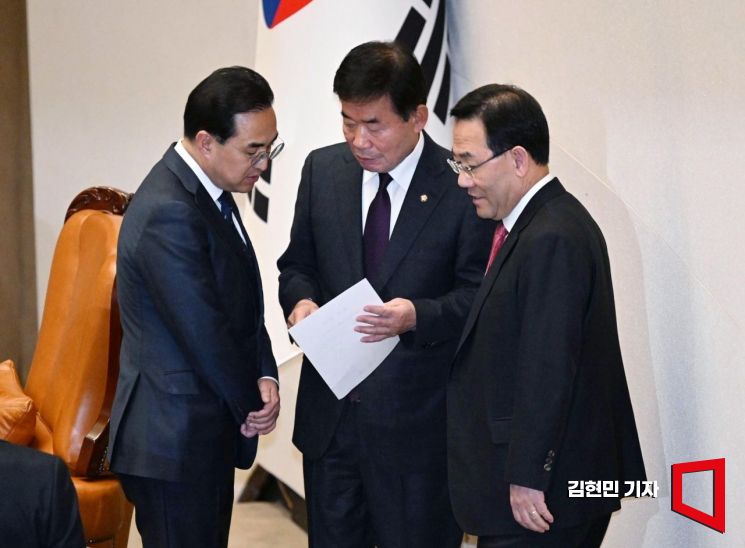 Speaker of the National Assembly Kim Jin-pyo and the floor leaders of the ruling and opposition parties are discussing the validity of invalid votes during the counting process of the arrest consent motion for National Assembly member Lee Jae-myung at the 8th plenary session of the 403rd National Assembly (extraordinary session) held at the National Assembly in Yeouido, Seoul on the 27th. From left, Park Hong-geun, floor leader of the Democratic Party of Korea, Speaker Kim, and Joo Ho-young, floor leader of the People Power Party. Photo by Kim Hyun-min kimhyun81@
Floor leader Joo explained the side effects of the amendment using the economic 'game theory' as an example. He said, "Once the law is enacted, farmers will adjust their production volume," adding, "Even now, there is overproduction, but it will be much more excessive." Floor leader Joo pointed out, "Currently, it costs hundreds of billions of won annually, but by 2025, about 1 trillion won, and by 2030, about 1.4 trillion won will be spent on purchasing surplus rice, which is then almost discarded at about one-tenth of the price five years later."
He added, "Before this bill is formally put to a vote in March, I will inform the public and farmers that this law does not benefit anyone."
However, on the same day, Park Hong-geun, floor leader of the Democratic Party, stated, "If the ruling party continues to maintain its refusal, there will be no further concessions or patience regarding the Grain Management Act," and declared, "The Democratic Party will definitely pass the Grain Management Act at the first plenary session of the March extraordinary session, as officially promised by the Speaker."
He claimed, "The amendment to the Grain Management Act is not a sole proposal by the Democratic Party," adding, "It has been carefully reviewed and reflected opinions from farmers, the Agriculture, Food, Rural Affairs and Oceans Committee, the Speaker's mediation plan, as well as concerns from the government and ruling party."
However, the Presidential Office has indicated that it will exercise a 'veto' if the Grain Management Act passes the National Assembly. According to Article 53 of the Constitution, a bill passed by the National Assembly is sent to the government, and the President promulgates it within 15 days. If the President has objections, they may return the bill to the National Assembly with a written statement within 15 days and request reconsideration. In this process, if a majority of the total members are present and two-thirds or more of the attending members approve, the President's veto can be overridden. However, with 169 seats, the Democratic Party is expected to find this difficult.
Accordingly, there remains a possibility that the ruling and opposition parties will attempt negotiations during the process of agreeing on the legislative schedule. Lee Su-jin, spokesperson for the Democratic Party floor, said during a back briefing after the floor strategy meeting the previous day, "The Speaker asked for the negotiations to be completed by tomorrow, but discussions have not yet progressed," adding, "We need to observe whether there is any progress in discussions between the ruling and opposition parties."
© The Asia Business Daily(www.asiae.co.kr). All rights reserved.
![Clutching a Stolen Dior Bag, Saying "I Hate Being Poor but Real"... The Grotesque Con of a "Human Knockoff" [Slate]](https://cwcontent.asiae.co.kr/asiaresize/183/2026021902243444107_1771435474.jpg)
















