KIST-GIST Research Team Develops Technology to Triple Durability
Attention on Overcoming Commercialization Barriers of 'Safety-Durability'
Storage Capacity Over 10 Times Compared to Conventional Lithium-Ion Batteries
Lithium metal batteries are one of the next-generation secondary battery candidates that can replace unstable and low-capacity lithium-ion batteries. Their storage capacity is 10 times higher. However, they have not been commercialized due to safety and durability issues. Domestic researchers have attracted attention by developing a technology that can improve the durability of lithium metal batteries by three times.
The Korea Institute of Science and Technology (KIST), together with the Gwangju Institute of Science and Technology (GIST), announced on the 28th that they have developed a technology that improves the durability of lithium metal batteries by more than three times by using carbon fiber paper as the anode material.
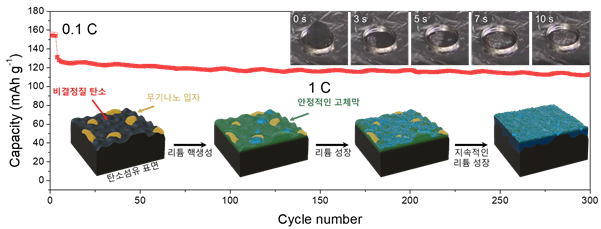
With the explosive increase in demand for secondary batteries due to the spread of electric vehicles, the need for next-generation secondary batteries with larger capacity and fast charging capabilities than the currently most widely used lithium-ion batteries is growing. Among them, lithium metal batteries, which replace graphite, the anode material of lithium-ion batteries, with lithium metal, can theoretically achieve a capacity 10 times higher than lithium-ion batteries. However, during charging and discharging, dendritic lithium crystals form on the lithium surface, causing the separator to tear, resulting in durability and safety issues that have prevented commercialization.
The research team replaced the copper thin film coated with lithium metal, which is used as the anode material of lithium metal batteries, with a thin carbon fiber paper containing lithium metal. The developed carbon fiber paper was surface-treated with inorganic nanoparticles of amorphous carbon and sodium carbonate on carbon single fibers to have lithium-friendly properties while preventing sharp growth of lithium dendrites.
As a result of using the carbon fiber paper anode material developed by the research team, lithium metal batteries with durability more than three times higher than copper thin films could be manufactured. While copper thin films experienced short circuits after about 100 charge-discharge cycles, the newly developed carbon fiber paper showed stable performance even after more than 300 cycles. Additionally, the energy density of lithium metal batteries using copper thin films increased from 240 Wh/kg to 428 Wh/kg, about 1.8 times. Furthermore, since molten lithium is rapidly absorbed into the carbon fiber paper, it is expected that the electrode manufacturing process can be simplified.
Seongho Lee, director of the KIST center leading the research, stated, “Considering that the density of carbon fiber is five times lower than copper and its cost is cheaper, the anode material proposed by the research team is an important achievement that can accelerate the commercialization of durable and lightweight lithium metal batteries.”
The results of this study were published in the January issue of the international journal Advanced Energy Materials (IF=29.698, JCR top 2.464%).
© The Asia Business Daily(www.asiae.co.kr). All rights reserved.
![Clutching a Stolen Dior Bag, Saying "I Hate Being Poor but Real"... The Grotesque Con of a "Human Knockoff" [Slate]](https://cwcontent.asiae.co.kr/asiaresize/183/2026021902243444107_1771435474.jpg)
















