Household Loan Interest Rate at 5.47%... Declines for the First Time in 20 Months
Loan-to-Deposit Interest Rate Spread Widens Again to 1.63 Percentage Points

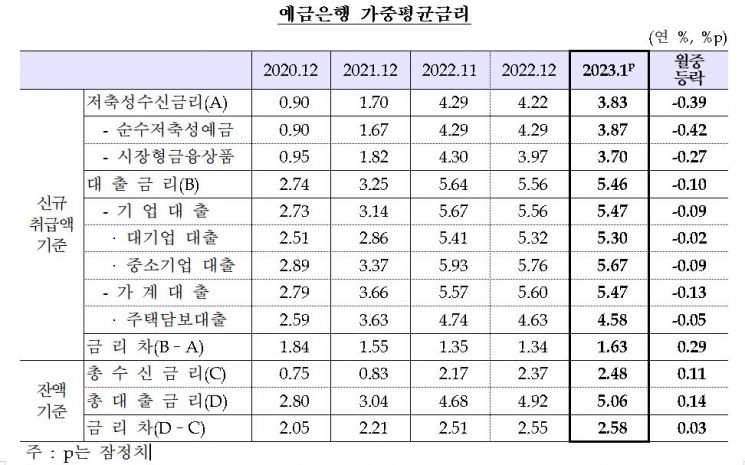
As competition among banks eased, interest rates on savings deposits such as time deposits fell to the 3% range last month. Loan interest rates also showed a downward trend due to factors such as household loan rates turning downward for the first time in 20 months. However, since the decline in deposit interest rates (-0.39 percentage points) was larger than the decline in loan interest rates (-0.10 percentage points), the interest rate spread between deposits and loans widened again after one month.
According to the 'Weighted Average Interest Rates of Financial Institutions' statistics released by the Bank of Korea on the 28th, the household loan interest rate (weighted average, based on new contracts) of deposit banks in January this year was 3.83% per annum, down 0.39 percentage points from the previous month. Pure savings deposits fell by 0.42 percentage points to 3.87%, mainly due to time deposits (-0.42 percentage points), while market-type financial products fell by 0.27 percentage points to 3.70%, mainly due to financial bonds (-0.50 percentage points).
In the case of loan interest rates, they recorded 5.46%, down 0.10 percentage points from the previous month due to the decline in benchmark interest rates. Household loans fell by 0.13 percentage points to 5.47%, mainly due to general unsecured loans (-0.76 percentage points) and mortgage loans (-0.05 percentage points). This is the first time in 20 months that household loans have declined. Corporate loans fell by 0.09 percentage points to 5.47%, with large corporations down 0.02 percentage points and small and medium-sized enterprises down 0.09 percentage points.
The interest rate spread between deposits and loans widened again to 1.63 percentage points after one month. This was because the decline in deposit interest rates was larger than the decline in loan interest rates. Park Chang-hyun, head of the Bank of Korea's Financial Statistics Team, explained, "In the deposit sector, the proportion of short-term products with relatively low interest rates increased, while in the loan sector, the proportion of short-term products under one year with low interest rates decreased. Also, the proportion of unsecured loans, which have relatively higher interest rates compared to other loans, increased in household loans. As a result, the decline in loan interest rates was smaller than the decline in deposit interest rates."
The proportion of fixed-rate household loans rose by 4 percentage points from the previous month to 47.2%, the highest level since January 2020, when it was 50.2%. The Bank of Korea explained this as "due to the decline in fixed-rate loan interest rates and the expansion of safe conversion loans."
In the case of non-bank financial institutions, deposit interest rates fell across all financial institutions compared to the previous month, while loan interest rates rose. Deposit interest rates fell in the order of savings banks (-0.50 percentage points), Saemaeul Geumgo (-0.21 percentage points), credit unions (-0.17 percentage points), and mutual finance (-0.17 percentage points), while loan interest rates rose in the order of Saemaeul Geumgo (0.18 percentage points), credit unions (0.16 percentage points), savings banks (0.10 percentage points), and mutual finance (0.02 percentage points).
© The Asia Business Daily(www.asiae.co.kr). All rights reserved.
![Clutching a Stolen Dior Bag, Saying "I Hate Being Poor but Real"... The Grotesque Con of a "Human Knockoff" [Slate]](https://cwcontent.asiae.co.kr/asiaresize/183/2026021902243444107_1771435474.jpg)

















