Announcement of Civil Advisory Group Activities on Tongbok Tunnel Accident
"Preliminary Review of Defect Repairs and Collaboration with Related Agencies Are Important"
Poor Construction by Contractor and Supervisor... KORAIL's Supervisory Responsibility
During the defect repair work (cross-section repair) on the upper part of the Tongbok Tunnel, the carbon fiber sheet (nonwoven fabric) attached to the ceiling fell off, causing a power outage in the overhead contact line and vehicle malfunction. Carbon fiber, a conductor, is an inappropriate construction material, but Korea Railroad Corporation (KORAIL) approved the construction without reviewing the technical aspects beforehand. Accordingly, the Ministry of Land, Infrastructure and Transport (MOLIT) is considering imposing penalty points on the construction and supervision companies for poor workmanship and fines on KORAIL.
On the 28th, MOLIT announced the analysis results of the accident causes and improvement measures to prevent recurrence, as reported by the Special Committee of the Private Advisory Group (hereinafter referred to as the Advisory Committee) formed to respond to the Tongbok Tunnel accident.
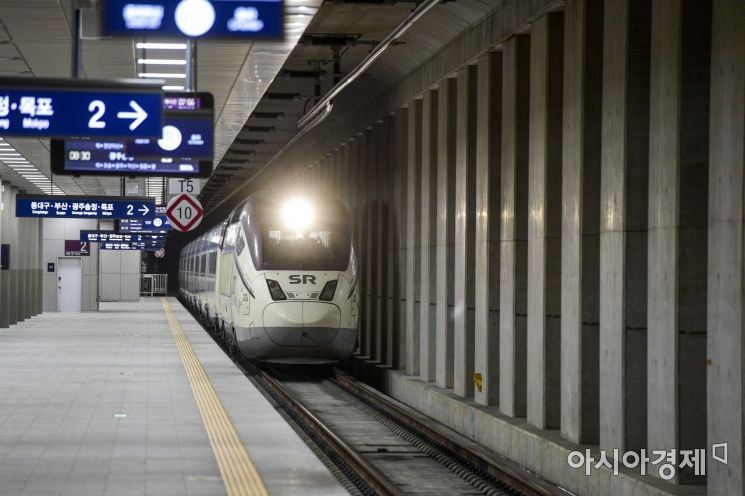
The Tongbok Tunnel accident occurred on December 30 last year at 5:03 p.m. in the section between Jije Station and Namsan Junction on the Suseo-Pyeongtaek High-Speed Line. The power outage in the overhead contact line and vehicle malfunction caused damage including 20m of catenary wire and 160m of feeder wire being burned, damage to 27 SRT trains, and delays of 167 high-speed train sets.
To objectively analyze the cause of the accident, MOLIT activated the Advisory Committee from the 5th of last month. The Advisory Committee consisted of 15 experts in four railway safety-related fields (operation, vehicles, electricity, and facilities), and conducted on-site inspections and specialized review meetings by field.
As a result, the Advisory Committee pointed out that the nonwoven fabric detached due to violation of construction methods and poor quality. It was investigated that a summer-use adhesive (resin) was used, and construction was carried out on-site at 2 to 3 degrees Celsius, although construction is prohibited below 5 degrees Celsius.
Additionally, although 9 to 15 hours should pass between primer application and nonwoven fabric attachment, the fabric was attached within just one hour, and the procedure of using a rubber spatula during the process was omitted, the Advisory Committee revealed. They also noted that no measures were taken to prevent falling debris considering the overhead contact line, nor was there a review of whether the product material was non-conductive.
The Advisory Committee stated, "The construction and supervision companies failed to consider that carbon fiber, a conductor, is an inappropriate construction material above the overhead contact line because its detachment could cause a serious overhead contact line failure," and added, "KORAIL's management was inadequate as it approved the construction despite the absence of carbon fiber construction methods and specification standards in the submitted documents for commencement."
Ultimately, the detached nonwoven fabric contacted the overhead contact line, causing a fire that generated conductive dust, which then spread inside the tunnel due to the wind pressure generated by train operation. This dust entered the vehicle's internal electrical equipment, causing malfunctions such as sparks (insulation breakdown), according to the analysis.
Accordingly, the Advisory Committee proposed banning the use of conductive fibers in overhead contact line tunnel sections. For KORAIL, it recommended establishing a prior review process including expert consultation on defect repair plans at the design and planning stages, and specifying the submission of documents such as construction methods and safety management plans. It also emphasized the need for design safety reviews even for small-scale improvement works.
It was also suggested to thoroughly verify whether the impact on operating lines and safety were properly reviewed during the track work plan consultation and approval one month before construction, and to subdivide inspection items by work type during the construction phase.
Furthermore, the Advisory Committee stressed cooperation among related organizations to ensure proper defect repair. If the construction company's defect repair action plans are delayed, the Korea National Railway Corporation and KORAIL should actively respond and manage the situation together through a 'Defect Repair Committee.'
Additionally, it emphasized the need to install a blocking barrier in the 50mm space between the cover and heat sink to prevent conductive materials from entering the motor block inside the vehicle, and to install insulating partitions to prevent spark spread. In case of recurrence of similar situations such as conductive foreign substances (dust, etc.) inside the tunnel, it urged temporary suspension of vehicle operation and resumption only after removal of foreign substances.
MOLIT plans to actively reflect the measures proposed by the Advisory Committee and steadily implement the 'Railway Safety Enhancement Measures' announced last month.
Lee Min-gyu, chairman of the Advisory Committee, said, "The Tongbok Tunnel accident involved complex problems at multiple stages including construction, supervision, and management/oversight," and added, "To prevent such accidents from recurring, it is necessary for MOLIT, KORAIL, the Korea National Railway Corporation, and related organizations to actively collaborate."
© The Asia Business Daily(www.asiae.co.kr). All rights reserved.

















