Announcement of Conclusions at the 2nd Day of the Labor Party Plenary Meeting
"Agricultural Production Transformation Must Be Achieved Within the Next Few Years"
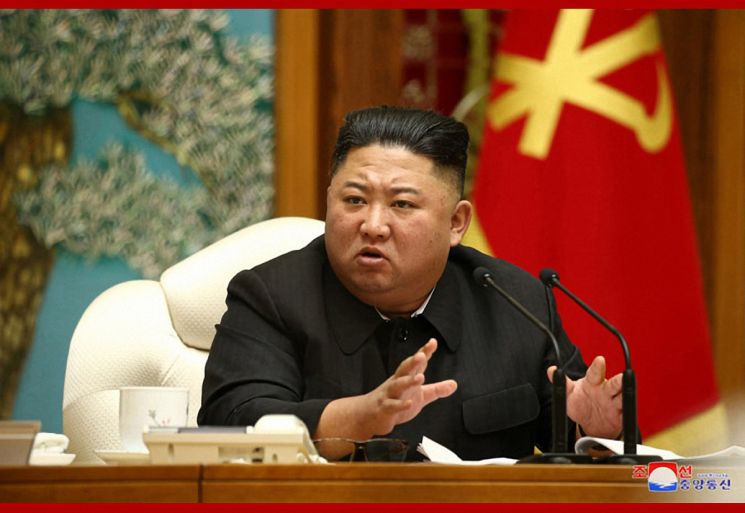
Kim Jong Un, Chairman of the State Affairs Commission, emphasized the need to "bring about a fundamental transformation in agricultural production to achieve the grain production target," according to a report by the Korean Central News Agency (KCNA) on the 28th. This was during an unusually convened plenary meeting held within a short period to find ways to resolve the severe food shortage in North Korea.
According to the report, Chairman Kim stated during the "conclusion on the first agenda item" on the second day of the expanded meeting of the 7th plenary session of the 8th Central Committee of the Workers' Party held the previous day, "As long as there is a strong leadership system in the entire party and the united strength of the entire people, there is nothing we cannot accomplish."
Chairman Kim expressed his determination to bring about a revolutionary change in agricultural production, saying, "Within the next few years, a fundamental transformation in agricultural production must be achieved."
The meeting discussed the second agenda item, "Establishing strict discipline in the implementation of the people's economic plan," and the third agenda item, "Current issues in improving the state's financial and fiscal affairs," KCNA reported. This is interpreted as an effort to address various problems such as corruption and inefficiency that have appeared in the recent implementation of North Korea's economic policies, and to seek improvement measures in the financial sector, which is closely related to the national economy.
KCNA evaluated, "The plenary meeting, which sets development guidelines and bold practical measures to firmly uphold the self-reliant national economy and the socialist economy, which are the material foundation and lifeline of the state's existence, and to continuously increase its own strength, is raising the absolute consensus and positive enthusiasm of the participants." It also stated, "The plenary meeting decided to discuss, amend, and supplement the draft resolutions on the agenda items in subcommittees and consultation meetings before final deliberation and adoption."
Accordingly, it is expected that the adoption of the resolution will take place during the "final deliberation" scheduled for the same day.
The plenary meeting opened on the 26th at the headquarters building of the Party Central Committee. On the first day, the agenda items were approved, and a report was heard on last year's work to realize the "New Era Rural Revolution Program."
However, North Korea's food shortage is expected to be difficult to improve in the near term. North Korea has been suffering from a food crisis comparable to the "Arduous March" period due to a combination of last spring's drought, summer floods, and the impact of COVID-19. Even considering only the production volume of food crops, it decreased by 180,000 tons compared to the previous year. Reports indicate that starvation deaths are occurring not only in outlying areas but also in Kaesong, considered a "wealthy area."
Ultimately, North Korea reconvened the Party plenary meeting just two months after the end of last year. Considering that it is usually held once or twice a year, this is an unusual decision, indicating the North Korean authorities' urgency regarding food and livelihood issues. It is expected that through this plenary meeting, North Korea will attempt to address problems that arose during the implementation of last year's primary policy task of "grain production."
The Ministry of Unification believes that the "control"-centered grain policy exacerbated the situation during the worsening of North Korea's food conditions. Since the end of last year, North Korea has shown a trend of strengthening government control over food and strictly prohibited grain transactions between individuals. Although this was a measure aimed at realizing a more realistic purchase price, it is observed that it ultimately caused a contraction in transactions and problems in the distribution process.
© The Asia Business Daily(www.asiae.co.kr). All rights reserved.

















