2021 Tea Production Volume Up 12.7% Year-on-Year
Tendency of MZ Generation to Enjoy Premium Tea Culture
The tea market, represented by tea bags and fruit syrups, has been growing amid the COVID-19 pandemic. As outings decreased and time spent indoors increased, the population seeking to enjoy time alone has grown. In particular, among some MZ generation (Millennials + Generation Z), there is an active consumption trend such as visiting tea specialty stores and receiving recommendations for premium tea bags from tea sommeliers.
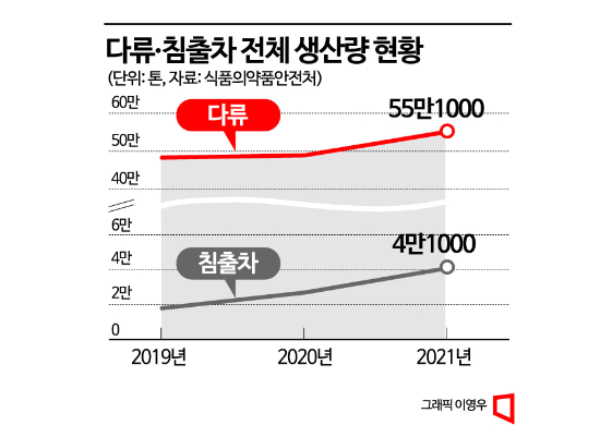
According to the Korea Agro-Fisheries & Food Trade Corporation on the 28th, the total tea production in 2021 was 551,000 tons, an increase of 12.7% compared to the previous year. The production volume in 2020 was 489,000 tons, which was a 1.2% increase compared to 2019 (483,000 tons). This means it has steadily increased for three consecutive years since 2019, when COVID-19 began in earnest.
In particular, the increase in infusion tea among all tea types was remarkable. The production volume of infusion tea in 2021 was 41,012 tons, which increased by about 13,500 tons compared to 27,488 tons in 2020. Tea products are foods made by manufacturing and processing plant-based raw materials and are broadly divided into infusion tea, liquid tea, and solid tea. Infusion tea refers to foods made by steeping young shoots, leaves, flowers, stems, etc., of plants in water and drinking the resulting liquid. It is mainly distributed in flat tea bags such as green tea, black tea, and herbal tea.
The increase in production volume of infusion tea, which requires more time to enjoy compared to liquid and solid teas, is a global trend. This is interpreted as a reflection of consumer desire to enjoy tea during leisure time as the time spent indoors increased due to COVID-19.
The main consumption channels showed different patterns depending on generation and occupation. Office workers mainly purchased traditional teas (green tea, brown rice green tea, barley tea) in bulk at large supermarkets, while some MZ generation tended to consume premium tea by visiting tea specialty stores. Tea specialty stores refer to spaces where rapidly growing premium tea bag infusion teas and blended teas can be enjoyed with professional recommendations from tea sommeliers. Recently, these have been spreading mainly around Seoul Forest and Seochon, attracting the interest of young people.
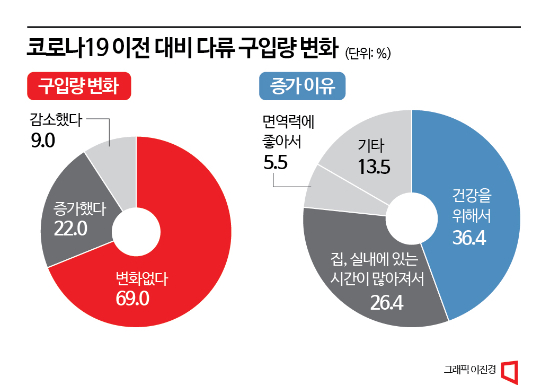
The ‘health trend’ that spread during the COVID-19 pandemic also contributed to the increase in tea consumption such as infusion tea. A survey conducted from November 18 to 23 last year targeting 500 adults in the metropolitan area and five major metropolitan cities who had purchased traditional tea or tea beverages within the past year showed that 22% answered that their tea purchase volume ‘increased’ compared to before COVID-19. 69% answered ‘no change,’ and 9% answered ‘decreased.’ The main reason for the increase was ‘for health’ (36.4%), followed by ‘spending more time at home or indoors’ (26.4%) and ‘good for immunity’ (5.5%).
An industry official said, "Recently, among the MZ generation, the demand to enjoy the relaxed atmosphere provided by tea specialty stores is growing, and interest in health is increasing, so tea culture is taking on a different form than before." He added, "The increasingly diversified and premium domestic tea culture is expected to satisfy not only consumers’ desires for psychological stability and healing but also their expectations to take care of physical health."
© The Asia Business Daily(www.asiae.co.kr). All rights reserved.
![Clutching a Stolen Dior Bag, Saying "I Hate Being Poor but Real"... The Grotesque Con of a "Human Knockoff" [Slate]](https://cwcontent.asiae.co.kr/asiaresize/183/2026021902243444107_1771435474.jpg)

















