Expected KOSPI Index 2260~2600
Focus on China's Two Sessions... Will Economic Growth Rate Exceed 5%?
China Reopening, Recommended Sectors: Secondary Batteries, Renewable Energy, Machinery, Steel
The securities industry expects the KOSPI in March to seek a rebound but remain within a trading range. In particular, it is anticipated that the lower bound will be supported around the early-year closing level (2225.67). There is a forecast that a sharp decline will not occur. Although the shock from U.S. employment and consumption indicators has dampened expectations for a 'pivot' (a shift from interest rate hikes to cuts), the fact that the tightening cycle is entering its later stages is cited as the basis for support at the lower bound. Additionally, with growing reopening (resumption of economic activities) expectations around China's Two Sessions (National People's Congress and Chinese People's Political Consultative Conference) in March, there is also a possibility of breaking out of the trading range.
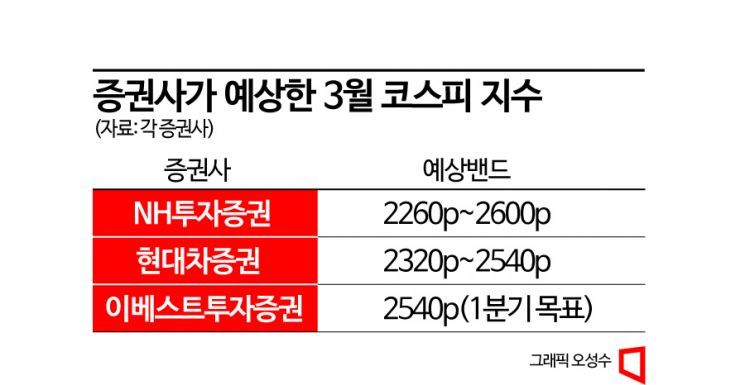
According to the securities industry, NH Investment & Securities projected the KOSPI range for March at 2260?2600 points. Hyundai Motor Securities forecasted 2320?2540 points. Ebest Investment & Securities set a first-quarter target of 2540 points.
The KOSPI rose 8.8% from 2225.67 on January 2 to 2423.61 on the 24th. The yearly high was 2497.40 on the 27th of last month. On that day, it recorded the yearly high (2484.02) based on the closing price. After the January rally, the KOSPI has struggled to surpass the 2500 level and has shown signs of hesitation since February.
Fading Expectations for Fed's Pivot
The reason the securities industry expects the trading range to continue in March is that expectations for a Fed pivot have diminished. U.S. economic indicators for January, including employment, inflation, and consumption, came out higher than expected, leading to a prevailing view that the Fed will maintain its tightening stance. However, despite heightened inflation concerns, the consensus is that the KOSPI will hold its lower bound.
Namjoong Moon, a researcher at Daishin Securities, evaluated, "After the release of the U.S. January employment data, the market took a three-week pause due to concerns about monetary policy, but the narrowing gap between the Fed and the market regarding monetary policy is a positive factor."
Previously, the market expected the Fed to pause rate hikes starting in March, but now forecasts have been revised to anticipate increases continuing until May. While the Fed has indicated a terminal rate of 5.50%, the market expects 5.25%. The Fed has expressed that rate cuts are unlikely this year, whereas the market sees a significant possibility of cuts in December.
Jaeseon Lee, a researcher at Hyundai Motor Securities, stated, "Most Fed officials still support a 25 basis point hike rather than 50 basis points at the March Federal Open Market Committee (FOMC) meeting," adding, "Expectations for a global economic soft landing are supporting the stock market's lower bound." He further analyzed, "Once downward revisions to earnings estimates conclude, support around the 2400 level, which corresponds to a WNRK (PBR) of 1, will be possible."
Expectations for China's reopening are cited as grounds for both supporting the KOSPI's lower bound and breaking out of the trading range. The market is focusing on China's Two Sessions scheduled for March 4. Since China, which had insisted on a 'zero COVID' policy, has shifted to a 'with COVID' policy, there is speculation that it may set an economic growth target exceeding 5% this time.
Researcher Jaeseon Lee explained, "Expectations for the resumption of economic activities in China, the largest customer driving the recovery of intermediate goods exporting countries, could emerge strongly around the March Two Sessions," adding, "The downward revisions to earnings in the Korean and Taiwanese stock markets have been gradually narrowing since the end of February."
According to the Korea International Trade Association, Korea is expected to benefit from a 0.16% increase in GDP due to China's 'with COVID' policy. This is the fourth highest after Taiwan (0.26%p), Vietnam (0.21%p), and Singapore (0.21%p). Although Korea's export share to China has decreased compared to 2021, it remains the highest at 22.8%. Due to high dependence on China, expectations for benefits from China's reopening are significant.
As expectations for China's reopening grow, there is analysis that corporate earnings have also approached the bottom. This is because earnings estimates have sharply declined last year, especially in countries with a large share of intermediate goods exports such as Korea and Taiwan.
NH Investment & Securities, which proposed the lowest KOSPI band, cited the proximity of earnings bottoms for U.S. and Korean companies as a key basis for support at the lower bound. Byungyeon Kim, head of the Investment Strategy Department at NH Investment & Securities Research Division, pointed out, "The Q4 earnings shock and recent deterioration in business conditions have been quickly reflected in earnings forecasts," adding, "Earnings estimates for the semiconductor sector are historically low." He further explained, "Considering recent trends in exchange rates and oil prices, the possibility of a turnaround in Korean exports, a rebound in Korea's inventory cycle index, and a narrowing of the export-import price spread inversion, a turnaround in Korean corporate earnings is imminent." Taking this into account, he added that the KOSPI's bottom could rise to the 2300 level, increasing the possibility of breaking out of the trading range.
"Turnaround in Korean Corporate Earnings Imminent"
NH Investment & Securities recommends focusing on beneficiaries of Chinese and U.S. policies in March. Representative sectors include materials expected to deplete inventories, consumer goods with strong localization strategies in China, and renewable energy sectors benefiting from the U.S. Inflation Reduction Act (IRA).
Researcher Jaeun Kim of NH Investment & Securities stated, "Recommended stocks include Samsung Electronics, SK Hynix, KNJ, Kakao, Celltrion, Korea Zinc, F&F, Cosmax, Kolmar BNH, Doosan Enerbility, Hanwha Solutions, and CS Wind," adding, "According to AI model predictions, the recommended sectors for March are Chinese reopening, secondary batteries and renewables, machinery, and steel."
© The Asia Business Daily(www.asiae.co.kr). All rights reserved.
![User Who Sold Erroneously Deposited Bitcoins to Repay Debt and Fund Entertainment... What Did the Supreme Court Decide in 2021? [Legal Issue Check]](https://cwcontent.asiae.co.kr/asiaresize/183/2026020910431234020_1770601391.png)
















