Strengthening the Public Support System
Proactive Introduction of Tailored Support Policies
On February 26, the Seoul Metropolitan Government announced plans to establish a more robust public support system to address the practical challenges faced by single-person households living alone.
Single-person households now account for 36.8% (1.49 million households) of all households in Seoul (4.05 million households). As this proportion has been increasing at an accelerating rate over the past three years (33.4% in 2019 → 34.9% in 2020 → 36.8% in 2021), the city plans to proactively introduce tailored support policies for single-person households.
To this end, Seoul will pursue customized policies that address the so-called “three insecurities” faced by single-person households: inconvenience (in daily life), anxiety (about safety), and dissatisfaction (with social networks). The city aims to respond to policy demands according to generation, personal preferences, and region.
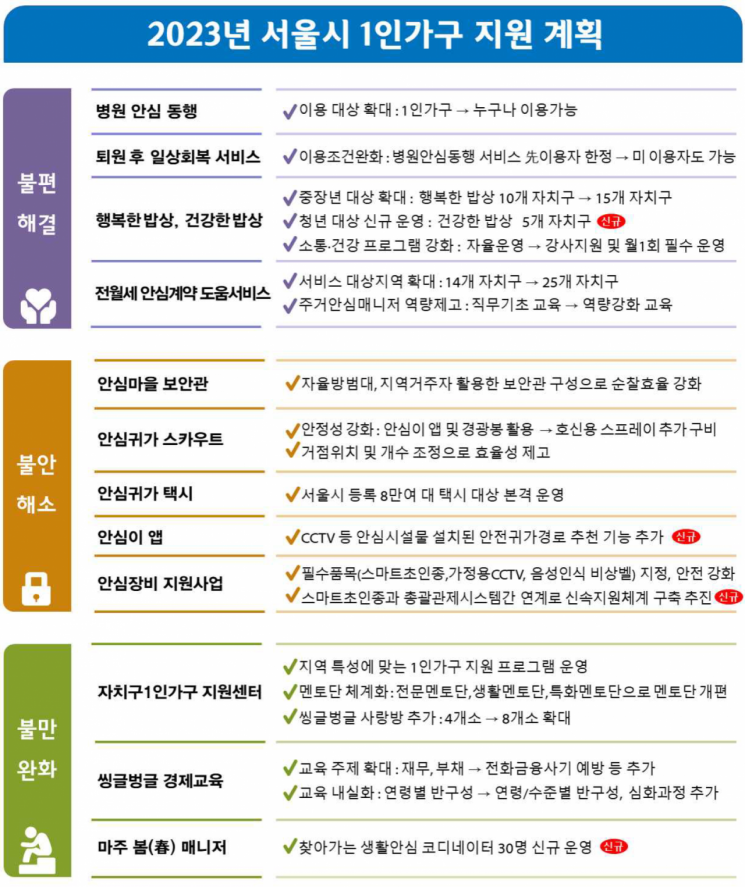
First, to alleviate the daily “inconveniences” of single-person households, Seoul will strengthen its living support services. The highly popular “Safe Companion to Hospital” service, which has a satisfaction rate of 93.9%, will be upgraded to provide support from hospital discharge through to full recovery. The “Safe Jeonse and Monthly Rent Contract Assistance Service,” designed for single-person households such as young adults starting their careers and seniors who have difficulties with real estate contracts, will be expanded to all 25 districts. The “Happy Table” social dining program, which has achieved a high satisfaction rate of 92.2%, will be extended from middle-aged participants to include young single-person households as well.
The city will also further strengthen its safety net to address the “anxiety” of single-person households. The “Ansim-i” app, currently used by 130,000 people, will introduce a new service in the second half of the year that recommends and provides routes equipped with safety facilities such as CCTV. The “Safe Neighborhood Security Guard” program, which has established itself as a trusted nighttime safety presence in local neighborhoods with a satisfaction rate of 92.3%, will collaborate with local voluntary security teams to more thoroughly address security blind spots.
To help alleviate “dissatisfaction” by supporting the social networks of single-person households who may be vulnerable to loneliness, the city will provide comprehensive support. Starting in April, a new “Majubom Manager” program, composed of peers, will be launched to provide psychological and emotional support for middle-aged single-person households struggling to form social connections. The “Single-Bungle Sarangbang,” a multipurpose communication space for single-person households, will be expanded from four to eight locations. The “Single-Bungle Economic Education” program, which supports economic independence, will broaden its curriculum to include topics such as preventing telephone financial scams.
The Seoul Metropolitan Government stated that it will further strengthen its single-person household policies to build “Seoul, the Special City of Safety for Single-Person Households.” This year, the city will invest 14.6 billion won in these three areas.
Kim Sunsoon, Director of the Women and Family Policy Office of the Seoul Metropolitan Government, said, “As we enter an era where one in three households is a single-person household, we will enhance and implement policies to resolve the inconveniences and anxieties experienced by those living alone and improve their quality of life, making Seoul a reliable friend and a special city of safety for single-person households.”
© The Asia Business Daily(www.asiae.co.kr). All rights reserved.
![Clutching a Stolen Dior Bag, Saying "I Hate Being Poor but Real"... The Grotesque Con of a "Human Knockoff" [Slate]](https://cwcontent.asiae.co.kr/asiaresize/183/2026021902243444107_1771435474.jpg)
















