[Naju=Asia Economy Honam Reporting Headquarters Reporter Kim Yuk-bong] Naju City, Jeollanam-do, will hold the ‘104th Anniversary of the March 1st Movement Commemoration Ceremony’ on the outdoor plaza of the Naju Student Independence Movement Memorial Hall at 10 a.m. on the 1st of next month, inviting local veterans organizations, independence activists, and their families.
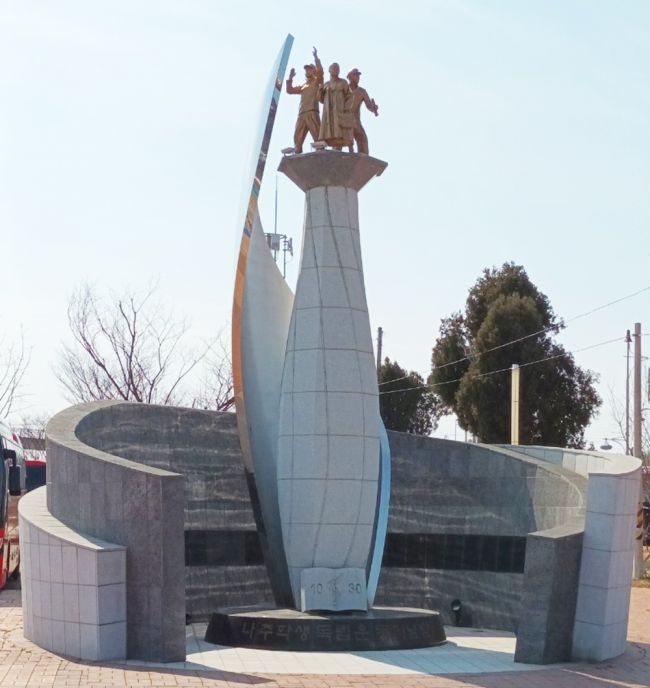
According to the city on the 23rd, the ceremony will proceed in the order of paying respects at the Student Independence Movement Memorial Tower before the ceremony, opening and national ceremony, reading of the Declaration of Independence, commemorative speech, commemorative performance, and three cheers for independence.
The Declaration of Independence is a lengthy declaration written during the March 1st Movement in 1919 to announce Korea’s (Joseon’s) independence to the world, and was jointly announced under the names of 33 national representatives.
At the ceremony, Yu Kyung-sik, a representative of the Liberation Association, is scheduled to read it aloud.
The commemorative performances will be held by the Naju Municipal Gugak Orchestra and the Municipal Art Troupe, who will honor the patriotic spirit of the ancestors through the singing of ‘The Country We Want’ and the ‘March 1st Movement Song,’ respectively.
The three cheers for independence, which will resonate in the sky of patriotic Naju, will be led by Park Hyung-geun, a descendant of independence activist Park Jun-chae (1914?2001).
Independence activist Park Jun-chae was a key figure in the Korean-Japanese student clash at Naju Station on October 30, which triggered the student independence movement on November 3, 1929.
When his cousin Park Ki-ok was harassed by a Japanese student, a clash between Korean and Japanese students, including Park Jun-chae, broke out in response. This led to the student independence movement on November 3.
At the Naju Student Independence Movement Memorial Hall plaza, the site of the ceremony, a memorial tower symbolizing the spirit and remembrance of the student independence movement was built in 2019. At the top of the tower stands statues of three Korean students who triggered the Naju Student Independence Movement.
Mayor Yoon Byung-tae said, “The Naju Student Independence Movement holds great historical significance in the history of Korean independence as it was a resistance by students against Japanese colonial rule and colonial education. Through the 104th March 1st Movement Commemoration Ceremony, we will reflect on the spirit of the patriotic people of Naju, the starting point of the student independence movement, honor local independence activists and their families, and continue to inherit and develop the independence spirit of our ancestors.”
Meanwhile, the first independence movement in the Naju area related to the March 1st Movement was sparked on March 15 in the town, where hundreds of people, including Choi Ki-jung, held a “Manse” (long live independence) demonstration.
At that time, Choi Ki-jung, a seodang (private school) headmaster, made about 50 Taegeukgi flags and had students distribute them to market merchants. He led the procession shouting “Long live Korean independence” loudly but was arrested by Japanese military police and served three years in prison, according to records.
Naju=Asia Economy Honam Reporting Headquarters Reporter Kim Yuk-bong baekok@asiae.co.kr
© The Asia Business Daily(www.asiae.co.kr). All rights reserved.
![Clutching a Stolen Dior Bag, Saying "I Hate Being Poor but Real"... The Grotesque Con of a "Human Knockoff" [Slate]](https://cwcontent.asiae.co.kr/asiaresize/183/2026021902243444107_1771435474.jpg)











