[Asia Economy Sejong=Reporter Dongwoo Lee] The government has set an export target of a total of $685 billion this year and is mobilizing the capabilities of all ministries to achieve it. To this end, it will invest 1.5 trillion won in export support budgets and strengthen support for export companies by supplying a record-high trade finance of 360 trillion won.
On the 23rd, the Ministry of Trade, Industry and Energy announced this cross-government export expansion strategy aimed at turning exports positive in 2023 at the '4th Export Strategy Meeting' presided over by President Yoon Seok-yeol. It is planned to be the first year of implementing the president’s emphasized 'all ministries industrialization,' with all ministries pooling their support capabilities to overcome the export crisis.
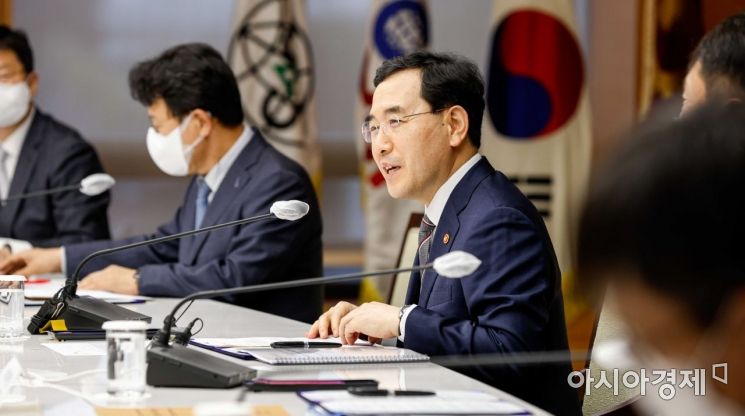 Minister Lee Chang-yang of the Ministry of Trade, Industry and Energy is delivering a keynote speech at the "Ministry of Industry and Financial Supervisory Service Jointly Hosted Business Restructuring-Banking Sector Linked Strategy Meeting and Business Agreement Ceremony" held on the 6th at the Korea Chamber of Commerce and Industry in Jung-gu, Seoul. Photo by Kang Jin-hyung aymsdream@
Export Target of 533 Billion Won for Key Industries such as Semiconductors and Electric Vehicles
First, in the 15 major manufacturing sectors, the goal is to achieve a total export performance of 533 billion won through key industries such as secondary batteries, electric vehicles, and semiconductors. Support for research and development (R&D) will be provided for secondary batteries to enter new markets worth 1 trillion won by 2030, and technology development and demonstration projects will be promoted to secure the three core performances (driving range, energy efficiency, charging speed) of electric vehicles. Through this, an environment for entering new electric vehicle markets such as Vietnam and the Philippines will be created. Considering the recovery period of the high value-added shipbuilding industry, efforts will focus on resolving labor shortages and financial difficulties. Large shipbuilding companies will be supported with up to 95% of the amount exceeding the limit, and small and medium-sized enterprises will be supported with 120 billion won in export ship financing, respectively.
For semiconductors, a key manufacturing industry, the investment tax credit will be increased, and 150,000 specialized personnel will be trained for system semiconductors and semiconductor post-processing technology development. In particular, 50 billion won each will be specially supported this year for infrastructure in semiconductor specialized complexes such as Pyeongtaek and Yongin. By 2029, 1 trillion won will be invested in next-generation intelligent semiconductors, and by 2028, 402.7 billion won will be invested in developing core artificial intelligence (AI) semiconductor technologies. In the petrochemical sector, 185.8 billion won will be invested from this year through 2030 to support carbon-neutral R&D projects.
Display will also closely support private investment worth 10 trillion won through 90 billion won in policy finance. Additionally, 87.5 billion won will be invested this year to innovate R&D for three major convergent displays?transparent, automotive, wearable?and inorganic light-emitting displays. The steel industry will create a low-carbon fund of 150 billion won to support investment in eco-friendly technologies, while the general machinery sector will invest 120 billion won this year in R&D and workforce training to strengthen robot manufacturing capabilities. For service robot demonstration models, 60 billion won will be supported.
Export of 10 Nuclear Power Plants and Strengthening Defense Industry Order Capabilities
In order-winning strategic industries, efforts will be made to strengthen competitiveness in nuclear power, defense, and overseas construction. To expand nuclear power plant orders, customized strategies will be pursued for countries such as the Czech Republic and Poland, and regulatory easing such as simplifying export procedures for the overseas export model APR1000 will be promoted. To boost defense exports, the number of defense leading trade offices will be expanded from 20 to 31. The government plans to operate an Overseas Construction Order Support Group in the overseas construction and plant sectors to strengthen order-winning capabilities.
For new promising export industries, such as agricultural products, logistics costs will be reduced by establishing a specialized export logistics system, and online Korean food sections in major countries’ shopping malls will be expanded. Strategic export items such as seaweed and tuna will be fostered, and the growth ladder voucher support will be used to transform domestic companies into export companies. In particular, 114 companies will be supported with up to 220 million won each to obtain international certifications, and overseas expansion will be assisted through a 20 billion won smart agriculture fund. In the digital industry, a full-cycle support system for the software sector will be established, and 9.9 billion won will be invested this year to support the development of 24 medical AI projects targeting 12 major diseases such as lung cancer and liver disease. Public-private R&D expansion will be promoted for pharmaceuticals (3.8 trillion won) and medical devices (1.6 trillion won), along with investment in the K-Bio vaccine fund (500 billion won).
Strengthening Cross-Ministry Collaborative Export Drive
The government will strengthen cross-ministry collaboration to achieve this year’s export target. First, all ministries will take the lead in expanding exports through summit economic diplomacy. The achievements of summit economic diplomacy in major markets such as the United Arab Emirates (UAE), Saudi Arabia, and Europe will be used as a stepping stone to link economic cooperation with export expansion. The Ministry of Economy and Finance, the Ministry of Trade, Industry and Energy, and the Public Procurement Service will focus on transforming domestic small and medium enterprises into export companies. Export-strong small and medium enterprises and startups with global competitiveness will be intensively nurtured, and export support functions of related organizations will be strengthened to expand overseas advancement of SMEs. The Ministry of Foreign Affairs and the Ministry of Land, Infrastructure and Transport will expand the collaborative system among overseas bases of export support organizations.
Capabilities to discover and promote inter-ministerial collaborative projects will also be enhanced. To effectively resolve difficulties faced by export companies, joint projects involving multiple ministries will be discovered, and cooperation will be carried out through cross-ministry export situation review meetings. Through the 'One-Stop Export and Order Support Group' launched last year, the government identified 335 export field difficulties and immediately resolved 68% (226 cases) of them. The Ministry of Trade, Industry and Energy stated, "We will implement export field visits and sector-specific export competitiveness enhancement measures in cooperation with each ministry through export situation review meetings and others."
© The Asia Business Daily(www.asiae.co.kr). All rights reserved.
![Clutching a Stolen Dior Bag, Saying "I Hate Being Poor but Real"... The Grotesque Con of a "Human Knockoff" [Slate]](https://cwcontent.asiae.co.kr/asiaresize/183/2026021902243444107_1771435474.jpg)
















