Investment Cost 10 Times Higher Than Taiwan... Growing Doubts About Efficiency
Challenges in Managing Partners and Workforce... US Support Is Crucial
[Asia Economy Reporter Jeong Hyunjin] Taiwan's TSMC, the world's largest foundry company, is building a semiconductor factory worth $40 billion (about 52 trillion won) in Arizona, USA. However, it is reported that internal doubts are emerging about whether this is an appropriate investment due to high costs and various difficulties in workforce management.
Despite these concerns, U.S. state governments, centered around Arizona where TSMC has established its base, are making every effort to attract semiconductor companies. The Biden administration is expected to announce detailed requirements for the Semiconductor Support Act later this week.
◆ Two Issues Troubling TSMC: "U.S. Investment Doesn't Make Sense"
On the 22nd (local time), The New York Times (NYT) reported, citing about 10 TSMC employees, that doubts about the U.S. factory are growing internally. The reason TSMC decided to invest in the U.S. was to find a solution amid the U.S.-China conflict over semiconductor supremacy, but this decision is said to be causing new problems.
According to the report, the first issue mentioned by employees is the enormous cost of building the semiconductor factory in the U.S. TSMC officially announced during last month's earnings report that the construction cost of the U.S. factory could be at least four times higher than building in Taiwan due to labor costs, inflation, and other factors. TSMC stated that while this investment may impact profitability this year, it still expects long-term benefits.
Due to the nature of the semiconductor industry, suppliers providing raw materials, equipment, and parts are necessary, and they are also forced to bear high costs. Calvin Su, president of Chang Chun Arizona, a petrochemical company building a $300 million factory near Phoenix, said that due to material supply shortages and preparation for U.S. government approval procedures, investment costs were ten times higher than in Taiwan. Taiwanese engineering firm CTCI also said that the construction costs of the Arizona factory exceeded expectations.
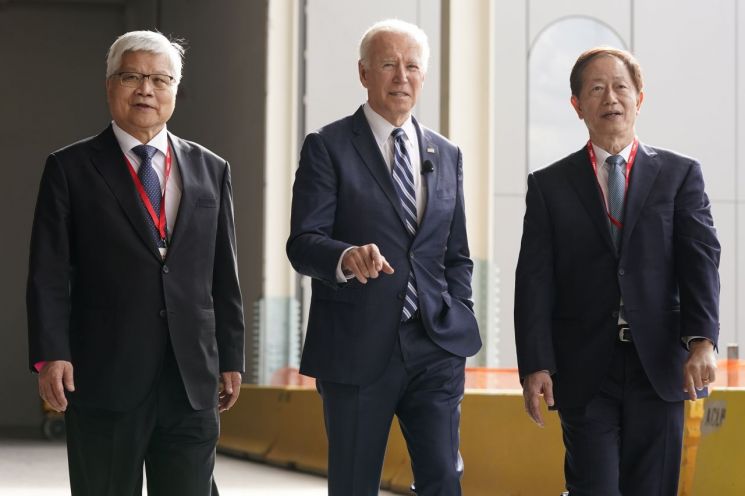 U.S. President Joe Biden (center), TSMC Chairman Mark Liu (right), and TSMC CEO C.C. Wei [Image source=Yonhap News]
Kirk Yang, chairman of private equity firm Kirkland Capital, said, "From a business perspective, TSMC's U.S. investment doesn't make sense," adding, "So far, the Phoenix project (TSMC's Arizona investment) has brought little benefit to TSMC or Taiwan."
Workforce management issues arising from cultural differences between the U.S. and Taiwan are also pointed out. From TSMC's perspective, which has mainly operated in Taiwan where long working hours and weekend shifts are common, managing American employees who strongly resist such practices is not easy.
TSMC employees who trained American engineers said that when performing tasks, Taiwanese employees follow the work methods without complaint once decided, but American employees often raise issues, suggesting better ways. A TSMC engineer in Arizona conveyed that when multiple tasks pile up, American employees refuse to take on new tasks, whereas Taiwanese employees put in extra time and effort to complete all tasks.
Wayne Chu, an engineer who left TSMC last year, told NYT, "The most difficult problem will not be technology. It will be workforce management."
◆ Arizona, Which Caught TSMC and Intel, Is 'Busy'... Semiconductor Support Act Details to Be Released
TSMC announced its investment plan in Arizona, USA, in May 2020. The U.S. and China clashed in the semiconductor supremacy war ignited by the COVID-19 pandemic, and the Biden administration introduced a large-scale semiconductor support policy. Initially, TSMC planned to invest $12 billion but declared in December of the same year that it would expand the investment to $40 billion. The planned factory operation start date is 2024. TSMC also revealed plans to add factories on nearby sites.
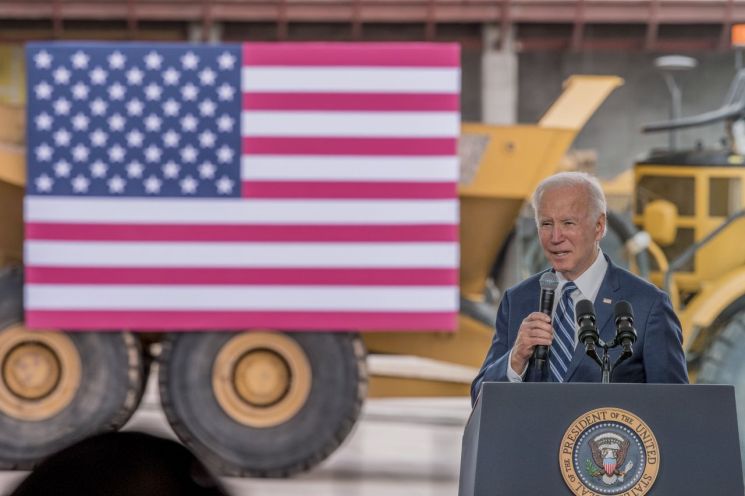
Arizona, chosen by TSMC as the site, is rapidly emerging as a semiconductor hub in the U.S. Not only TSMC but also Intel, a leading U.S. semiconductor company, is currently building factories there. The Arizona state government, local federal lawmakers, and universities are all working hard to build semiconductor industry infrastructure within Arizona. Additionally, as the Biden administration is expected to soon provide subsidies under the Semiconductor Support Act, efforts are underway to secure these funds.
NYT reported that Gina Raimondo, U.S. Secretary of Commerce overseeing semiconductor policy in the Biden administration, has recently held semiconductor-related meetings with Senator Mark Kelly (Arizona) and Arizona State University (ASU) over the past few weeks and appeared at a conference with the city of Phoenix. An Arizona state government official said they are exploring ways to receive subsidies under the Semiconductor Support Act promoted by the Biden administration and are continuing meetings with semiconductor companies such as Intel and TSMC.
Sandra Watson, director of the Arizona Commerce Authority, recently invited executives from about 20 semiconductor companies to the Super Bowl, the largest sports event in the U.S., held by the National Football League (NFL).
The Biden administration will soon fully launch the Semiconductor Support Act program worth a total of $53 billion. According to The Wall Street Journal (WSJ), Secretary Raimondo is scheduled to unveil detailed requirements, including specific subsidy payment plans for the Semiconductor Support Act, on the 23rd. Next week, companies will be provided with detailed guidance on how to apply for the funding.
© The Asia Business Daily(www.asiae.co.kr). All rights reserved.



















