[Asia Economy Reporter Choi Seok-jin, Legal Affairs Specialist] The Supreme Court has upheld the conviction of a man for rape resulting in death after he forcibly tried to drag a woman he had been drinking with into a motel, causing her to fall down the stairs and die.
The man claimed that he only intended to have consensual sex with the victim and had no intent to rape, and even if he had such intent, he could not have foreseen that the victim might die while trying to escape. However, these claims were rejected.
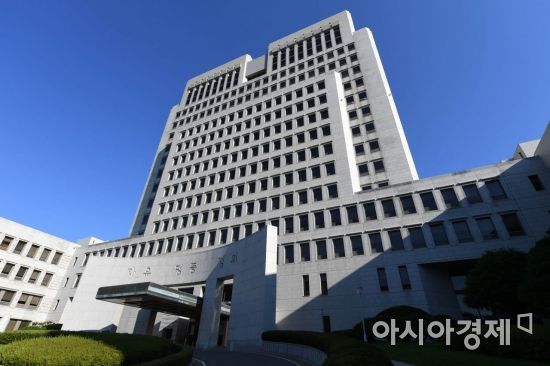
The Supreme Court's 3rd Division (Presiding Justice Oh Seok-jun) on the 23rd affirmed the lower court's ruling that found Mr. A, a man in his 40s charged with rape resulting in death, confinement resulting in death, and quasi-forcible molestation, guilty on all counts and sentenced him to five years in prison. The order to complete 40 hours of sexual violence treatment and a five-year employment ban at institutions related to children, adolescents, and persons with disabilities were also upheld as originally decided.
The court stated, "There is no error in the lower court's judgment that found the charges in this case guilty, nor was there a failure to conduct necessary hearings, nor a violation of the rules of logic and experience, nor a misunderstanding of the legal principles regarding the establishment of rape resulting in death, confinement resulting in death, and quasi-forcible molestation," thus rejecting the appeal.
Mr. A was tried on charges of forcibly trying to take Ms. B (female, 50 at the time of death), a customer at the screen golf practice range he operated in Ulju-gun, Ulsan Metropolitan City, to a motel, and when Ms. B tried to escape, she fell down the motel stairs, lost consciousness, was molested (quasi-forcible molestation), and ultimately died (rape resulting in death and confinement resulting in death).
According to the prosecution, the two, who knew each other casually, drank together at Mr. A's golf practice range from 8:20 p.m. the day before the incident until after midnight, and went outside around 1:50 a.m. the next day.
Mr. A, intending to take Ms. B home, saw her intoxicated and put her in a taxi, taking her to a motel district in Nam-gu, Ulsan. When Ms. B resisted entering the motel, Mr. A forcibly dragged her inside.
While Mr. A held Ms. B's shoulder with one hand to prevent her escape and was paying the motel fee, Ms. B bent down to slip away and fled hurriedly, but in the process, she fell down the stairs connecting the first floor to the basement of the motel, lost consciousness, and rolled down.
Mr. A sat Ms. B, who had lost consciousness after falling down the stairs, and put his hand inside her clothes, touching her abdomen and chest. He then carried Ms. B to a sofa in front of the counter, laid her down, and touched her chest and thighs with his hands.
Ms. B was taken to the hospital and underwent surgery but did not regain consciousness. Five days after the incident, on December 17, 2021, she was declared brain dead. Ms. B's family agreed to discontinue life support on January 6, and after the medical staff removed the life-sustaining equipment, Ms. B ultimately died. The cause of death on the death certificate was "brainstem compression due to traumatic subarachnoid hemorrhage without open intracranial wounds."
The prosecution judged that Mr. A forcibly confined Ms. B, who refused to enter the motel, inside a motel room and attempted to have forced sexual intercourse, resulting in Ms. B's death, applying charges of rape resulting in death and confinement resulting in death. They also included quasi-forcible molestation charges, considering that Mr. A molested Ms. B after she lost consciousness from falling down the stairs.
In court, Mr. A denied intent to rape. He claimed that on the day of the incident, while walking to take Ms. B home after leaving the golf practice range, the atmosphere was good, and when he asked, "Do you want to go to a motel?" Ms. B did not answer but seemed to nod. He said Ms. B initially agreed to go to the motel and have sex but later, as she sobered up, she felt embarrassed and tried not to enter the motel. He insisted that he only intended to have consensual sex with Ms. B and never planned to force her.
However, the first trial court did not accept Mr. A's claims. Based on taxi black box footage showing the two traveling together, CCTV footage showing Ms. B resisting entry into the motel and being forcibly pushed inside by Mr. A, and statements from motel staff, the court found that Mr. A had intent to rape.
It was also noted that Mr. A and Ms. B had no private friendship to the extent that they had never drunk alone before the incident, and that Ms. B visited Mr. A on the day of the incident because he repeatedly said he spent money on her, which raised her curiosity?factors supporting the court's judgment.
Mr. A also argued that even if he had intent to rape and used force to initiate the crime, he could not have foreseen that Ms. B would fall down the stairs and die, so charges of rape resulting in death or confinement resulting in death could not be established. He claimed there was no 'foreseeability,' a necessary condition for recognizing aggravated offenses like rape resulting in death.
However, the court judged that since Mr. A was aware that Ms. B was intoxicated, he could have reasonably foreseen that forcibly dragging her into the motel could cause her to stagger or lose balance and fall down the stairs while trying to escape.
Ultimately, the first trial court found Mr. A guilty on all three charges and sentenced him to 10 years in prison. It also ordered 80 hours of sexual violence treatment and a five-year employment ban at institutions related to children, adolescents, and persons with disabilities.
Under Article 40 of the Criminal Act (Concurrent Crimes), which states, "When one act constitutes several crimes, the punishment shall be imposed according to the heaviest crime," the heavier sentence is applied when one act corresponds to multiple offenses.
In this case, since rape resulting in death and confinement resulting in death are in a concurrent crime relationship, the heavier statutory penalty for rape resulting in death was applied. For the separate crime of quasi-forcible molestation, the statutory penalty was increased up to half of the maximum sentence for rape resulting in death, according to the provisions on concurrent offenses.
All charges against Mr. A were also upheld in the second trial following his appeal.
However, during the appeal, the prosecution requested a partial amendment to the indictment regarding the quasi-forcible molestation charge, which was approved by the court, making it impossible to maintain the first trial's verdict. The appellate court overturned the first trial's ruling and issued a new judgment.
The court stated, "At least from the point when the victim refused to enter the motel with the defendant, it can be recognized that the defendant had the intent to confine the victim in the motel room and rape her, and that the defendant had begun to execute the acts of rape and confinement."
It also pointed out, "It is a natural consequence that the victim would feel fear or terror from the defendant's infringement and try to escape, which can be connected to the occurrence of danger. It is also probable that the victim's death occurred during this process, and the defendant can be evaluated as having controlled the occurrence of the result."
Meanwhile, Mr. A completely denied the quasi-forcible molestation charge in the second trial, which he had admitted during the first trial. He claimed that he only massaged the victim to maintain her body temperature and blood circulation to help her regain consciousness, and that there was no reason to molest her in front of motel staff or the arriving 119 emergency responders, who could easily see the situation.
However, the court rejected this claim, noting that Mr. A did not massage Ms. B's entire body but only touched or stroked specific parts, and that he continued to exert physical force on Ms. B even when motel staff were watching right in front of him before she fell down the stairs.
Nevertheless, the appellate court reduced Mr. A's sentence to five years in prison, considering that he reached a settlement with Ms. B's family. The order for sexual violence treatment was also reduced from 80 hours to 40 hours.
The court stated, "This crime involved the defendant, who met the victim as a customer at his golf practice range, taking advantage of the victim's heavy drinking to confine her in a motel room and attempt to rape her, resulting in an attempted crime. During this process, the victim tried to escape, fell down the motel stairs, and ultimately died. The defendant also molested the victim after she lost consciousness from the fall. The nature of the crime is very serious, and the blameworthiness is high."
However, the court also considered the following mitigating factors favorable to Mr. A in sentencing: ▲ The serious result of Ms. B's death was not directly caused by Mr. A's assault but occurred because Ms. B slipped and fell while escaping ▲ Mr. A had no prior criminal record except for a fine for violating the Special Act on Traffic Accident Handling in 2008 ▲ Mr. A reached a settlement with Ms. B's family during the second trial by paying a substantial amount, and the family no longer wishes for further punishment against Mr. A.
The Supreme Court also found no problem with the appellate court's judgment and dismissed Mr. A's appeal, finalizing the second trial's ruling.
© The Asia Business Daily(www.asiae.co.kr). All rights reserved.
!["The Woman Who Threw Herself into the Water Clutching a Stolen Dior Bag"...A Grotesque Success Story That Shakes the Korean Psyche [Slate]](https://cwcontent.asiae.co.kr/asiaresize/183/2026021902243444107_1771435474.jpg)
















