Interview with Song Jaejun, CEO of NewLive
Professor of Otorhinolaryngology at Korea University Guro Hospital
Development of DTx 'SoriClear' and Electronic Medicine 'SoriCle'

[Asia Economy Reporter Chunhee Lee] "Tinnitus is a disease with no cure, causing many patients to suffer. I decided to start a business with the hope that electronic medicine and digital therapeutics (DTx) could help patients."
Recently, the first 'DTx' has finally been released, but there are concerns that a supporting DTx ecosystem has yet to be established. Besides issues like commercialization strategies and health insurance reimbursement rates, most DTx pipelines are concentrated on central nervous system (CNS) disorders such as mental illnesses and anxiety disorders, so a diverse range of pipelines is needed to build a vibrant ecosystem.
In this regard, NewLive, founded in 2018 by CEO Song Jae-jun, is drawing attention. Currently a professor in the Department of Otorhinolaryngology at Korea University Guro Hospital, CEO Song has treated tinnitus clinically for over 15 years. He explained, "Degenerative brain diseases like dementia require treatment of the entire brain network rather than just a part of the brain, so there are currently no suitable drugs or therapies. Tinnitus arises from similar causes, but drug treatments have low efficacy and counseling therapies are not widely used yet." He added, "Since I am very interested in developing technologies that can be used in actual clinical practice, I decided to start a business myself, believing that digital healthcare could provide help."

Tinnitus has a high prevalence rate of 20%, with over 300,000 patients receiving treatment annually. As the cochlea ages, sensorineural hearing loss occurs, which secondarily affects the auditory cortex of the brain, triggering tinnitus symptoms. Since aging is the main cause, the number of patients is rapidly increasing due to the accelerated aging of society. Moreover, persistent tinnitus symptoms internalize negative thoughts, causing anxiety symptoms and depression, and in severe cases, can lead to dementia or even extreme thoughts, so despite being a serious condition, current treatments have limitations.
CEO Song stated, "Existing drug treatments are very ineffective, leaving both patients and doctors dissatisfied," and added, "If cognitive behavioral therapy (CBT) is utilized, significant effects can be expected." Having actively introduced tinnitus CBT in Korea from its early stages, CEO Song said, "Due to issues like National Health Insurance reimbursement rates, CBT is mainly used in neurology or psychiatry departments. Although it is close to a standard treatment overseas, it remains at the textbook stage domestically, so we aim to develop the DTx 'SoriClear' as a standardized program that doctors encountering it for the first time in our clinical environment can use."
CEO Song identified the core of SoriClear as 'correcting negative cognitive distortions.' He explained, "Tinnitus causes many inconveniences in daily life, creating a vicious cycle where emotional states become unstable. The core of CBT is to correct this through counseling and education, and by converting this already validated offline therapy into an online digital format, we aim to enable systematic treatment."
Another central function is sound therapy. This treatment method involves continuously exposing patients to sounds that do not irritate the nerves externally to prevent the perception of tinnitus. CEO Song emphasized, "Online digitalization allows for patient-customized sound therapy." Since the tinnitus frequency varies by patient, this unique data is embedded in the application, enabling treatment reflecting this to be received daily at home rather than in a hospital.
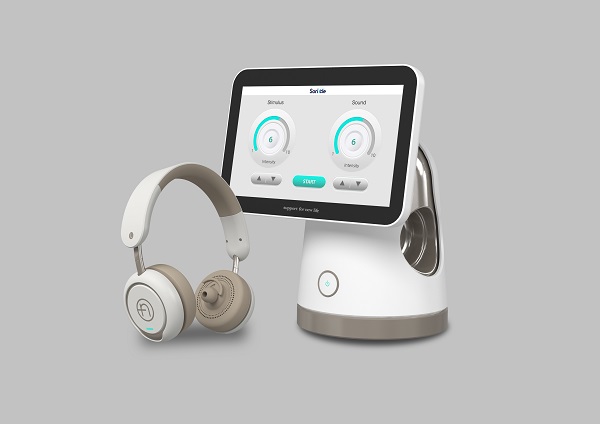
NewLive is also developing the electronic medicine 'SoriCle' alongside SoriClear. It stimulates the vagus nerve, one of the brain nerves, to activate brain plasticity. CEO Song said, "Vagus nerve stimulation has already received FDA approval in the U.S. and is covered by health insurance in Korea for severe depression. However, since it requires surgical implantation like an implant, the burden is high, so we plan to improve the drawbacks of existing devices through relatively non-invasive electronic medicine."
In terms of development stages, SoriCle is ahead. Unlike SoriClear, which is currently preparing for Good Manufacturing Practice (GMP) certification, SoriCle is conducting exploratory clinical trials at Seoul National University Hospital and Ewha Mokdong Hospital, with clinical trials for insomnia also underway. CEO Song emphasized, "Since it is a brain stimulation electronic medicine, I believe there are countless additional indications possible beyond tinnitus, such as insomnia, depression, and cognitive dysfunction." The plan is also to develop DTx pipelines for insomnia, depression, and anxiety disorders.
Regarding the simultaneous development of electronic medicine and DTx, he said, "In the long term, we expect them to be integrated into a single platform," adding, "They are not competitive but complementary, and applying them together is expected to enhance treatment effects." Currently, DTx uses hardware like smartphones or tablets, and electronic medicine is also likely to be controlled via wearable devices through smartphones in the long run, so synergy effects are anticipated.
© The Asia Business Daily(www.asiae.co.kr). All rights reserved.
!["The Woman Who Threw Herself into the Water Clutching a Stolen Dior Bag"...A Grotesque Success Story That Shakes the Korean Psyche [Slate]](https://cwcontent.asiae.co.kr/asiaresize/183/2026021902243444107_1771435474.jpg)


















