Total Compensation Cap for Registered Directors Reduced from 15 Billion to 8 Billion
Cost Reduction Measures Including Performance Bonus Cuts Amid Economic Slowdown in Gyeonggi
[Asia Economy Reporter Yuri Choi] Naver is significantly reducing the compensation cap for directors, including the Chief Executive Officer (CEO). This is the first time the company has cut the compensation limit for registered directors.
Naver will propose a motion at the regular shareholders' meeting on March 22 to reduce the directors' compensation cap from 15 billion KRW to 8 billion KRW. Under the Commercial Act, if the articles of incorporation do not specify the amount of directors' compensation, it must be approved at the shareholders' meeting. Accordingly, listed companies seek approval for directors' compensation limits annually at shareholders' meetings.
This is the first time Naver has reduced the compensation cap. It started at 1 billion KRW when it went public in 2002 and steadily increased it. The cap was raised to ▲2 billion KRW in 2003 ▲3 billion KRW in 2004 ▲5 billion KRW in 2005 ▲10 billion KRW in 2006 ▲15 billion KRW in 2007, and has been maintained since then.
The actual total payments have never exceeded 10 billion KRW. However, there have been cases where payments exceeded the newly proposed compensation cap. For example, when the CEO retired and retirement benefits were paid or when incentives increased, payments approached nearly 10 billion KRW.
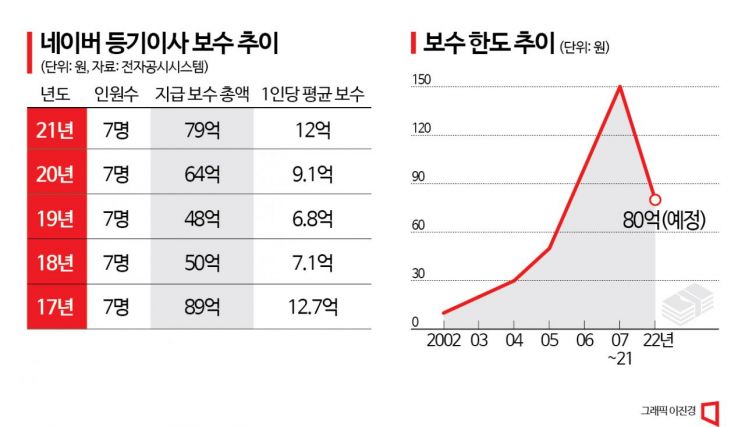
The reason for cutting the compensation cap is due to increased management uncertainty. Although annual sales surpassed 8 trillion KRW for the first time last year, operating profit declined, worsening profitability. This year, concerns remain about the impact on advertising revenue, a major income source, due to the economic slowdown. This is why cost reduction efforts have been focused on since last year.
Reducing this year's performance bonuses is part of that effort. While there are differences by organization and individual, employee performance bonuses were cut by more than 20% compared to the previous year. The same applies to executives and mid-level managers known as responsibility leaders. Due to poor stock performance, the restricted stock units (RSUs) received by CEO Choi Soo-yeon and other executives last year were valued at '0 KRW.' RSUs are a system where company shares are granted free of charge upon achieving certain targets, with the compensation amount equal to the stock's par value. Responsibility leaders' RSU payments were cut by 50%, and cash compensation was uniformly reduced.
At a recent employee communication event called 'Companion Day,' CEO Choi said, "This year, we are facing the most difficult economic situation ever, and Naver must overcome these challenges for the time being," adding, "We need to transform into an efficient organization to meet market expectations."
It is also interpreted that the National Pension Service (NPS), Naver's largest shareholder with an 8.29% stake, influenced the decision by opposing the directors' compensation cap. The NPS voted against the 15 billion KRW compensation cap approval at last year's shareholders' meeting, citing that it was excessive considering the company's size and management performance. In October last year, the NPS also changed its purpose of holding Naver shares from 'simple investment' to 'general investment,' signaling the possibility of more active shareholder engagement.
A Naver official explained, "There is a difference between the compensation cap and the actual amount paid," adding, "Taking this into account, we decided to adjust the compensation cap."
© The Asia Business Daily(www.asiae.co.kr). All rights reserved.
![Clutching a Stolen Dior Bag, Saying "I Hate Being Poor but Real"... The Grotesque Con of a "Human Knockoff" [Slate]](https://cwcontent.asiae.co.kr/asiaresize/183/2026021902243444107_1771435474.jpg)
















