Sunset of 8-Hour Additional Overtime Work System for Businesses with Fewer Than 30 Employees Enters Second Month
Rushing Work to Meet Delivery Deadlines... Safety Accident Concerns
Despite 1-Year Guidance Period
SMEs and Startups "Worried Employees Might Report"
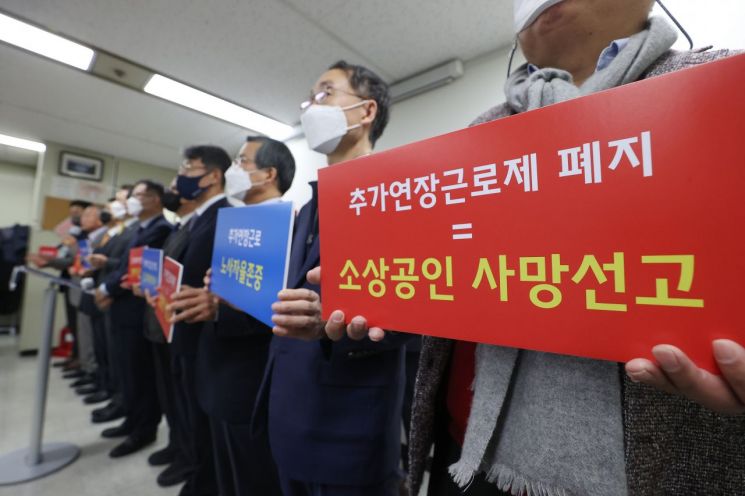 The small and medium-sized enterprise sector held a press conference last December at the Korea Federation of SMEs in Yeouido, Seoul, urging the extension of the sunset provision for the 8-hour additional overtime work system.
 [Image source=Yonhap News]
[Asia Economy Reporter Donghyun Choi] "If an accident happens like this, won't we be punished under the Serious Accident Punishment Act later on?"
Park, the CEO of a mold company operating in the Sihwa Industrial Complex in Ansan, Gyeonggi Province, is currently overwhelmed with worries. Due to the sunset of the 8-hour additional extended work system, he tries to meet delivery deadlines by adhering to the statutory working hours as much as possible, which makes him rush the work. As a result, he is constantly anxious that a safety accident might occur. CEO Park said, "Although a one-year grace period was given for the additional extended work system, it is still the same as being a lawbreaker," and added, "From next year, when the grace period ends, the Serious Accident Punishment Act will even apply to workplaces with fewer than 50 employees, which basically means small businesses are doomed."
When the 8-hour additional extended work system applied to workplaces with 5 to 29 employees ended at the end of last year, the small and medium-sized enterprises (SMEs) sector fell into despair. Many SMEs, already short-staffed, are struggling to meet delivery deadlines as the maximum statutory working hours have been reduced. Many places are worried that employees might report them, even though they have no choice but to work overtime illegally.
The 8-hour additional extended work system was a temporary measure introduced in July 2021 when the 52-hour workweek was applied to workplaces with fewer than 50 employees, allowing small-scale workplaces (5 to 29 employees) to work an additional 8 hours per week. Despite opposition from the SME sector, it was abolished on December 31 last year due to the sunset clause. The government and the ruling party attempted to extend the sunset until 2024 through legislation, but it failed due to opposition from the opposition party. Currently, the bill to extend the sunset is dormant in the National Assembly’s Environment and Labor Committee files.
To alleviate on-site difficulties, the government decided to grant a one-year grace period for the additional extended work system. Workplaces with fewer than 30 employees will be exempt from regular labor inspections during the grace period. For other labor inspections, even if violations of working hours are found, a correction period of up to 9 months (3 months initially, with an additional 3 to 6 months if necessary) will be given.
However, CEOs of SMEs and startups operating businesses with fewer than 30 employees say the grace period is meaningless. Even if labor inspections are relaxed for a while, they can be immediately punished if an employee reports them. In fact, if a workplace causes social controversy and undergoes special inspections during the grace period, they will be immediately penalized without a correction period. A startup CEO in the education sector said, "Since additional extended work beyond the 52-hour workweek is now illegal, if someone reports and an investigation is conducted, there is nothing to say. Friends at other companies leave work early under the 52-hour system, so if only my company works overtime, wouldn’t they want to report it?"
The smaller the workplace, the more cases there were of workers filing complaints with the labor office for employers not properly complying with working hours. According to the Ministry of Employment and Labor’s survey, last year, there were 648 cases where workers reported violations of the 52-hour workweek by workplaces or employers through complaints, accusations, or petitions. This is 3.6 times higher than the 179 cases in 2018, when the 52-hour system was first implemented. Among these, the number of 'petitions' was 274 for workplaces with fewer than 50 employees, 186 for 50 to 299 employees, and 54 for 300 or more employees. It can be interpreted that smaller workplaces have more worker dissatisfaction due to lack of funds and manpower. The additional extended work system, which served as a buffer to prevent labor-management conflicts in workplaces with fewer than 30 employees, has collapsed. There is a high possibility that labor-management conflicts will surge in small workplaces with fewer than 30 employees. There are 630,000 workplaces with 5 to 29 employees nationwide, employing 6.03 million people.
The SME sector is repeatedly demanding the prompt re-legislation of the 8-hour additional extended work system. A representative from the Korea Federation of SMEs said, "While the National Assembly’s Environment and Labor Committee is pushing forward the 'Yellow Envelope Act' (amendment to the Labor Union Act), there is no discussion at all about the 8-hour additional extended work system," and urged, "If they truly care about people’s livelihoods, they should promptly review and process the bill."
© The Asia Business Daily(www.asiae.co.kr). All rights reserved.
![Clutching a Stolen Dior Bag, Saying "I Hate Being Poor but Real"... The Grotesque Con of a "Human Knockoff" [Slate]](https://cwcontent.asiae.co.kr/asiaresize/183/2026021902243444107_1771435474.jpg)
















