Yoon Visits 'Eorini Byeongwon' "Will Spare No Support"
Orders Establishment of 24-Hour Video Consultation System
Supports Medical Devices for Schools... "A Matter of Human Rights"
[Asia Economy Reporter Baek Kyunghwan] President Yoon Suk-yeol on the 22nd pointed out that the phenomenon of doctors avoiding pediatrics is "not the fault of the doctors, but the government's policy." President Yoon judged that the medical support system must be changed even if government finances are invested, stating, "We will promote post-compensation through public policy fees to this end."
On the morning of the same day, President Yoon visited Seoul National University Children's Hospital located in Jongno-gu, Seoul, to directly observe the medical site and announced a government support plan to strengthen the pediatric medical system, saying, "We must ensure that there is no gap in the essential medical pediatric system." The core of the plan is to resolve the recent social issue of the lack of personnel and support in pediatrics and adolescent medicine, and to establish an emergency medical system where citizens can receive essential medical services anytime and anywhere.
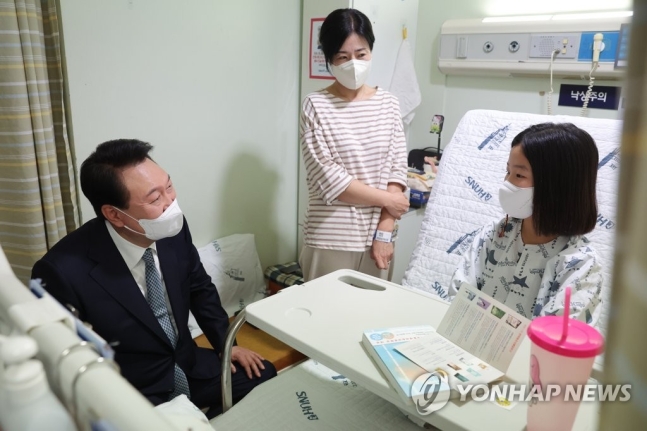 President Yoon Suk-yeol visited the Pediatric Surgery Ward of Seoul National University Children's Hospital in Jongno-gu, Seoul, on the 22nd, encouraging hospitalized children and their guardians.
 [Photo by Yonhap News]
This visit was made based on President Yoon's judgment that "in the era of low birth rates, it is more important than anything else to strengthen the social conditions so that children can grow up healthily." One of the reasons President Yoon visited the pediatric medical site is that the total fertility rate last year recorded the lowest ever at 0.78, the lowest figure since statistics began in 1970. This result ranks last among OECD member countries and is less than half the average.
There was also a strong sense of crisis reflecting that pediatrics are decreasing nationwide and even specialized personnel are declining, facing a "collapse of the pediatric and adolescent medical system." The shortage of pediatricians, low birth rates, and the 'recruitment difficulties' caused by low fees (medical expenses) have been prolonged. In addition, the suspension of inpatient treatment and nighttime emergency room care in pediatrics and adolescent medicine, mainly in hospitals located in the metropolitan area, is already expanding.
On this day, President Yoon pointed out the phenomenon of doctors avoiding pediatrics as "the government's policy fault." He said that despite the accumulation of such problems over a long period, timely responses were not made, and he first proposed post-compensation through public policy fees. President Yoon instructed, "Guarantee the costs involved in essential treatments such as pediatric care and emergency care through public policy fees, and compensate appropriate fees considering the additional input costs for treating children."
In particular, President Yoon ordered the establishment of a system capable of video consultation related to the creation of a 24-hour pediatric specialized counseling center. He added, "If children seem abnormal at night, they should be able to receive counseling remotely."
He asked the Ministry of Education to review measures to place nurses in schools so that children wearing medical devices such as ventilators can attend school without worry. This instruction was given after hearing a story at the meeting about a young patient who suffers from a rare muscular disease and needs to wear a ventilator but cannot attend school. President Yoon pointed out, "This issue is not about welfare but a matter of human rights."
President Yoon toured outpatient treatment sites and attended the 'Essential Pediatric Medical Policy Meeting' to discuss effective measures to strengthen the pediatric medical system. He said, "Children suffering from severe diseases are the vulnerable group that the government must prioritize in care," and also urged, "University hospitals and others should have a sense of mission and do their best in severe pediatric care."
The main points of the government's measures announced that day are ▲ expansion of the severe pediatric medical system ▲ elimination of blind spots in pediatric care during nighttime and holidays ▲ securing pediatric medical personnel through appropriate compensation. Reflecting the government's medical policy stance that 'pediatric care = essential medical care,' the plan is to first expand the Children's Public Specialized Medical Centers to increase medical infrastructure that specializes in treating children with severe diseases such as cancer and rare incurable diseases. There is a plan to gradually expand centers in four regions?Incheon, Gyeonggi, Chungbuk, and Jeju?that currently do not have Children's Public Specialized Medical Centers.
To respond appropriately even during nighttime or holidays, starting from the second half of this year, the government will promote expanding compensation for the '24-hour Pediatric Specialized Counseling Center' that provides 24-hour consultation and the 'Moonlight Children's Hospital' that offers outpatient care during nighttime and holidays. In addition, the government plans to compensate unavoidable losses occurring at Children's Public Specialized Medical Centers through public policy fees and begin diversifying employment methods to secure pediatric specialists. After the meeting, President Yoon reiterated, "We will strengthen government support so that medical staff can focus on treating children." He also requested, "Please share various good opinions from the field so that effective measures can be implemented."
© The Asia Business Daily(www.asiae.co.kr). All rights reserved.
![Clutching a Stolen Dior Bag, Saying "I Hate Being Poor but Real"... The Grotesque Con of a "Human Knockoff" [Slate]](https://cwcontent.asiae.co.kr/asiaresize/183/2026021902243444107_1771435474.jpg)
















