Bank of Korea Governor Lee Chang-yong: "Government and BOK Do Not Conflict"
Dispelling Timing Controversy... "Same Priority on Inflation"
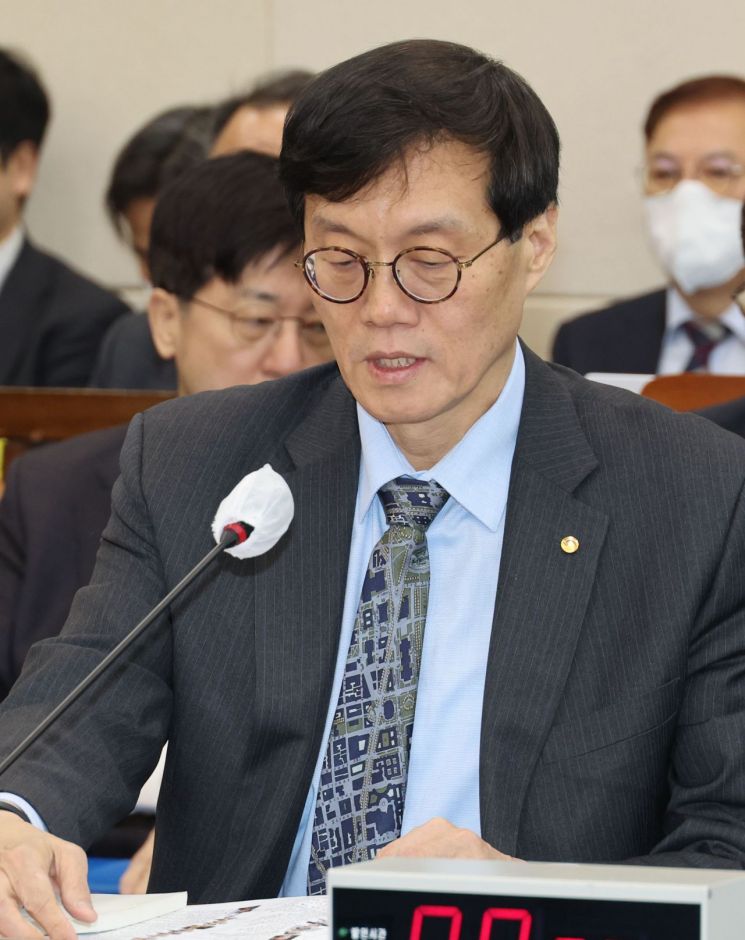 Bank of Korea Governor Lee Chang-yong is reviewing documents at the full meeting of the Planning and Finance Committee held at the National Assembly in Yeouido, Seoul, on the afternoon of the 21st.
 [Image source=Yonhap News]
Lee Chang-yong, Governor of the Bank of Korea, rebutted the criticism that the conflicting policy directions between the government and the Bank of Korea are causing market confusion by stating, "Both the government and the Bank of Korea share the same understanding that price stability is the top priority." Regarding the government's increase in public utility charges, he said, "If energy prices are not raised, it could actually have a negative impact on inflation," adding, "They need to be raised to an appropriate level."
On the 21st, during a briefing to the National Assembly's Planning and Finance Committee, when Kang Jun-hyun, a member of the Democratic Party of Korea, said, "The Bank of Korea is raising the base interest rate while the government is easing loan regulations, which is contradictory," Governor Lee responded, "They are not contradictory."
Kang said, "President Yoon Suk-yeol recently publicly demanded a reduction in loan interest rates, saying that banks have a public nature, etc. The Bank of Korea is raising the base interest rate to suppress demand, while the government is trying to lower interest rates. How can price stability be achieved in this situation?
In response, Governor Lee said, "The government’s comments on interest rates are because, after the unexpected 'Legoland incident' at the end of last year, short-term interest rates rose rapidly, and they are trying to adjust that." He added, "Basically, since the base interest rate has risen significantly, the effects of monetary policy are continuing."
He continued, "I do not necessarily think that the government's easing of loan regulations conflicts with the Bank of Korea," emphasizing, "We have raised the base interest rate, so overall interest rates have increased, and the government can adjust parts where interest rates suddenly rise and pose high risks."
When Kang again questioned whether the government and the Bank of Korea are cooperating closely, Governor Lee explained, "Deputy Prime Minister Choo Kyung-ho also said that policies prioritizing price stability come first, and then the economy is considered. Both the government and the Bank of Korea agree that price stability is the most important task, and once it is achieved, then the economy is considered."
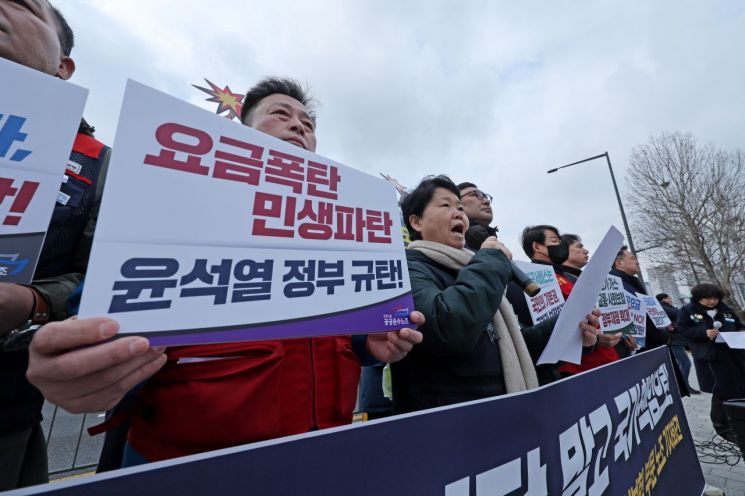 Members of the Public Transport Workers' Union hold related placards at a press conference calling for the strengthening of national responsibility for public utility charges near the Presidential Office in Yongsan-gu, Seoul, on the morning of the 16th. [Image source=Yonhap News]
Regarding the government's easing of real estate loan regulations, Governor Lee said, "While price stability is important, financial stability must also be considered," adding, "From a macro perspective, the easing of loan regulations for multi-homeowners is a policy to prevent a sharp decline in the real estate market."
He added, "Currently, the impact of the real estate regulation easing on the market is minimal. We are striving for price stability through interest rates."
In response to Kang's criticism that the government's increase in public utility charges such as electricity and gas is negative for price stability, Governor Lee said, "The rise in public utility charges acts as a factor preventing prices from falling," but also noted, "However, from the perspective of the entire national economy, it is unavoidable to raise energy prices such as electricity, water, and gas."
He explained, "If energy prices do not rise, the current account balance could turn into a deficit, which would negatively affect inflation through the exchange rate. Also, if Korea Electric Power Corporation's deficit grows, the issuance of KEPCO bonds increases, which raises interest rates. It is necessary to raise electricity, water, and gas charges to an appropriate level to prevent these side effects."
© The Asia Business Daily(www.asiae.co.kr). All rights reserved.


















