[Asia Economy Yeongnam Reporting Headquarters Reporter Hwang Du-yeol] Busan Port Authority (BPA) held a kickoff meeting on the 21st to develop a mechanical fender system as an alternative to rubber fenders to reduce marine environmental pollution.
The project was selected as a joint investment-type task under the New Product Development Project by the Ministry of SMEs and Startups, receiving 450 million KRW in national funding. BPA and Dongbo Chain Industry will each bear 450 million KRW and 269 million KRW respectively, with a total development cost of 1.069 billion KRW expected to be invested by February 2025.
Fenders are cushioning devices used to prevent damage to the ship hull and quay wall when a vessel docks and moors, and most are currently made of rubber.
Rubber deteriorates and hardens when exposed to ultraviolet rays and salt, causing performance degradation, and when torn or damaged, partial maintenance is not possible, requiring full replacement.
Additionally, when rubber fenders are disposed of by incineration, large amounts of harmful substances are emitted, and damaged rubber sinking into the sea causes marine pollution such as microplastic generation.
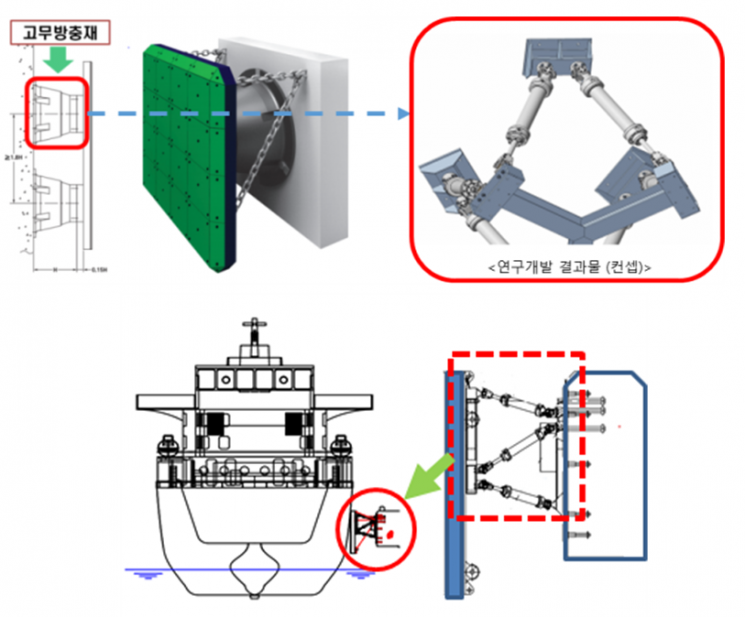 Conceptual diagram of rubber insect repellent material and mechanical (cylinder) insect repellent system.
BPA stated that replacing rubber fenders with hydraulic cylinders can solve these environmental pollution problems and make maintenance much easier.
At the kickoff meeting, Dongbo Chain Industry and the Korea Research Institute of Ships and Ocean Engineering, the research performing organizations, announced plans to develop the mechanical fender to ensure sufficient cushioning performance and resistance to salt, making maintenance and inspection convenient.
Min Byung-geun, head of BPA’s Construction Headquarters, said, “If the development of mechanical fenders is successfully promoted, it will reduce maintenance and environmental costs, realize sustainable port implementation, and flexibly respond to the demand for improved fender performance due to ship enlargement, making it competitive in both domestic and international markets.”
© The Asia Business Daily(www.asiae.co.kr). All rights reserved.
![Clutching a Stolen Dior Bag, Saying "I Hate Being Poor but Real"... The Grotesque Con of a "Human Knockoff" [Slate]](https://cwcontent.asiae.co.kr/asiaresize/183/2026021902243444107_1771435474.jpg)











