Bank of Korea Reports on Temporary National Assembly Work Status
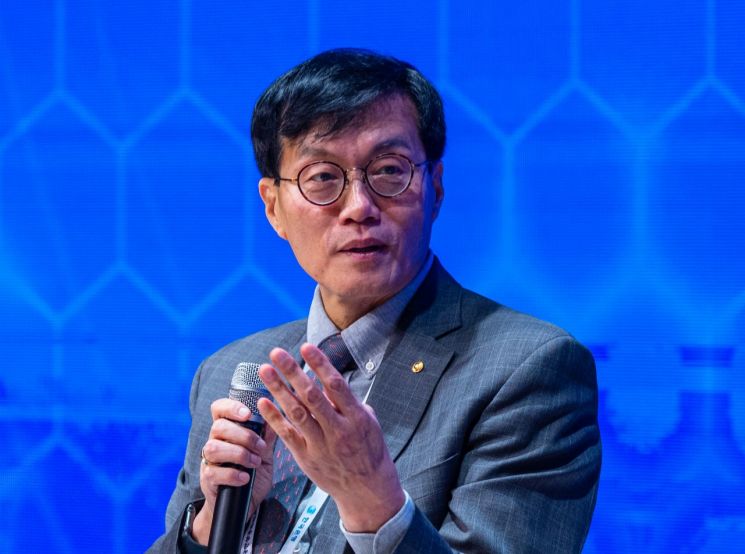 Lee Chang-yong, Governor of the Bank of Korea, is having a discussion with Shin Hyun-song, Senior Economist and Head of the Research Department at the Bank for International Settlements (BIS), at the joint seminar between the Bank of Korea and the Korea Chamber of Commerce and Industry held on the morning of the 1st at the International Conference Hall of the Korea Chamber of Commerce and Industry in Jung-gu, Seoul, under the theme "Changes in the Economic Paradigm and Korea's Response Measures."
 [Photo by Yonhap News]
The Bank of Korea stated that the Chinese economy is showing a rapid recovery following the lifting of COVID-19 quarantine measures, and explained that the domestic economy is expected to improve its growth trend from the second half of the year. Regarding monetary policy, it showed a somewhat cautious stance, saying it will decide on additional base rate hikes considering the slowdown in growth and financial stability.
In a status report to the provisional National Assembly on the 21st, the Bank of Korea said, "Our economy has experienced a deepening short-term recession amid continued high inflation, but as external conditions improve toward the second half, growth is expected to recover while inflationary pressures gradually ease."
According to the Bank of Korea, although the global economy's growth rate is expected to slow significantly compared to last year, expectations for improvement after the second half are increasing due to the rising possibility of a soft landing in the US and Eurozone and the normalization of the Chinese economy.
In particular, China is predicted to experience a rapid economic recovery driven by pent-up demand centered on face-to-face services such as dining out and travel, supported by the lifting of quarantine measures and government policy support.
The economic recovery following China's reopening is expected to positively impact the domestic economy through improved exports to China and an influx of tourists. The Bank of Korea expects exports to China to first recover in chemical products sensitive to China's domestic demand, then expand to include items such as mobile phones and semiconductors.
However, the Bank of Korea added, "This time, since China is expected to recover centered on consumption, the effect on boosting domestic growth is anticipated to be less than during China's past investment-driven growth period."
Consumer prices are expected to continue their slowing upward trend, but uncertainties remain high regarding international oil price trends, public utility fee hikes, and policy responses from major central banks, so upward pressure also persists.
The Bank of Korea stated, "The increase in public utility fees may have secondary ripple effects on the prices of other goods and services beyond the direct inflationary impact."
Regarding the direction of monetary policy, the Bank of Korea said it will continue its 'tightening stance,' but the intensity has weakened.
The Bank of Korea said, "Considering that inflation above the target level is expected to continue throughout the year, it is necessary to maintain a tightening stance focusing on price stability," adding, "however, we will carefully review the effects of past rate hikes, the pace of inflation slowdown, downside risks to growth, risks related to financial stability, and changes in major countries' monetary policies to determine the necessity of additional base rate hikes."
The housing market is expected to remain sluggish for the time being due to high loan interest rates and a chain decline in sales and jeonse prices. However, the Bank of Korea judged that the government's recent real estate measures have had the effect of preventing a sharp decline in buying sentiment and moderating the pace of housing price drops.
© The Asia Business Daily(www.asiae.co.kr). All rights reserved.

















