Presidential Office "Sent to National Assembly Today"
Report to Plenary Session on 24th, Vote Expected on 27th
High Possibility of Rejection but Byeongye Faction's '28 Votes' Crucial
[Asia Economy reporters Ki-min Lee and Young-won Kim] President Yoon Seok-yeol has approved the request for consent to arrest Lee Jae-myung, leader of the Democratic Party of Korea, who is accused of breach of trust involving approximately 490 billion won.
The presidential office spokesperson announced on the 21st, "The request for consent to arrest Lee was received yesterday, the president's approval has been granted, and it will be sent to the National Assembly."
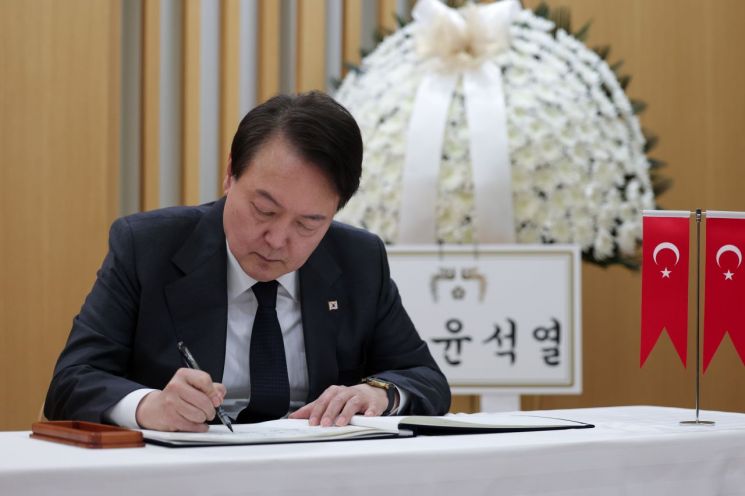
The request for consent to arrest Lee is scheduled to be reported at the plenary session of the National Assembly on the 24th and then put to a vote at the plenary session three days later on the 27th. According to Article 26 of the National Assembly Act, the Speaker of the National Assembly must report the request for consent to arrest at the first plenary session convened after receiving the request, and the vote must be held between 24 hours and 72 hours after the report.
As this is the first time in constitutional history that a request for consent to arrest the leader of the main opposition party has been approved, conflicts between the presidential office, the ruling party, and the Democratic Party are escalating to the extreme. On the morning of the same day, Joo Ho-young, floor leader of the People Power Party, proposed at the party's floor strategy meeting that even if the March extraordinary session is convened, the date for Lee’s warrant hearing should be avoided. This was a criticism of the Democratic Party’s move to convene an extraordinary session after the regular session ended last year to avoid judicial risks for Lee. Sung Il-jong, chairman of the policy committee, also criticized at the morning floor strategy meeting that "As the judicial trial for the criminal charges against Lee approaches, he is reaching out to the Korean Confederation of Trade Unions for protection by mobilizing multiple layers of defense."
The Democratic Party leadership refrained from commenting on the request for consent to arrest Lee on the same day. However, Lee is scheduled to explain the unfairness of the prosecution’s detention warrant during a personal statement at the Democratic Party’s parliamentary meeting in the afternoon. Oh Young-hwan, spokesperson for the Democratic Party, said, "Legal experts within the party will explain the legal review of the currently requested warrant," and added, "There will be a process to confirm the consensus of party members afterward." This means that while the party will not decide an official stance on the request for consent to arrest, vote management will be conducted.
For this reason, the political circle predicts that the likelihood of the request for consent to arrest Lee being approved is low. So far, a total of 64 requests for consent to arrest have been submitted to the National Assembly, of which 16 were approved. In the 21st National Assembly, requests for consent to arrest were submitted and approved for lawmakers Lee Sang-jik (Independent), Jung Jung-soon (Democratic Party), and Jung Chan-min (People Power Party). Regarding the recent case of the request for consent to arrest Democratic Party lawmaker Roh Woong-rae on bribery charges, Minister of Justice Han Dong-hoon personally explained the necessity of detention at the National Assembly in December last year, but the request was rejected.
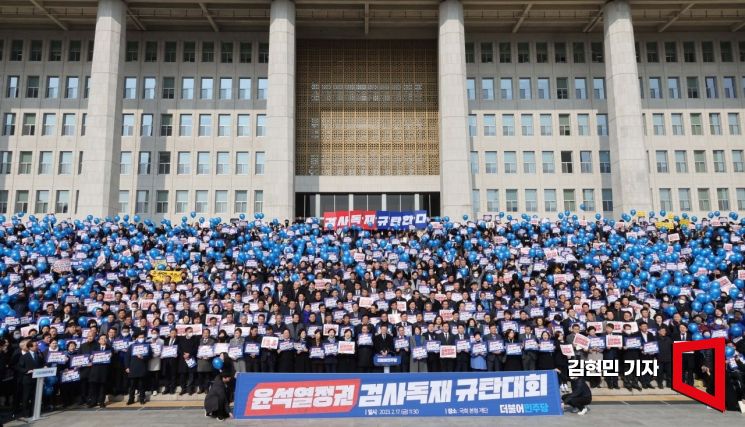 Lee Jae-myung, leader of the Democratic Party of Korea, Park Hong-geun, floor leader, members of the National Assembly, party committee chairpersons, and party members are shouting slogans at the "Condemnation Rally Against Prosecutorial Dictatorship of the Yoon Seok-yeol Administration" held on the stairs in front of the main building of the National Assembly in Yeouido, Seoul, on the 17th. Photo by Kim Hyun-min kimhyun81@
In particular, the request for consent to arrest requires a majority of the total members present and a majority vote to pass. The Democratic Party holds 169 seats, which is more than half of the total 299 seats, making this situation favorable for Lee. However, since the vote is by secret ballot, if more than 28 votes from non-Lee factions within the Democratic Party defect, combined with the votes from the People Power Party (115 seats), Justice Party (6 seats), and Transition Korea (1 seat), the request for consent to arrest could be approved.
Earlier, the prosecution filed a detention warrant on the 16th on charges including breach of trust under the Act on the Aggravated Punishment of Specific Economic Crimes, violation of the Conflict of Interest Prevention Act, violation of the Anti-Corruption Act, bribery under the Act on the Aggravated Punishment of Specific Crimes, and violation of the Act on the Regulation of Concealment of Criminal Proceeds, related to the Daejang-dong and Wirye New Town development project preferential treatment allegations and the Seongnam FC sponsorship fund allegations. In response, the Seoul Central District Court sent the request for consent to arrest Lee to the prosecution on the 17th, which was then submitted to President Yoon after passing through the Supreme Prosecutors’ Office and the Ministry of Justice.
Lee also fully denied the charges in a 20-page rebuttal and explanation document regarding the prosecution’s detention warrant, stating, "Requesting a detention warrant based on the manner or content of testimony is clearly a violation of the Criminal Procedure Act and an unconstitutional disposition."
© The Asia Business Daily(www.asiae.co.kr). All rights reserved.
![Clutching a Stolen Dior Bag, Saying "I Hate Being Poor but Real"... The Grotesque Con of a "Human Knockoff" [Slate]](https://cwcontent.asiae.co.kr/asiaresize/183/2026021902243444107_1771435474.jpg)

















