Pain of Being Removed from Maintenance Zone in 2015
Transforming into a Residential Complex of 1,400 Households Where History and Culture Coexist
[Asia Economy Reporter Onyu Lim] Sindang 10 District in Jung-gu, Seoul, which was deregulated from the maintenance zone in 2015, finalized its maintenance plan in just 1 year and 6 months thanks to Seoul City's Rapid Integrated Planning. This district, a residential area behind the Dongdaemun commercial district, is set to transform into a residential complex of 1,400 households where history, culture, and industry coexist.
On the 20th, Seoul City held a special subcommittee meeting of the Urban Planning Committee for Rapid Integrated Planning and announced on the 21st that it had approved the revised maintenance plan for the Sindang 10 District housing maintenance-type redevelopment zone. Since its designation as a maintenance zone in 2006, the Sindang 10 District project had been stagnant for a long time and suffered the setback of deregulation in 2015. However, the project began to gain momentum after being selected as a target for 'Rapid Integrated Planning' in August 2021. Despite its excellent location as a residential area behind the Dongdaemun commercial district, adjacent to the triple station area and the Gwanghuimun fortress historical resource, Sindang 10 District had long been perceived as a deteriorated area.
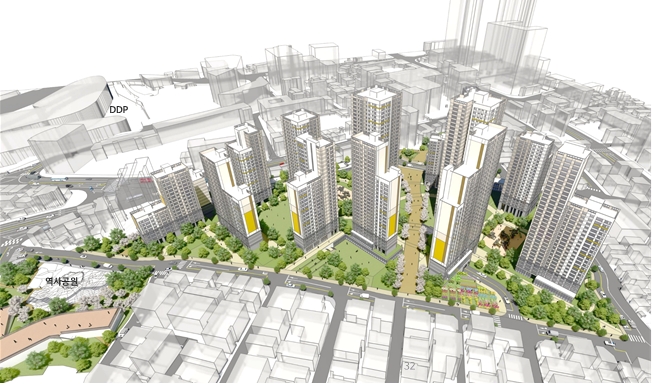
With the confirmation of the maintenance plan for Sindang 10 District, the area will be reborn as a 'green ecological urban residential complex where history, culture, and industry coexist' (up to 35 floors, floor area ratio 297%, scale of 1,400 households).
Sindang 10 District incorporates four planning principles as a representative residential complex in the urban area. First, it plans to form a stepped skyline considering the relationship with adjacent low-rise residential areas and create an open complex by establishing pocket parks and community spaces on the lower floors. Second, it revitalizes existing commercial streets through a circulation plan that supports the sewing industry backing Dongdaemun Fashion Town and connects to the Sindang-dong Tteokbokki Alley.
Third, exhibition facilities, museums, and a historical park (6,100㎡) will be established to enjoy historical and cultural resources such as the Seoul Fortress Wall, Gwanghuimun, and Dongdaemun Design Plaza (DDP). The historical park is expected to become a landmark for Seoul citizens where they can enjoy the atmosphere of the area from Gwanghuimun to DDP. Fourth, Sindang 10 District is located within a triple station area, with Dongdaemun History & Culture Park Station, Sindang Station, and Cheonggu Station all within a 5-minute walk, giving it locational advantages as an urban residential area. According to the plan, commercial and industrial support functions will be placed on the lower floors around Sindang Station, with small housing units on the upper floors, creating a vibrant urban residential area for young people and downtown workers through mixed-use development.
Jo Nam-jun, Director of Seoul City Urban Planning Bureau, said, “Sindang 10 District is significant in that it presents a model of Seoul’s urban residential complex that breaks away from the typical residential redevelopment paradigm by incorporating diverse functions such as culture, commerce, and industry,” adding, “Rapid Integrated Planning will create ‘good plans’ that raise the qualitative level of redevelopment along with fast ‘speed’ through active communication with residents.”
© The Asia Business Daily(www.asiae.co.kr). All rights reserved.
![Clutching a Stolen Dior Bag, Saying "I Hate Being Poor but Real"... The Grotesque Con of a "Human Knockoff" [Slate]](https://cwcontent.asiae.co.kr/asiaresize/183/2026021902243444107_1771435474.jpg)
















