Announcement of a policy that takes a step forward in spatial and content aspects of the nation's first gentrification prevention policy
Expansion of policy zones to Seongsu Station and Yeonmujang-gil area, restriction on chain business entry, and promotion of floor area ratio relaxation upon agreement signing
Re-pursuit of legislation through public discussion on institutional improvements such as the introduction of management fee regulations
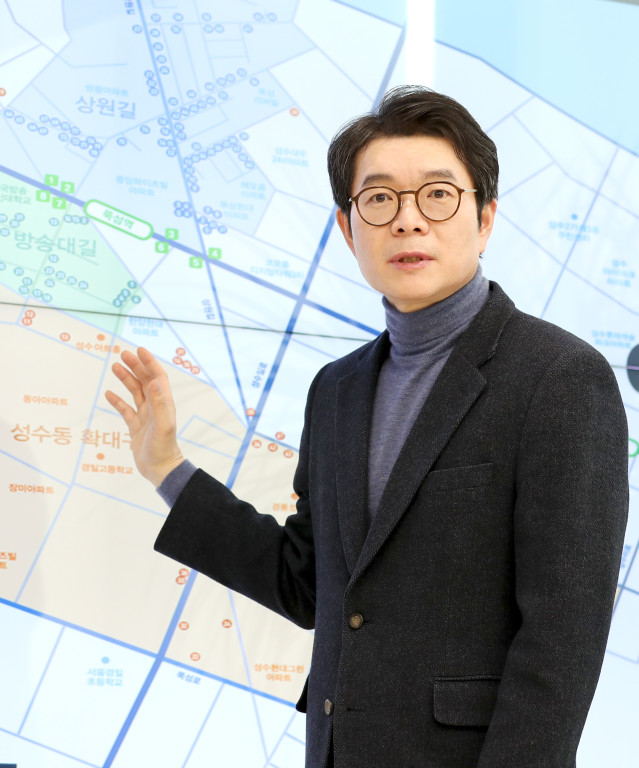 Jung Won-oh, Mayor of Seongdong-gu, explaining the Season 2 of the anti-gentrification policy promoted by Seongdong-gu
[Asia Economy Reporter Park Jong-il] Seongdong-gu (Mayor Jeong Won-oh) is launching the so-called 'Gentrification Prevention Policy Season 2,' a step forward from the successfully established gentrification prevention policy.
The main point of this Season 2 policy is to expand the gentrification prevention policy, which was centered around Seoul Forest and Ttukseom Station, to the areas around Seongsu Station and Yeonmujang-gil.
Additionally, efforts will be made to prepare improvements to laws and systems related to gentrification prevention, such as the Commercial Building Lease Protection Act.
Meaningful achievements of the nation's first gentrification prevention policy
Seongdong-gu introduced the gentrification prevention policy nationwide for the first time in 2015, when the term 'gentrification' was still unfamiliar, focusing on Seongsu-dong, and achieved considerable results. The district enacted a gentrification prevention ordinance, established a dedicated organization, and designated Seoul Forest-gil, Bangsongdae-gil, and Sangwon-gil as sustainable development zones. It also restricted the entry of large corporations and franchises within the zone and signed agreements with building owners to stabilize rents, earning recognition for preserving local characteristics and contributing to rent stability.
Furthermore, in cooperation with other local governments, it formed the 'Gentrification Local Government Council' and actively advocated for the enactment and amendment of related laws by issuing urging statements. As a result, the Act on the Mutual Growth and Revitalization of Local Commercial Districts (hereinafter ‘Local Commercial District Act’) was passed by the National Assembly and enacted. It also succeeded in amending the Commercial Building Lease Protection Act (hereinafter ‘CBLPA’) to extend the lease protection period from 5 to 10 years and reduce the rent increase cap from 9% to 5%. Notably, the Local Commercial District Act is a rare case where a local government ordinance (Seongdong-gu Ordinance on Mutual Cooperation of Local Communities and Designation of Sustainable Development Zones) was legislated into law.
Zero vacancy rate street, Seongsu Station area responds to gentrification
While the gentrification prevention policy centered on sustainable development zones has been successfully established, signs of gentrification have appeared in areas not covered by the zones, such as Seongsu Station and Yeonmujang-gil, requiring accurate surveys and countermeasures.
This area has recently become a 'hot place' with a rapidly increasing floating population mainly among the MZ generation, with famous brands like Musinsa Studio and Dior entering, resulting in a vacancy rate close to ‘0’ despite the economic downturn. Yeonmujang-gil is bustling on weekdays and weekends alike with cafes, restaurants, and pop-up stores offering atmospheres not found anywhere else in Seoul.
Accordingly, Seongdong-gu conducted a 'Study on Gentrification Response Measures in the Seongsu Station Area' for four months starting in October last year. The survey results showed that while the floating population and sales continue to grow, rents are also rising sharply.
Rent per pyeong (3.3㎡) was 100,000 KRW in 2018 but rose 50% to 150,000 KRW in 2022. Sales increased by 25.6% during a similar period.
Through the study, Seongdong-gu analyzed four main causes of the sharp rent increase and derived improvement measures. The causes were identified as ▲ actual rent increase through management fee hikes ▲ increased frequency of rent hikes due to shortened lease renewal cycles ▲ lease contracts not covered by the CBLPA (contracts with new tenants, contracts for newly constructed buildings, or contracts exceeding the converted deposit standard) ▲ tenants’ lack of information leading to failure to utilize protection systems.
Among these, the most significant factor influencing rent increases was new lease contracts not subject to the Commercial Building Lease Protection Act, which also drove up rents for existing tenants.
Gentrification Prevention Policy Season 2: Spatial expansion and institutional improvement
Reflecting the study results, Seongdong-gu established the '2023 Comprehensive Plan for Gentrification Prevention' and is implementing 'Gentrification Prevention Policy Season 2.' First, the policy, which was centered on the sustainable development zone around Seoul Forest, will be expanded to include the areas around Seongsu Station and Yeonmujang-gil.
The district plans to build an urban management system that significantly relaxes floor area ratio on the condition of signing rent stabilization agreements when constructing new or additional buildings, and restricts new chain business (franchise) entries to preserve the unique local character and prevent uniformity of alleyways.
As confirmed in the recent survey, there are still many points to be supplemented. These need to be achieved through legislation, and based on prior experience, detailed improvement measures will be prepared and publicized together with like-minded local governments such as the 'Gentrification Local Government Council.'
The research report concluded that improvements are needed to address loopholes exploited for illegal practices, including ▲ introduction of management fee regulations ▲ mandatory reporting of actual transaction prices for commercial leases ▲ improvement of rent increase calculation methods ▲ consideration of rent ceiling implementation ▲ abolition or improvement of the converted deposit system ▲ mandatory participation in commercial lease dispute mediation procedures.
Jeong Won-oh, mayor of Seongdong-gu, nicknamed the 'Gentrification Doctor,' said, “I believe gentrification is not a matter of conflict but a matter of healing,” and added, “I want to create policies where landlords, tenants, and local residents can coexist sustainably and prosper together.”
© The Asia Business Daily(www.asiae.co.kr). All rights reserved.

















