France Bans Single-Use Items in Stores This Year
McDonald's Offers 'Reusable' Rubber Containers
Eco-Friendly and Collectible Appeal Drives Huge Popularity
[Asia Economy Reporter Kim Sung-wook] The French McDonald's has recently seen a surge in popularity of its French fry containers locally, leading to an increase in people taking them home.
On the 19th (local time), according to the Financial Times (FT) and others, McDonald's recently replaced its signature red French fry containers with ones made of rubber material. To comply with the French government's circular economy law, the disposable paper containers coated with plastic were replaced with reusable packaging. The bottom of this red rubber container features a small McDonald's logo.
The newly changed French fry containers have gained great popularity not only for their eco-friendly image but also for their aesthetic appeal, sparking a desire to collect them. Some customers reportedly take the containers as souvenirs and use them as interior decor items.
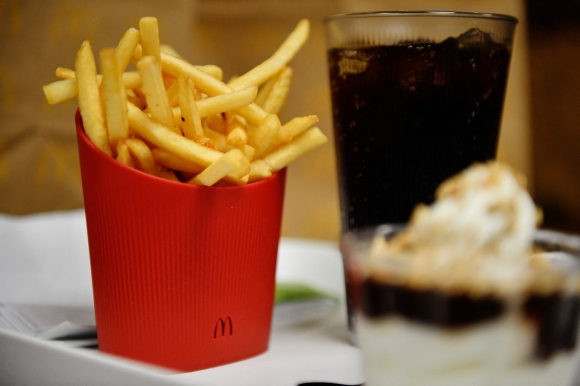 The rubber material French fry container provided at McDonald's in Levallois-Perret, France, last December.
 [Photo by AFP·Yonhap]
In particular, President Emmanuel Macron contributed to this trend last month by posting a photo of the McDonald's packaging on social media to promote government policy. At the time, President Macron said, "Look around you. The circular economy law is not just about not using plastic straws," adding, "Changes are happening in France to alter consumption patterns and reduce waste."
France began promoting the circular economy law in 2020 with the goal of completely banning single-use plastic packaging products by 2040. As part of this, starting January this year, a system has been implemented that completely prohibits the use of disposable plates, cups, and utensils in restaurants with 20 or more seats when dining in. Authorities expect this system to reduce approximately 150,000 tons of disposable waste, amounting to 2 billion items.
Accordingly, local fast-food outlets have reportedly been serving food in reusable glass, plastic, or rubber containers instead of disposable ones since the end of last year, ahead of the system's enforcement. In McDonald's case, they invested 100 million euros (about 140 billion KRW) to switch all drink cups, spoons, forks, and knives to reusable materials. After customers finish their meals and return the tableware, the restaurant washes them with hot water for reuse.
However, the paper packaging industry is opposing this, fearing a loss of market share if reusable tableware becomes widespread. The European Paper Packaging Alliance (EPPA) claims that disposable paper products are more environmentally friendly, stating, "The carbon emissions and water usage required for washing and drying reusable tableware are 2.8 times and 3.4 times higher, respectively, than those of disposable paper products."
© The Asia Business Daily(www.asiae.co.kr). All rights reserved.
![Clutching a Stolen Dior Bag, Saying "I Hate Being Poor but Real"... The Grotesque Con of a "Human Knockoff" [Slate]](https://cwcontent.asiae.co.kr/asiaresize/183/2026021902243444107_1771435474.jpg)
















