Underground Water at Punggye-ri Nuclear Test Site Used as Drinking Water by Residents
Radioactive Contaminated Specialty Products Smuggled to Korea, China, and Japan
Government Silent on 'Radiation Exposure Investigation'... "Results Must Be Disclosed"
[Asia Economy Reporter Jang Hee-jun] A survey has revealed that radioactive substances released from North Korea's 'Punggye-ri Nuclear Test Site' pose a risk of spreading to hundreds of thousands of residents through groundwater. In particular, it highlights concerns that smuggling and distribution of agricultural and marine products produced near the nuclear test site expose neighboring countries such as South Korea, China, and Japan to radiation risks, drawing significant attention.
The Transition Justice Working Group (TJWG), a North Korea human rights organization, disclosed these findings on the 21st through a special report titled "Mapping the Risk and Impact of Groundwater Contamination by Radioactive Substances at North Korea's Punggye-ri Nuclear Test Site." This is the first comprehensive overview addressing the risk of radioactive substances leaking from the nuclear test site spreading to residents and neighboring countries via water.
Lee Young-hwan, head of the Transition Justice Working Group, evaluated, "Until now, North Korea's nuclear program has been regarded solely as a security issue, but this report confirms that nuclear testing is a 'human rights issue' threatening not only residents but also the right to life of people in South Korea and surrounding countries."
'Radioactive Groundwater' Beneath the Nuclear Test Site... Flows to the East Sea
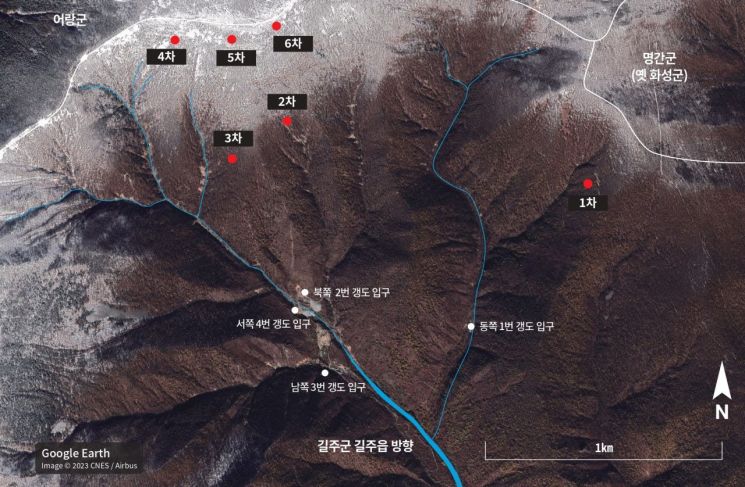 Confluence point of surface water around the Punggye-ri nuclear test site [Provided by Transition Justice Working Group (TJWG)]
North Korea conducted six nuclear tests at the Punggye-ri Nuclear Test Site located in Kilju County, North Hamgyong Province, from 2006 to 2017. During the sixth nuclear test on September 2017, multiple natural earthquakes and surface deformations including ground subsidence of about 50 cm were confirmed. Concerns about radioactive material leakage increased during this period. Professor Lee Soo-gon of the University of Seoul, who appeared as an expert witness at the National Assembly at the time, expressed concern, stating, "The continuous earthquakes after the nuclear test suggest ground fissures and radioactive leaks," and "The frightening thing is the groundwater. It is in an out-of-control state."
The report focused on the geographical structure around the Punggye-ri Nuclear Test Site. Just as all surface and groundwater circulates, water around the nuclear test site converges at several points and forms streams. In particular, water originating from Mantapsan Mountain, where the test site is located, is called 'Jangheungcheon.' This waterway flows into Namdaecheon to the south, passes through Kilju-eup, the most populous town in Kilju County, and crosses the boundary between Hwadae County and Kimchaek City before flowing into the East Sea. Considering that North Korea experiences flooding every summer, the possibility of spread is even greater.
Nevertheless, North Korea maintains the claim that "there has been no radioactive material leakage at all." It has never presented scientific evidence to support this claim or allowed external on-site measurements. When journalists from South Korea, the United States, China, Russia, and the United Kingdom visited the site during the 2018 tunnel demolition publicity, nuclear experts were excluded, and radiation measuring devices brought by reporters were reportedly confiscated before the event. There is also an anecdote that a reporter from Korean Central TV was urged to drink water from a stream in front of the tunnel but refused when told to "drink first."
Residents Use 'Radioactive Groundwater' as Drinking Water Despite Exposure Concerns
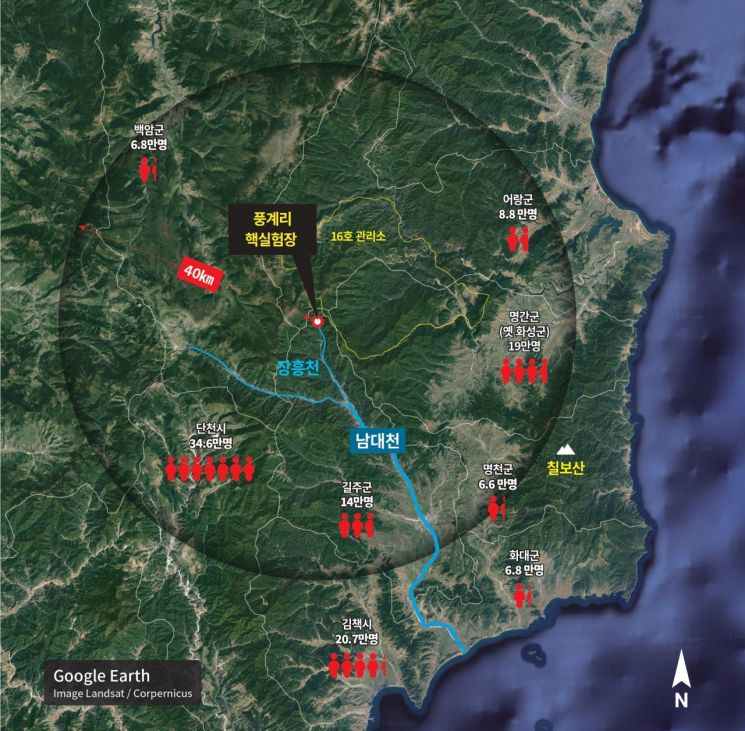 Areas within a 40 km radius of the Punggye-ri nuclear test site and the Jangheungcheon~Namdaecheon danger zones [Provided by the Transitional Justice Working Group (TJWG)]
An investigation of North Korean defectors from Kilju County revealed that the North Korean authorities have never evacuated residents or issued prior warnings before nuclear tests. Despite direct exposure risks, no measures were taken. The report expresses serious concern that residents around the nuclear test site are using the 'problematic groundwater' for drinking and agricultural purposes. A defector who lived in Kilju-eup testified, "Although I lived in an apartment, the water pressure was weak, and water was useless above the second floor," adding, "Most people used communal wells (groundwater) for drinking."
The South Korean government has also considered this issue. After the fifth nuclear test in 2016, concerns about groundwater contamination and drinking water for residents near the nuclear test site were raised in the National Assembly. Hong Yong-pyo, then Minister of Unification, who attended the national audit, explained, "People living in Kilju County drink water coming down from Punggye-ri, so there are suspicious parts," and "a more thorough investigation is needed." However, it is unclear whether any investigation at the Ministry of Unification level was conducted afterward.
The report designates eight administrative districts near the Punggye-ri Nuclear Test Site as the radiation exposure impact zone. These include two cities, Kimchaek and Dancheon, and six counties: Kilju, Hwadae, Myongan, Myongcheon, Orang, and Baekam. The population of these areas is estimated at approximately 1.08 million. Assuming 50% of residents are affected by radioactive substances, that amounts to 540,000 people; even at a reduced estimate of 25%, it reaches 270,000. The 28,700 inmates (estimated as of June last year) in Political Prison Camp No. 16 adjacent to the nuclear test site are also within the impact zone.
Specialty Products Around the Nuclear Test Site... Spread to Neighboring Countries Through 'Smuggling'
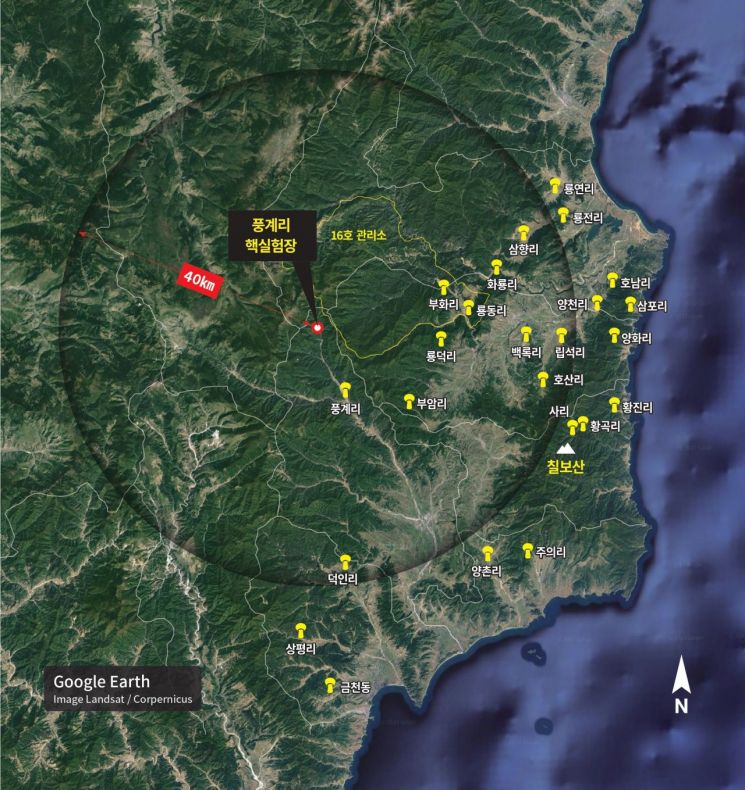 Songi Mushroom Producing Area around the Punggye-ri Nuclear Test Site [Provided by the Transitional Justice Working Group (TJWG)]
South Korea should pay attention to the risk of exposure through 'smuggling of specialty products.' Agricultural and marine products grown with groundwater exposed to radioactive substances are also highly likely to be contaminated. The Pine Mushroom, which has been commercialized under the name 'Chilbosan' and distributed worldwide, is a representative example. Chilbosan is located 53 km from the nuclear test site (the impact radius in case of a nuclear facility accident is 40 km), but residents in the area testified that "many pine mushrooms were harvested around Punggye-ri, and after it became a restricted zone, they continued to pick them from surrounding mountains." There is a strong possibility that pine mushrooms from around the nuclear test site were disguised as 'Chilbosan Pine Mushrooms.'
North Korean authorities have long used such specialty products as a means to earn foreign currency but have not disclosed the items or scale of overseas distribution. Domestically, these products gained popularity with tariff exemptions after the first inter-Korean summit, and even when China and Japan suspended imports after the first nuclear test in 2006, North Korean agricultural and marine products continued to be allowed for distribution. Although imports were banned under the 5.24 measures during the Lee Myung-bak administration following the Cheonan sinking incident, North Korean specialty products disguised as Chinese goods continue to be imported through peddlers.
In 2015, the government announced that radioactive cesium isotopes exceeding nine times the standard level (100 Bq/kg), measuring 981 Bq/kg, were detected in dried North Korean lingzhi mushrooms smuggled disguised as Chinese products. These substances are produced during nuclear fission and have a strong connection to nuclear testing, but the government ultimately failed to identify the origin of the mushrooms. Later, controversy arose when former President Moon Jae-in gifted 2 tons of pine mushrooms to Kim Jong-un in Pyongyang in 2018. These were distributed as gifts of 500g each to about 4,000 elderly separated family members without radiation testing.
Government Silent on 'Exposure Investigation'... "Immediate Relief Needed"
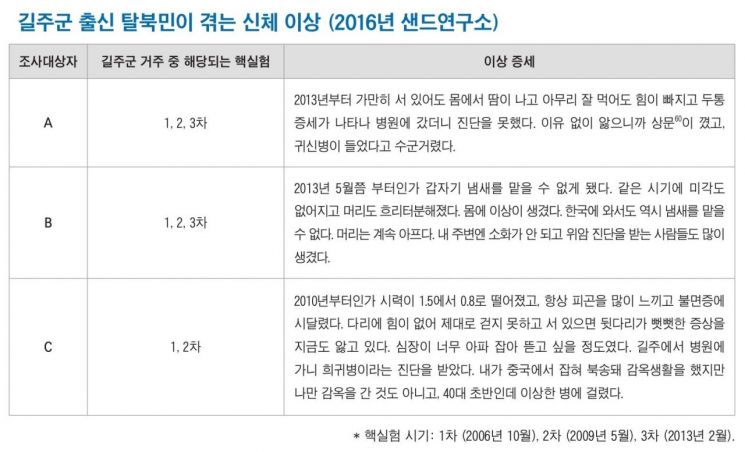 Physical Abnormalities Experienced by Defectors from Kilju County [Provided by Transition Justice Working Group (TJWG)]
The first investigation into the risk of radioactive material leakage from the Punggye-ri Nuclear Test Site and exposure testing for defectors from Kilju County was conducted not by the government but by a defector-led civil research group. Choi Kyung-hee, who was the first defector to earn a doctorate from the University of Tokyo and founded the Sand Institute in South Korea, detected that people from Kilju County were complaining of abnormal symptoms and conducted in-depth investigations of 23 defectors who had lived in Kilju County for several years after North Korea's first to third nuclear tests starting in July 2016. The results revealed that they were experiencing unexplained headaches, weight loss, and sensory function decline.
Subsequently, the Ministry of Unification and the Korea Institute of Radiological & Medical Sciences conducted radiation exposure tests on defectors from the Kilju area during the Moon Jae-in administration from 2017 to 2018. However, the number of tested individuals was only 40, with 30 in 2017 and 10 in 2018. Notably, over 20% of them?9 people?showed chromosomal abnormalities at concerning levels, but the report criticizes that the government was reluctant to publicize the findings, seemingly mindful of North Korea's opposition. It also pointed out that the test results initially scheduled for announcement by the Ministry of Unification were downgraded to a 'back briefing' and ended with verbal explanations without providing data.
Ultimately, follow-up tests were discontinued and have not resumed to date. Shin Hee-seok, legal analyst at the Transition Justice Working Group, emphasized, "The government should immediately conduct radiation exposure tests on all 881 defectors from eight cities and counties near Punggye-ri who lived there since 2006 and disclose the results. Accurate information must be provided to defectors showing exposure symptoms, and based on the test results, the international community should be urged to demand immediate, effective, and thorough investigations against North Korea."
Meanwhile, the Transition Justice Working Group is a human rights investigation and documentation organization established in Seoul in 2014 by human rights activists and researchers from South Korea, North Korea, the United States, the United Kingdom, and Canada. It addresses large-scale human rights violations in societies transitioning from armed conflict or dictatorship or where transitions have not yet occurred, aiming for a victim-centered approach.
© The Asia Business Daily(www.asiae.co.kr). All rights reserved.



















