Major Companies Withdraw IPOs Amid Stock Market Slump
Outlook for Second Half Clouded by Measures to Enhance IPO Soundness
[Asia Economy Reporter Hyungsoo Park] Due to economic recession, tightening policies, and sluggish stock markets, major prospective listed companies planning initial public offerings (IPOs) are facing deep concerns. Even Oasis, which had raised expectations, experienced a bitter outcome in demand forecasting, making it unlikely that any major companies will enter the domestic stock market in the first half of this year. Even if the stock market recovers in the second half, it is difficult to predict the timing of listings due to uncertainties about the impact of the IPO soundness enhancement measures being promoted by regulatory authorities.
Even Trusted Oasis Withdraws Listing
According to the investment banking (IB) industry on the 21st, major prospective listed companies expected to go public this year include Kurly, K-Bank, Oasis, CJ Olive Young, Kakao Entertainment, SSG.com, 11st, SK Ecoplant, EcoPro Materials, and LG CNS. In the second half of last year, concerns about inflation and the rise of the won-dollar exchange rate caused companies such as Hyundai Engineering, SK Shieldus, and One Store to delay their listing schedules.
Until the end of last year, there was strong anticipation that major companies would consecutively list starting from the second quarter of this year. This was because it would be difficult to postpone the listing indefinitely considering the exit schedules of financial investors (FIs) and corporate growth strategies.
However, this year, Kurly, Golfzon County, and K-Bank have successively withdrawn their listings, spreading a negative sentiment toward large-scale IPOs. Oasis had strong management intentions to list, and with the recent surge in stock prices of newly listed companies, expectations were high for its market entry. However, contrary to expectations, institutional investors showed a passive stance during demand forecasting, and FIs invested in Oasis opposed the low public offering price, leading to the withdrawal of the listing.
According to the current atmosphere, it is difficult not only for the first half but also for the second half of this year to see listings, according to the IB industry. A practical officer in charge of IB at a major securities firm said, "Recently, as major companies have withdrawn or postponed IPO plans, there are no ongoing large deals," adding, "It will be difficult to enter the stock market in the first half of this year."
LG CNS, which has the highest expectations in this year's IPO market, has not yet concretized its listing plans. A representative from LG CNS said, "There are no plans yet" regarding the listing. The timing of CJ Olive Young's IPO, which is essential in the CJ Group's management succession process, remains unpredictable. The company pushed for listing last year but postponed it considering market conditions. This year, an investigation by the Fair Trade Commission (FTC) is hindering progress. The FTC is examining whether CJ Olive Young pressured suppliers not to trade with other health and beauty (H&B) companies. Depending on the case, fines, penalties, or administrative sanctions could affect the preliminary listing examination. It is highly likely that the listing will be delayed until the FTC's results are announced. CJ Olive Young's largest shareholder is the holding company CJ, holding 51.15% of shares. Lee Sun-ho, CJ CheilJedang's management leader, holds 11.04% of shares.
Kakao Entertainment raised 1.2 trillion won last month through a pre-IPO (pre-listing equity investment). This has given them some leeway to pursue listing while monitoring market conditions. Moreover, since the corporate value may change depending on the acquisition of SM Entertainment, opinions suggest that discussing the timing of the listing is premature.
11st, a first-generation domestic e-commerce company, promised to list by September this year when raising funds from FIs in 2018. To keep this promise, they need to file for preliminary listing examination soon, but the situation has become complicated as both Kurly and Oasis have faced setbacks.
Companies that have not yet filed for preliminary listing examination are unlikely to enter the stock market in the first half of this year due to time constraints. Heungkuk Securities analyzed that among 379 companies listed on the domestic stock market over the past five years from 2018 to last year, it took an average of 155 days from the date of filing for preliminary listing examination to the listing date. Even considering that relatively large companies take less time than the average, there is insufficient time to complete listing by the end of June. Companies meeting the criteria for excellent companies can be exempted from the 'corporate continuity' review during qualitative examination, reducing the listing examination period from 45 days to 20 days.
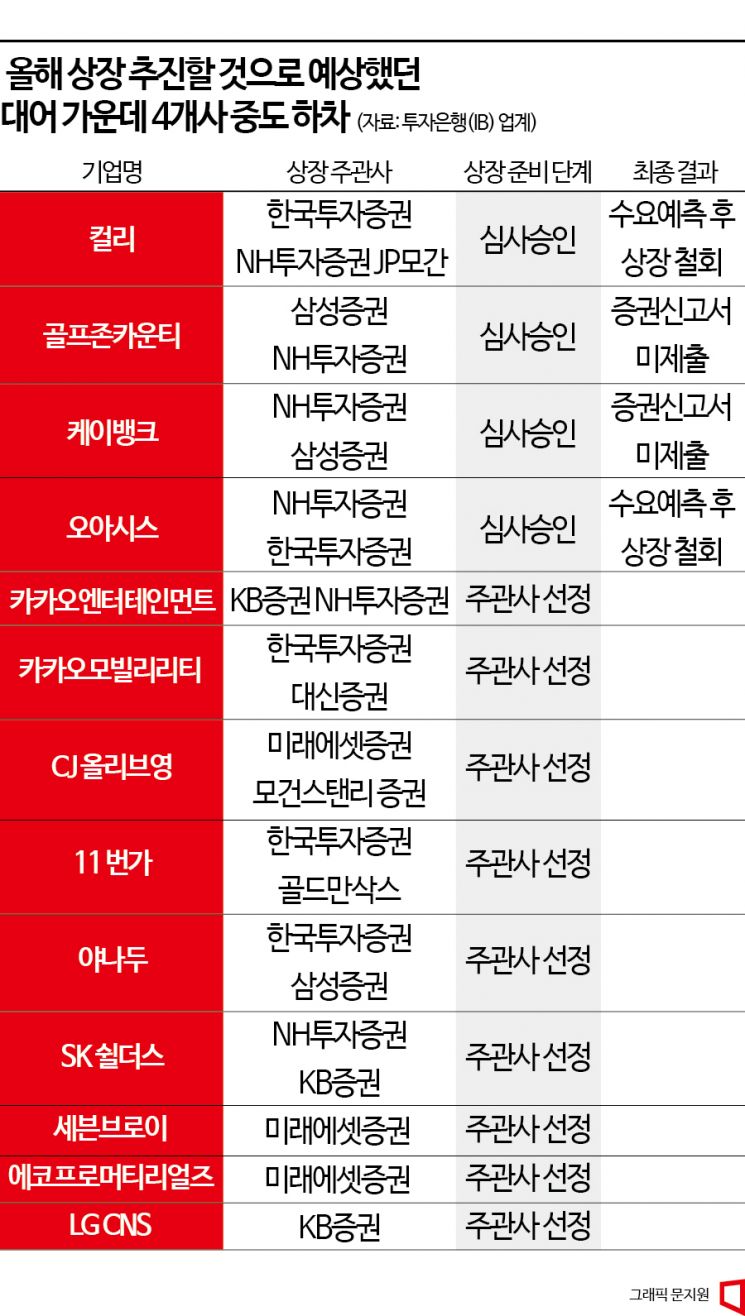
Major Companies Unwelcome to IPO Soundness Enhancement Measures
The problem is that the outlook for the second half of the year is also difficult to be optimistic about at this point. An IPO industry insider explained, "Currently, it is not easy for growth stocks to be recognized for their corporate value when raising funds just before listing in the IPO market," adding, "There are many cases where past corporate values are higher than the expectations of institutional investors participating in demand forecasting for public offerings, so an adjustment process is necessary."
In the past two to three years, unlisted companies have been recognized with high corporate values. As concerns about inflation increased and interest rates rose, there has been much controversy over overvaluation when pricing public offerings. A person in charge of IPOs at a major securities firm lamented, "Large IPOs can only succeed if growth potential is recognized in the market," adding, "Given the current market situation, it seems difficult to list due to conservative evaluations."
The impact of the 'IPO soundness enhancement measures' being promoted by regulatory authorities was cited as a variable in considering the timing of listings. Kwangyoung Oh, a researcher at ShinYoung Securities, said, "If major institutional improvements such as related regulation revisions are completed in the first half of this year, an appropriate public offering price will be calculated," adding, "It is expected that a foundation will be established to allocate public offering shares based on actual demand and payment ability."
Starting in April, financial investment regulations and association rules will change so that underwriters confirm the payment ability of institutional investors participating in demand forecasting before allocating shares. Also, if the public offering price is not stated during demand forecasting, shares cannot be allocated. This aims to eliminate fictitious subscription demand and strengthen the price discovery function during demand forecasting. The practice of mandatory holding will also be improved to prevent mass selling of public offering shares immediately after listing or after the mandatory holding period ends.
The government is seeking ways to prevent bubbles in public offering prices. It expects that the implementation of improvement measures will reduce controversies over overvaluation. While this may create a favorable environment for public offering investors, prospective listed companies aiming for high public offering prices may not welcome the implementation of these measures.
© The Asia Business Daily(www.asiae.co.kr). All rights reserved.
![User Who Sold Erroneously Deposited Bitcoins to Repay Debt and Fund Entertainment... What Did the Supreme Court Decide in 2021? [Legal Issue Check]](https://cwcontent.asiae.co.kr/asiaresize/183/2026020910431234020_1770601391.png)















