Vote on Lee's Arrest Consent Bill in Plenary Session on 27th
Democratic Opposition Likely to Defeat, Attention on Support Vote Scale
Will Defection Votes Be Identified During Voting? Sparks Political Controversy
[Asia Economy Reporter Yoon Seul-gi] As the vote on the arrest motion against Lee Jae-myung, leader of the Democratic Party of Korea, approaches on the 27th, attention is focused on the opposition parties' voting results. Currently, since the Democratic Party holds a massive opposition bloc with 168 seats, the possibility of a sole rejection is high, but the internal perspectives on this are complex.
This is because the political implications contained in the vote on whether to consent to the arrest of National Assembly member Lee Jae-myung are significant. Whether the motion is rejected or approved, it could cause political repercussions. This is also related to the behind-the-scenes nomination battles that have already begun ahead of the 22nd general election scheduled for April next year. It is a tension between those who want to run the election under a different banner rather than politician Lee Jae-myung and those who want to maintain the current leadership system.
The ruling and opposition parties have agreed to hold a plenary session on the 27th for the vote on the arrest motion against Leader Lee. The arrest motion will be reported at the plenary session on the 24th. Then, three days later, on the 27th, a secret ballot vote on the arrest motion against Leader Lee will take place at the plenary session. The quorum for the approval of the arrest motion requires a majority of the total seats present and a majority of the attending members' approval. If approved, the court will set a date for the pre-trial detention hearing, and if rejected, the warrant will be dismissed without a hearing.
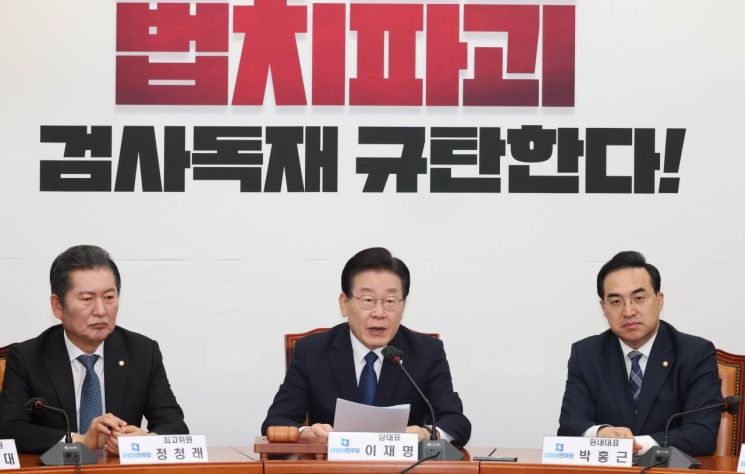
Currently, since the Democratic Party holds 168 seats as the giant opposition, the arrest motion against Leader Lee is likely to be rejected. Even if the People Power Party (115 seats), the Justice Party (6 seats), and Assembly member Cho Jeong-hoon of the Transition Korea party vote in favor, the total would only be 122 votes.
However, if at least 28 Democratic Party members vote in favor, the arrest motion could be approved. Some members classified as non-Lee Jae-myung faction or independent-minded within the party are analyzed to possibly cast dissenting votes. There are also voices within the party urging the approval of the arrest motion. Former emergency committee member Park Ji-hyun is demanding the approval of the arrest motion. Relatedly, internal concerns are also being sensed within the party.
Assembly member Cho Eung-cheon appeared on BBS Radio's 'Jeon Young-shin's Morning Journal' on the 14th and said, "When talking, there are quite a few members who cautiously hint at supporting the arrest motion." Former Minister of SMEs and Startups Park Young-sun argued on CBS Radio's 'Kim Hyun-jung's News Show' on the 20th that Lee's resignation from the leadership position could be a 'masterstroke.'
Although the vote is by secret ballot, if the arrest motion is approved or if more Democratic Party votes in favor than expected emerge, there is a possibility that so-called 'dissenting vote detection' efforts will be carried out, especially among supporters. Members who have publicly expressed support for the arrest motion or those from the non-Lee faction could become targets of suspicion. This is a burden for members who must pass the party primary gate for the 22nd general election nominations.
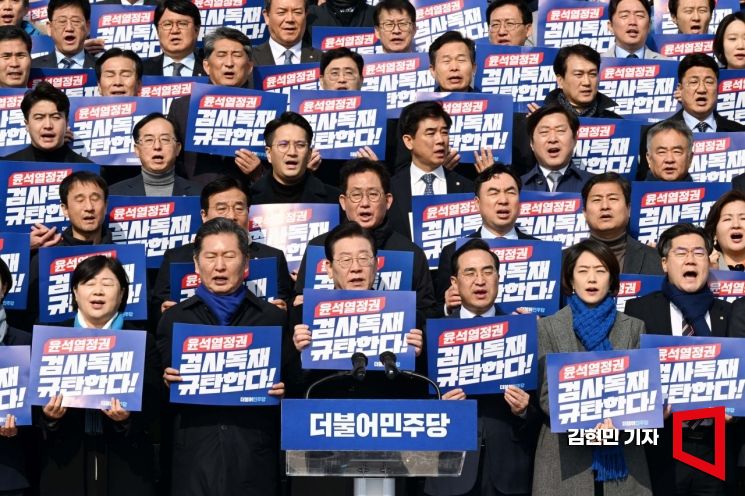 Lee Jae-myung, leader of the Democratic Party of Korea, Park Hong-geun, floor leader, members of the National Assembly, party committee chairpersons, and party members are shouting slogans at the "Condemnation Rally Against Prosecutorial Dictatorship of the Yoon Seok-yeol Administration" held on the stairs in front of the main building of the National Assembly in Yeouido, Seoul, on the 17th. Photo by Kim Hyun-min kimhyun81@
Given that the Democratic Party has even held outdoor rallies under the slogan of condemning 'prosecutorial dictatorship,' some view that it will be difficult for a large number of votes in favor to be cast if the actual vote takes place. This is because casting a vote in favor could be seen as acknowledging the legitimacy of the prosecution's investigation.
In particular, there have been criticisms of 'political prosecution' from some quarters because the prosecution's warrant request against Leader Lee used political rhetoric rather than legal terms, such as 'double standards' and 'Asitabi' (I am right, others are wrong).
Democratic Party Assembly member Woo Sang-ho stated, "Saying that half of the National Assembly members would die and the Assembly would be dissolved is the same nonsense," and asserted that there would be no organized dissenting votes. On the 20th, appearing on the YouTube channel 'Kim Eo-jun's Humility is Difficult News Factory,' Woo analyzed that "28 members dissenting is almost a split," and said the possibility of such an event happening without any warning signs is "zero percent."
Woo also argued, "Requesting an arrest warrant in the National Assembly itself is nonsense," adding, "The possibility of it passing is zero percent; it's just a political show. In any case, there is no reason for detention, and even if the warrant hearing is properly conducted, it will definitely be dismissed."
© The Asia Business Daily(www.asiae.co.kr). All rights reserved.
![User Who Sold Erroneously Deposited Bitcoins to Repay Debt and Fund Entertainment... What Did the Supreme Court Decide in 2021? [Legal Issue Check]](https://cwcontent.asiae.co.kr/asiaresize/183/2026020910431234020_1770601391.png)
















