Big Pharma Novo Nordisk Celebrates 100th Anniversary
Domestic Branch Approaching 30th Anniversary
Semienchuk: "Increasing Korea R&D Share"
Professor Han Seolhee: "Wegovy Reduces Brain Inflammation"
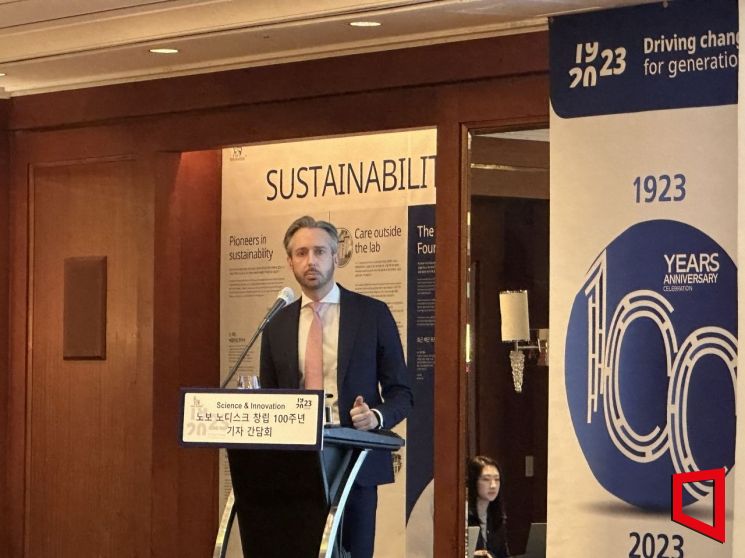 On the morning of the 20th, Sasha Semientchuk, CEO of Novo Nordisk Pharmaceuticals, spoke at the press conference held in Gangnam-gu, Seoul, celebrating the 100th anniversary of Novo Nordisk's founding.
 [Photo by Lee Chun-hee]
[Asia Economy Reporter Chunhee Lee] Novo Nordisk, which has maintained nearly half of the market share in the global diabetes and obesity treatment market, celebrated its 100th anniversary and announced its commitment to actively expanding its pipeline into other diseases while further strengthening its position through additional research and development (R&D) of existing diabetes and obesity treatments.
Sasha Semienchuk, CEO of Novo Nordisk Pharmaceuticals, stated at a press conference held on the morning of the 20th in Gangnam-gu, Seoul, "Novo Nordisk has been dedicated to leading change for the healthy lives of chronic disease patients based on scientific innovation over the past 100 years. In Korea, we have continuously increased our R&D investment, resulting in a fivefold increase in clinical trials over the past five years. Currently, we are continuing R&D innovations for a healthy humanity, including research on Alzheimer's, cardiovascular diseases, and non-alcoholic steatohepatitis (NASH)."
Founded in Denmark in 1923, Novo Nordisk, a global big pharma company, is celebrating its 100th anniversary this year. CEO Semienchuk emphasized, "Novo Nordisk is proud to be the world's second-largest pharmaceutical company by market capitalization, producing 50% of the world's insulin and providing medicines to 40 million patients." In particular, beyond insulin, the company maintains a high market share worldwide through 'liraglutide' (Victoza, Saxenda) and 'semaglutide' (Ozempic, Wegovy), which were developed as diabetes treatments and are also used for obesity treatment.
Established in 1994, Novo Nordisk Pharmaceuticals Korea is approaching its 30th anniversary. CEO Semienchuk said, "We provide services to 272,000 patients and supply 50% of insulin in Korea. We plan to double the number of patients benefiting from Novo Nordisk over the next two years, reaching 550,000 by 2025."
Based on these efforts, Novo Nordisk plans to continuously build a diverse portfolio. Sid Mohamed El Amin Taha Dahawi, Medical Director of Novo Nordisk Pharmaceuticals Korea, introduced the current and future pipelines and R&D investments spanning seven therapeutic areas including diabetes, obesity, hemophilia, growth hormone disorders, Alzheimer's, cardiovascular metabolic diseases, and NASH. He stated, "Over the next 20 years, we aim to meet unmet needs more rapidly through various pipelines. We also intend to enable patients to quickly monitor and treat diseases through various methods such as drug delivery systems (DDS) and digital solutions."
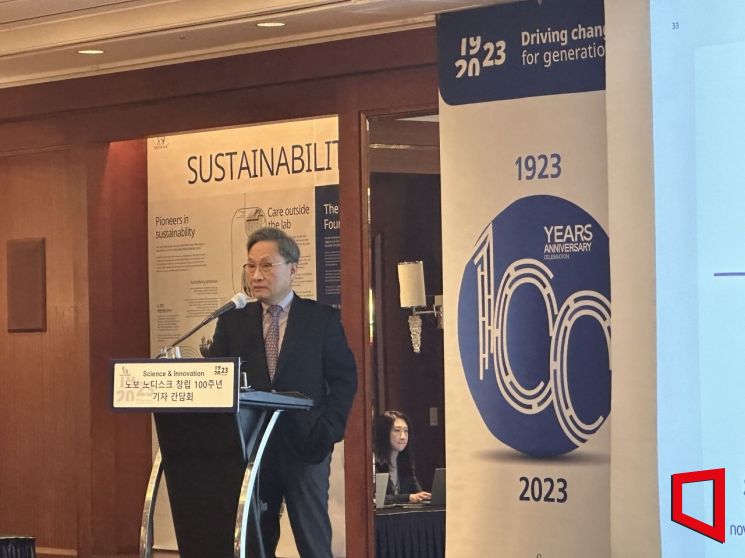 On the morning of the 20th, at a press conference held in Gangnam-gu, Seoul to commemorate the 100th anniversary of Novo Nordisk's founding, Professor Han Seol-hee of the Department of Neurology at Konkuk University Hospital is giving a lecture.
 [Photo by Lee Chun-hee]
Notably, Novo Nordisk is conducting a clinical trial named 'NH6535' to verify semaglutide as a treatment for early Alzheimer's dementia patients. The global Phase 3a clinical trial (EVOKE) is underway with 1,840 participants. In Korea, Professor Han Seolhee of Konkuk University Medical Center is the national principal investigator, conducting the trial at a total of 12 institutions including Konkuk University Medical Center, Seoul National University Bundang Hospital, Ewha Womans University Seoul Hospital, Chungnam National University Hospital, and Inha University Hospital.
Professor Han, who spoke at the event, emphasized, "If diabetes is not treated, dementia will inevitably occur. Recently, Alzheimer's has also been called 'Type 3 diabetes' or 'brain diabetes.'" Type 3 diabetes refers to the concept that amyloid beta protein, known to cause Alzheimer's dementia when accumulated in the brain, can cause diabetes by damaging pancreatic function when accumulated in the pancreas. In other words, the substances that cause diabetes and dementia are the same.
Regarding this, Professor Han explained, "One of the pharmacological actions of semaglutide is to reduce the activation of inflammation, which is a cause of aging and dementia in the brain. We have started research to see if it can be used in the early stages of dementia." He added, "Once nerve cells are damaged by inflammation, removing the inflammation is ineffective. Therefore, we intend to use it for patients who are likely to develop dementia within a few years due to diabetes or obesity, rather than those already diagnosed with dementia."
© The Asia Business Daily(www.asiae.co.kr). All rights reserved.
![User Who Sold Erroneously Deposited Bitcoins to Repay Debt and Fund Entertainment... What Did the Supreme Court Decide in 2021? [Legal Issue Check]](https://cwcontent.asiae.co.kr/asiaresize/183/2026020910431234020_1770601391.png)
















