Domestic and International Candy Market Growth After COVID-19
Consumers Seem to Increase Due to Long Mask Wearing
Various Products Launched Considering Health, Shape, and Texture
The candy and jelly market, which refreshes the mouth, is growing amid the COVID-19 pandemic. The main reason is the increased demand due to longer mask-wearing times. Various new products tailored to consumers' heightened health awareness, such as reducing sugar content and removing artificial colors and flavors, are also pouring out.
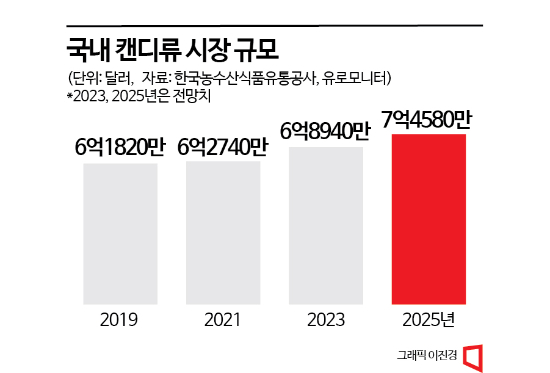
According to the Korea Agro-Fisheries & Food Trade Corporation and Euromonitor on the 21st, the domestic candy market size in 2021, when COVID-19 became full-scale, was $627.4 million, an increase of about 1.47% compared to $618.2 million in 2019, before the pandemic. The market size is estimated to be $627.4 million this year, the fifth year since the outbreak, and is expected to grow to $745.8 million by 2025.
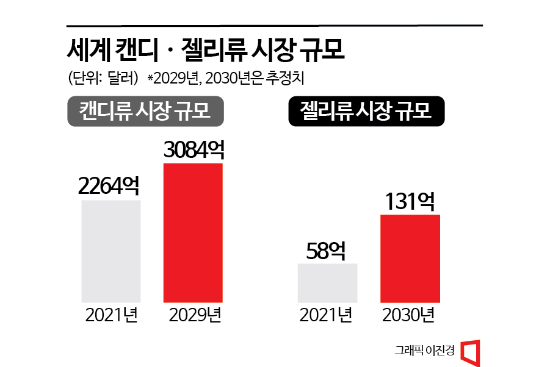
The expansion of the candy market size is a global trend as well as domestic. The global candy market size is expected to increase by more than 3.9% over eight years, from $226.4 billion in 2021 to $308.4 billion in 2029. The jelly market size is also projected to grow by about 9.5%, from $5.8 billion in 2021 to $13.1 billion in 2030.
This is interpreted as a result reflecting consumers' demand to conveniently remove bad breath and refresh their mood due to longer mask-wearing times after COVID-19. Additionally, the overall increase in snack demand due to more time spent at home, such as remote work, also influenced this trend.
The industry is targeting consumers by launching various products considering shape, texture, and health in line with market expansion. In particular, many products reflect the intensified 'health trend' after COVID-19. This is generally to break the perception that candies and jellies contain a lot of sugar and are unhealthy.
Notably, 'low-sugar and alternative sweetener' products using substitutes like stevia instead of sugar are becoming a major product group. This reflects consumers' tendency to carefully check sugar content when purchasing products. Additionally, new products using fruits that make sour tastes feel sweet have appeared, allowing satisfaction without actual sugar intake. 'Vegan products' excluding harmful artificial additives are also popular. Instead of animal gelatin and plant gelatin used to create chewy and soft textures, only natural additives such as agar and carrageenan extracted from seaweed like miyeok (sea mustard) are used. Unique textures and shapes targeting the preferences of the main consumer group of candies and jellies, the MZ generation (Millennials + Generation Z), are also emerging one after another. Unlike existing jelly products with soft and bouncy textures, jellies with crispy and fluffy textures and transparent products without colorful hues are gaining attention.
An industry official said, "Recently, candies and jellies with various concepts from ingredients to taste and texture are being released," adding, "As interest in health is high and the MZ generation shares their enjoyment of various products on social media (SNS), products tailored to their characteristics are expected to increase, and the market size is likely to steadily grow."
© The Asia Business Daily(www.asiae.co.kr). All rights reserved.


















