GIST Develops Non-Toxic, High-Resilience Cryopreservation Agent
Applicable for Rare Cell Storage and Organ Transplantation
Domestic researchers have presented the feasibility of realizing Korean-style cryonics technology. Unlike existing methods, they developed a cryoprotectant with excellent restoration ability upon thawing and no toxicity.
The Gwangju Institute of Science and Technology (GIST) announced on the 20th that a research team led by Professor Eunji Lee from the Department of Materials Science and Engineering developed nanosized metal-organic framework particles conjugated with antifreeze protein-derived peptides that can effectively control ice formation during cell freezing and thawing. They secured a foundational technology for synthesizing cryoprotectants with superior cell restoration capabilities compared to existing cryoprotectants.
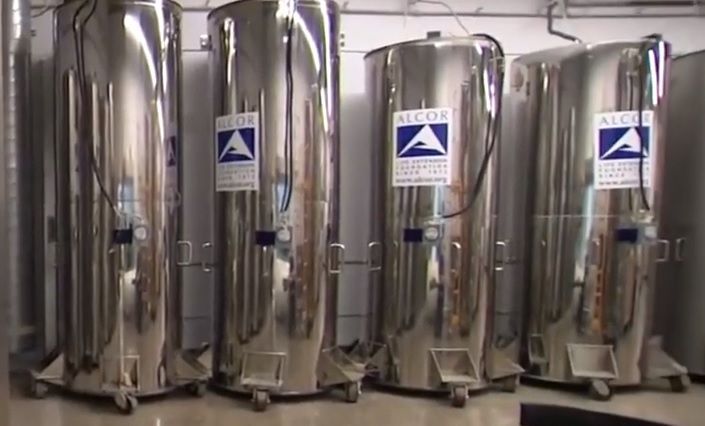
The technology developed by the research team is also attracting attention as a foundational technology that could realize so-called "cryonics." The concept of "cryonics," which involves freezing people with incurable diseases at ultra-low temperatures and awakening them in the future when medical science has advanced significantly to treat them, has sparked curiosity among many who dream of extending their lifespan. In fact, some companies in the United States and elsewhere have commercialized and started offering such services. However, skepticism prevails due to physical damage occurring when cells frozen at ultra-low temperatures are thawed and the difficulty in restoring normal function, as well as the high toxicity of cryoprotectants injected into bodily fluids instead of water. The question remains whether future technology can truly revive "dead people."
The research team developed a nanoparticle-form cryoprotectant that shows superior restoration ability compared to existing chemical cryoprotectants when cells are cryopreserved at ultra-low temperatures and exhibits no toxicity even at high concentrations, making it suitable for mass production. When used at a very small amount (1/2200) compared to the conventional chemical cryoprotectant dimethyl sulfoxide (DMSO), it demonstrated comparable cell recovery rates (average 70%) and cell proliferation efficacy (4-fold increase within 48 hours).
The research team explained, "Due to its excellent biocompatibility, it is expected to be utilized in various fields such as rare cell preservation and organ transplantation. When freezing cells, preservation solutions are used to minimize cell damage caused by ice crystals. Recently, as interest in personalized medical technologies has increased, there has been growing attention to cryopreservation technologies for high-value biological samples such as stem cells, umbilical cord blood, reproductive cells, cell therapies, and even organs, which are aggregates of cells."
Specifically, conventional cryoprotectants such as dimethyl sulfoxide, sodium phosphate, and glycerol have critical drawbacks including cell toxicity at high concentrations that destroy cells, and repeated freeze-thaw cycles that damage cell membranes and cause genetic mutations during cell restoration.
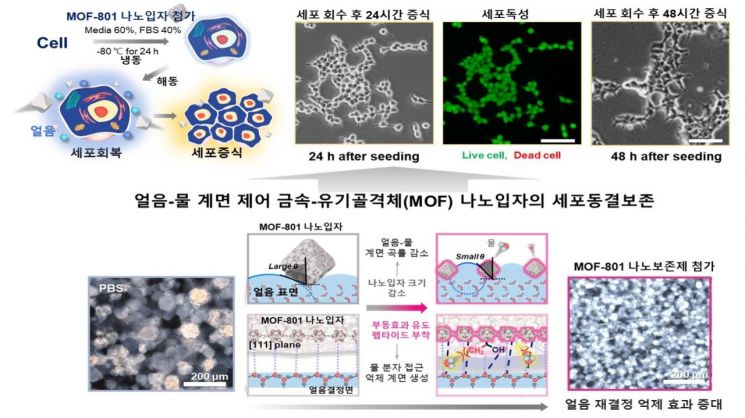 High biocompatibility and cell recovery rate with mass-producible nanosized metal-organic framework cryoprotectants: operating principles and application fields. Image courtesy of GIST
The research team focused on the instability principle of the ice-water interface and the chemical bonding sites on the ice surface. They synthesized zirconium metal-organic framework nanoparticles with a lattice size similar to ice crystal lattices and excellent biocompatibility, and chemically bonded antifreeze protein-derived peptides to the nanoparticle surfaces, producing three types of nanoparticles (10/30/250 nm).
When the nanoparticles developed by the research team were added to water and subjected to freeze-thaw cycles, observation of ice recrystallization showed that the antifreeze protein-derived peptides regularly arranged on the nanoparticle surfaces induced strong chemical bonding with the ice surface, effectively blocking water infiltration,
and the small-sized nanoparticles increased the microcurvature of the ice-water interface, lowering the freezing point and very effectively inhibiting ice growth.
Ice recrystallization refers to the growth of small ice crystals formed during freezing into larger ice crystals during thawing. The nanoparticles developed by the research team effectively bonded to the ice surface, demonstrating excellent ice control effects, thereby effectively preserving cells during freezing and restoring them healthily upon thawing.
These nanoparticles showed excellent biocompatibility even at high concentrations compared to existing cryoprotectants, and despite using an extremely small amount (50 μg/mL), when applied to various cell lines such as kidney cells, cancer cells, and stem cells, they demonstrated cell recovery rates and proliferation efficacy comparable to or higher than existing cryoprotectants.
Professor Lee said, "This study is significant in that it suggests the possibility of developing an economical cryo-nanopreservative that can be mass-produced while ensuring excellent biocompatibility." She added, "In particular, it overcomes the fatal drawbacks of existing chemical cryoprotectants, shows almost no toxicity even at high concentrations, and can achieve results comparable to existing preservatives even when used in very small amounts. We expect it to have a significant impact on related biomedical fields such as rare cell preservation and organ transplantation."
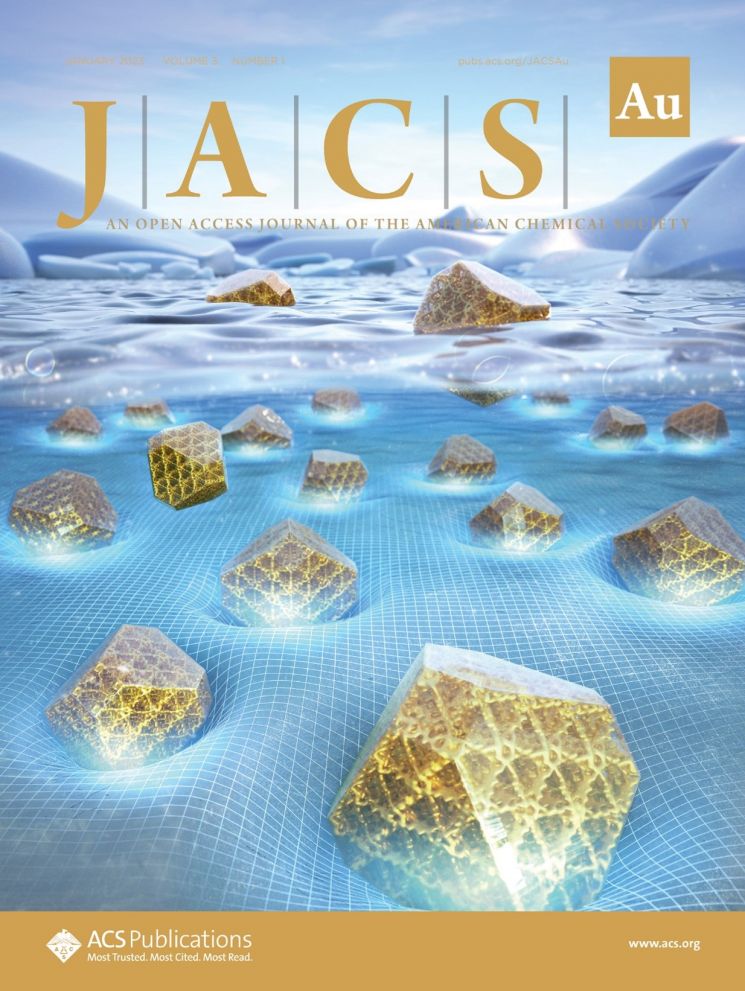
The results of this study were published as a cover article in the international journal JACS Au, published by the American Chemical Society (ACS), on the 23rd of last month.
© The Asia Business Daily(www.asiae.co.kr). All rights reserved.
![Clutching a Stolen Dior Bag, Saying "I Hate Being Poor but Real"... The Grotesque Con of a "Human Knockoff" [Slate]](https://cwcontent.asiae.co.kr/asiaresize/183/2026021902243444107_1771435474.jpg)


















