KCCI Public-Private Joint 'Regulation and Investment Difficulty Reception Center'
Receives 102 Cases in 100 Days Since Opening
[Asia Economy Reporter Jeong Dong-hoon] The Regulatory and Investment Difficulty Reception Center established at the Korea Chamber of Commerce and Industry (KCCI) has identified investment projects worth over 11 trillion won awaiting approval and requested resolution from the Office for Government Policy Coordination and the Ministry of Trade, Industry and Energy.
On the 20th, KCCI announced that the 'KCCI Regulatory and Investment Difficulty Reception Center,' which opened on November 14 last year, submitted 102 regulatory and corporate difficulty issues received over 100 days to the government. Among these, 25 cases involving investment difficulties blocked by regulations amount to a total of 11.69 trillion won. KCCI has actively requested related ministries to provide support so that companies can proceed with their planned investments without disruption.
The KCCI 'Regulatory and Investment Difficulty Reception Center' is a public-private joint regulatory improvement channel that maximizes the strengths of both sectors by separating 'reception' and 'policy coordination.' It was established in November last year. Corporate difficulties received at seven regional centers nationwide (Seoul, Busan, Daegu, Incheon, Gwangju, Daejeon, Ulsan) are forwarded to the relevant ministries through the Office for Government Policy Coordination, and the ministries provide feedback on their review results to the companies. Investment difficulty issues requiring in-depth discussion due to conflicts among related agencies and stakeholders are forwarded to the Ministry of Trade, Industry and Energy for stakeholder consultation and on-site inspections.
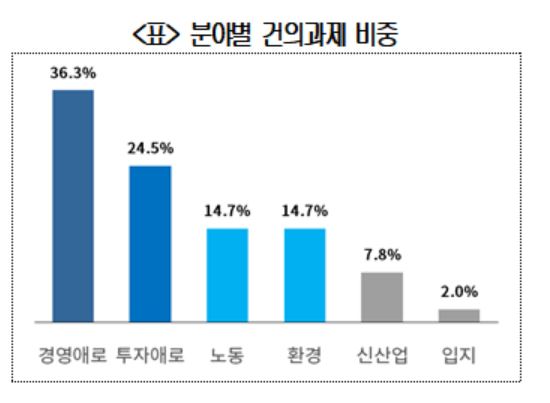
By sector: ① Management difficulties, ② Investment difficulties, ③ Labor regulations in order... The most frequent single topic is ‘Industrial complex-related difficulties’
According to major proposals identified on-site by KCCI, by sector, ‘management difficulties’ that hinder corporate management activities accounted for the largest share at 36.3%. This was followed by ‘investment difficulties’ (24.5%), ‘labor’ (14.7%), ‘environment’ (14.7%), ‘new industries’ (7.8%), and ‘location’ (2.0%).
In terms of content, about 10% of all proposals requested relaxation of industrial complex entry standards and infrastructure improvements. Amid rapid changes in the economic and industrial structure, many regional companies voiced difficulties with existing industrial complex systems that do not reflect current realities.
For example, Company A plans to invest about 100 billion won to establish a factory within an industrial complex. However, the types of businesses allowed and the area allocated for entry into the industrial complex are based on standards from when the complex was established (2010), making it virtually impossible for new industries to enter. Company B, located in an agricultural and industrial complex, currently uses groundwater because industrial water is not supplied. Although new investment proposals have been received, the lack of surplus water makes the expansion of investment uncertain.
At regional reception centers, many difficulties related to the 'foreign worker visa system improvement' were reported, indicating that many companies face manpower supply issues. Notably, the part-time employment sectors and working hours for foreign students show a significant gap from the actual employment status of foreign workers in local areas, highlighting the need for improvement.
Among the received issues, there were also requests to resolve difficulties related to hydrogen composite charging stations. In natural green areas, the building coverage ratio is lower than in other zoning areas, making it difficult to establish hydrogen composite charging stations. Accordingly, Company C proposed making permanent the temporarily applied building coverage ratio relaxation system (from 20% to 30%). There was also a proposal to establish distance standards between LPG charging facilities and hydrogen charging facilities.
Lee Sang-heon, head of KCCI’s Regulatory Innovation Team, said, "Although regulatory and corporate difficulty issues continue to be received through the reception center, few have actually been resolved," adding, "We plan to continuously monitor the processing status of investment and regulatory difficulties and urge related ministries to handle them promptly." Meanwhile, KCCI plans to expand and operate the Regulatory and Investment Difficulty Reception Centers nationwide beyond the current seven regional centers.
© The Asia Business Daily(www.asiae.co.kr). All rights reserved.