Jasaeng Korean Medicine Hospital Spine and Joint Research Institute Team
Protecting Liver Cells through Expression of Antioxidant Enzymes
[Asia Economy Reporter Lee Gwan-ju] The hepatoprotective effects and therapeutic mechanisms of 'Ulgum,' a medicinal herb, have been confirmed.
The research team led by Senior Researcher Kim Hyun-sung at Jaseng Hospital of Korean Medicine Spine and Joint Research Institute announced on the 20th that Ulgum promotes the antioxidant effects of 'Sirtuin1' and 'heme oxygenase,' positively influencing hepatocyte protection and inhibition of liver toxicity. The results of this study were published in the February issue of the SCI(E)-level international journal Nutrients (IF=6.706).
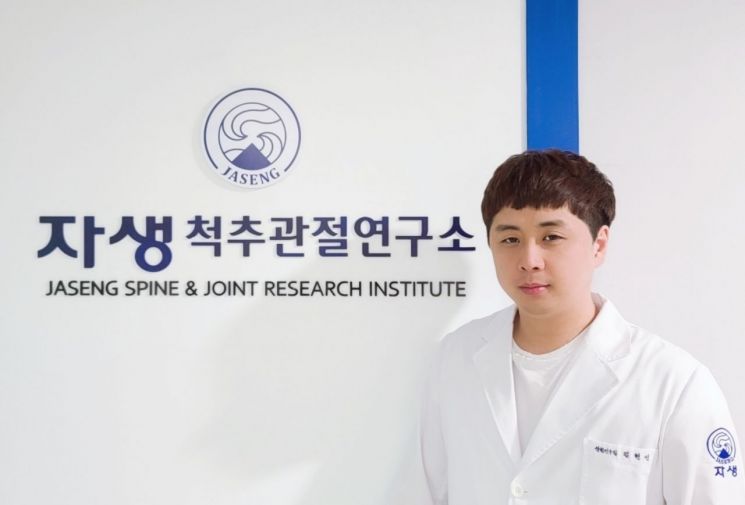 Hyunseong Kim, Senior Researcher at Jaseng Spine and Joint Research Institute. [Photo by Jaseng Hospital of Korean Medicine]
Ulgum has excellent liver-protective efficacy and is used to inhibit and treat liver toxicity. In fact, the liver function improvement effect of 'Saengganhwan,' a herbal prescription with Ulgum as the main ingredient, has been proven in previous studies. However, research on how Ulgum protects and restores damaged hepatocytes has not been conducted, making it difficult to clearly explain the therapeutic mechanism until now.
The research team treated hepatocytes isolated from rats with Ulgum at three concentrations (100, 200, 400 μg/mL) and then induced hepatocyte damage using acetaminophen. As a result, Sirtuin1, which sharply decreased in expression after acetaminophen treatment, increased proportionally to the concentration of Ulgum, and the expression of heme oxygenase also became active. Sirtuin1 and heme oxygenase inhibit oxidative reactions that cause damage to cells and tissues through antioxidant action. The research team interpreted that Ulgum actively induces the expression of antioxidant genes and enzymes, enhancing the recovery capacity of damaged hepatocytes.
Animal experiments were also conducted to confirm changes in liver enzyme levels. The research team divided the experimental rats into a Ulgum administration group and a control group without Ulgum administration and compared changes in the representative liver function test enzymes, aspartate aminotransferase (AST) and alanine aminotransferase (ALT). The Ulgum administration group was orally given Ulgum extract at two concentrations (20, 100 mg/kg) for one week.
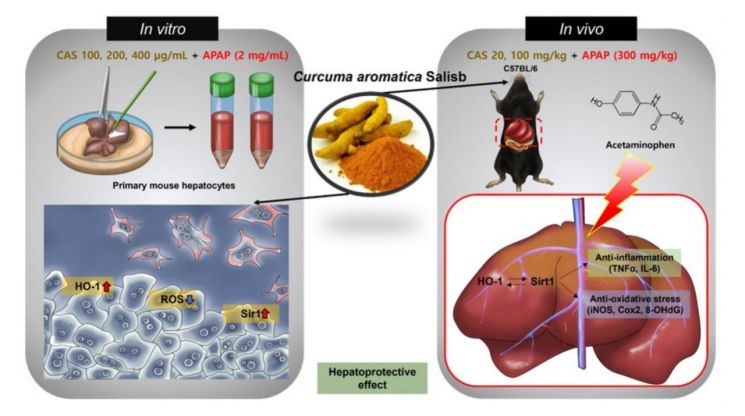 Cell experiments and animal studies on turmeric, a major herbal ingredient in Saengganhwan, confirmed the hepatoprotective mechanism.
 [Photo by Jaseng Hospital of Korean Medicine]
The normal range for AST and ALT is below 40 U/L, but when the liver is damaged, levels increase to hundreds or thousands. In the control group treated with acetaminophen, AST rose to 1633. In contrast, AST levels in the Ulgum administration group were 913 and 603 at 20 and 100 mg/kg concentrations, respectively, showing lower liver enzyme levels with higher Ulgum concentration. ALT also surged to 4758 in the control group but was significantly lower at 2088 and 1015 in the Ulgum groups, about 2 to 4 times less. Liver enzyme levels in the group administered only Ulgum showed no significant difference from normal. Additionally, in liver tissue condition experiments, acetaminophen-treated liver tissue showed a decrease in overall volume along with liver damage. Conversely, liver tissue from rats pre-treated with Ulgum showed inhibited liver damage, closely resembling normal liver tissue.
Senior Researcher Kim said, "This study is significant as it is the first to identify that Ulgum’s hepatoprotective and liver toxicity inhibitory effects are achieved through the expression of Sirtuin1 and heme oxygenase," adding, "Furthermore, it is expected to help dispel misunderstandings about liver toxicity related to herbal medicine."
© The Asia Business Daily(www.asiae.co.kr). All rights reserved.
![Clutching a Stolen Dior Bag, Saying "I Hate Being Poor but Real"... The Grotesque Con of a "Human Knockoff" [Slate]](https://cwcontent.asiae.co.kr/asiaresize/183/2026021902243444107_1771435474.jpg)

















