Intense Battle for Liquidity Delayed by Market Uncertainty
High Demand for Corporate Bonds of Large Conglomerate-Affiliated Construction Firms
Non-Investment Grade Construction Companies Struggle with High Interest Rates and Low Demand
[Asia Economy Reporter Lim Jeong-su] As the bond market stabilizes somewhat, construction companies are successively raising funds. After the bond market tightened following last year's Legoland incident, they have begun actively securing liquidity that had to be postponed. However, the borrowing rates and investment demand vary sharply by construction company. Large construction companies affiliated with conglomerates that have good credit ratings or strong backing secure large-scale investment demand at relatively low interest rates, while non-investment grade construction companies face difficulties in raising funds or must bear high interest rates. With the real estate market expected to worsen for an extended period, construction companies' funding costs have increased significantly.
Will the tailwind for conglomerate-affiliated companies continue?
Hyundai Construction will conduct a bond demand forecast over two days starting on the 20th for a total of 150 billion KRW in corporate bonds. They will raise investors for 70 billion KRW in 2-year bonds and 80 billion KRW in 3-year bonds. If orders flood in, they plan to increase issuance up to 300 billion KRW, double the original amount. The desired interest rate for the demand forecast was presented as the average of private bond rating agencies' evaluation rates (average market rate) minus 50 basis points (1bp=0.01%) to plus 50 basis points. Hyundai Construction's evaluation rate had dropped to the low 4% range but has recently shown a slight upward trend. If investment demand is strong, bond issuance below 4% is possible.
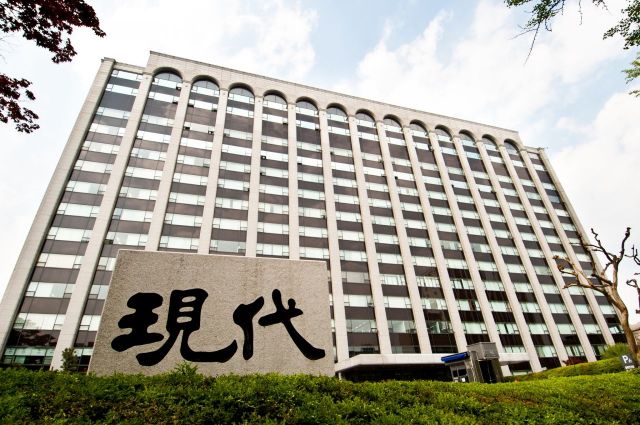
Hyundai Construction has formed a large underwriting group. KB Securities, Mirae Asset Securities, Shinhan Investment Corp., NH Investment & Securities, Samsung Securities, Hyundai Motor Securities, and Daishin Securities have all signed a total underwriting contract to purchase any unsold Hyundai Construction bonds. If investment demand is insufficient during the demand forecast, these securities firms will purchase the shortfall with their own funds.
The investment banking industry expects a large influx of investment demand since Hyundai Construction is affiliated with the Hyundai Motor Group. SK Ecoplant (A-) recently gathered 508 billion KRW in investment demand during a 100 billion KRW corporate bond issuance demand forecast. The 1-year bonds were fully subscribed at market rate minus 10bp, 1.5-year bonds at minus 11bp, and 2-year bonds at minus 25bp. By slightly raising the interest rate, issuance could be increased up to 200 billion KRW.
Although SK Ecoplant has somewhat lower creditworthiness within the construction industry, being affiliated with the SK Group was a key factor in its successful issuance. An IB industry official said, "Large construction companies affiliated with conglomerates like SK Ecoplant and Hyundai Construction attract investment demand due to their strong backing, which makes their risk-adjusted interest rates attractive," adding, "The popularity of relatively safe bonds with higher interest rates is expected to continue for the time being."
Non-investment grade construction companies rely on private bonds and CP
Non-investment grade construction companies have secured urgent liquidity through private bonds and commercial paper (CP), which do not require a demand forecast, as they cannot enter the public bond market. Even when they do enter the public market, they fail to secure sufficient demand, burdening the underwriting syndicate.
Taeyoung Construction plans to issue 100 billion KRW worth of 2-year private bonds at an interest rate of 7.80% on the 20th. Earlier, its holding company TY Holdings received a capital injection of 400 billion KRW borrowed at 13% from the global private equity firm Kohlberg Kravis Roberts (KKR). Although the group's support intention was confirmed and interest rates somewhat decreased, they still continue to raise funds at high interest rates.
Isu Construction issued 13 billion KRW worth of 6-month private bonds on the 17th. The issuance rate was decided at 9% after consultation with investors. On the 26th of last month, they also issued 10 billion KRW worth of 1-year private bonds at 9%. Compared to issuing private bonds at the 6% level in July last year, the borrowing rate has risen by more than 2.5 percentage points in six months. Cape Investment & Securities and Hanyang Securities purchased all of Isu Construction's private bonds and then sold them to institutional investors.
Earlier, mid-sized construction company HL D&I (BBB+) faced failure in the public bond issuance market. They attempted to issue 50 billion KRW worth of 1-year corporate bonds at a high interest rate of 9%, but only 14 billion KRW worth of 'buy' orders were received. Despite offering high interest rates, investment demand was insufficient. The Korea Development Bank purchased the unsold bonds.
A bond manager at an asset management firm said, "For BBB-rated construction company bonds, it is uncertain whether investment demand can be gathered even if double-digit yields are offered," adding, "Within the same BBB rating, construction company bonds are considered riskier, so required yields tend to be relatively higher."
Construction bonds also face selection... "Polarization to continue long-term"
Korea Land Trust (A-), Hanshin Engineering & Construction (BBB), Shinsegae Construction (A), and GS Construction (A+) have also announced plans to issue corporate bonds. Korea Land Trust is raising funds for the first time in a year since issuing public bonds in February last year. At that time, they issued 100 billion KRW each in 2-year and 3-year maturities at interest rates in the high 3% and mid-4% ranges, respectively. Hanshin Engineering & Construction will issue corporate bonds about four months after issuing private bonds at a 6% interest rate in October last year. This will be their first public bond issuance in a year. GS Construction is issuing corporate bonds for the first time in about two years.
A corporate bond market official said, "Even among A-rated construction company bonds, investment demand will vary depending on whether they are affiliated with conglomerates, concerns about project financing (PF) contingent liabilities, and expected performance," adding, "The polarization within construction company bonds is unlikely to be resolved in the short term."
© The Asia Business Daily(www.asiae.co.kr). All rights reserved.
![Clutching a Stolen Dior Bag, Saying "I Hate Being Poor but Real"... The Grotesque Con of a "Human Knockoff" [Slate]](https://cwcontent.asiae.co.kr/asiaresize/183/2026021902243444107_1771435474.jpg)
















