Thunderstorm Occurring in July Last Year, Longest Duration Case in the Arctic
First Thunderstorm Observed in the Arctic in 2019... Impact of Global Warming
[Asia Economy Reporter Kim Hyun-jung] The longest-lasting thunderstorm ever recorded in the Arctic has been reported. Experts analyze that climate change, including global warming, may be the cause.
On the 17th (local time), the weekly news magazine Newsweek reported this, citing a press release from the Arctic and Antarctic Research Institute (AARI) in Russia. According to the data, AARI observed a thunderstorm lasting 55 minutes in the Arctic last July. The first observation of an Arctic thunderstorm was in 2019, when a thunderstorm lasted for 40 minutes. Subsequently, two more thunderstorms lasting 40 minutes and 25 minutes respectively were observed in 2021.
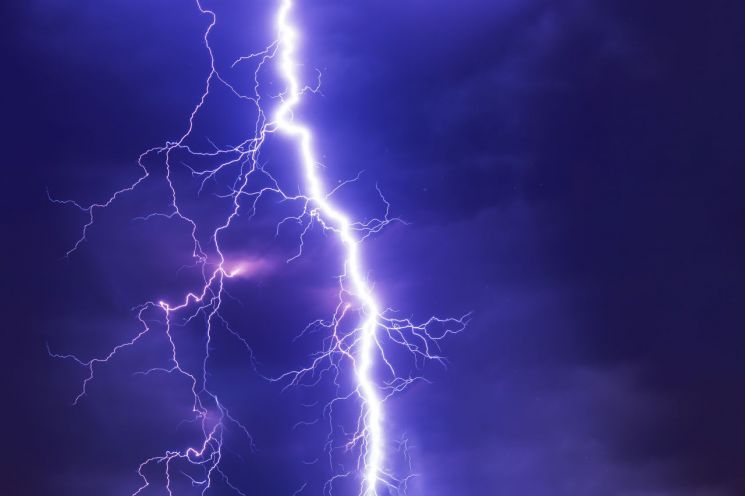
Thunderstorms, which are characterized by heavy rain accompanied by thunder and lightning, are extremely rare in polar regions. This is because the atmosphere in polar regions is cold and dry. Therefore, experts explain that the recent observations of Arctic thunderstorms appear to be due to climate change.
For a thunderstorm to form, a thick and humid air layer is essential. Thunderstorms occur when a warmer air mass rises due to buoyancy, usually generated by a single cumulonimbus cloud, bringing strong storms and heavy rain to a narrow area. Sometimes, they also produce hail and tornadoes.
Jennifer Francis, a senior researcher at the Woodwell Climate Research Center in Massachusetts, USA, explained to Newsweek, "Warm and humid air is necessary for thunderstorms to form, but both are rare in the Arctic." She added, "The Arctic's average temperature rise rate is 3 to 4 times higher compared to the entire Earth." Furthermore, she analyzed that atmospheric water vapor worldwide, including the Arctic, has increased by about 4%, and this warming and humidity increase are key factors in the formation of Arctic thunderstorms.
The reduction of sea ice due to global warming also contributed to the increase in thunderstorms. According to researcher Francis, as ice melts, sea levels rise, and the melting snow fails to reflect solar radiation, increasing heat absorption in polar regions. She said, "When sea ice disappears and temperatures rise in high-latitude areas, the atmosphere becomes much more unstable," adding, "If warm air masses rapidly ascend, they can contribute to thunderstorm occurrence."
Meanwhile, lightning is also being observed more frequently in the Arctic than before. According to a 2021 study published in the journal Geophysical Research, lightning occurrences rapidly increased within a 690-mile (1,110 km) radius around the North Pole from 2010 to 2020. The number of lightning strikes in 2021 was comparable to the total number of strikes in the previous nine years combined, as revealed by this study.
© The Asia Business Daily(www.asiae.co.kr). All rights reserved.

















